
The AI-Resume Tells Recruiters Flag on Sight, and How to Fix Each One
Ten specific AI-resume patterns that flag on sight. What each one looks like, and the exact rewrite to remove it.
Last updated: September 2026.
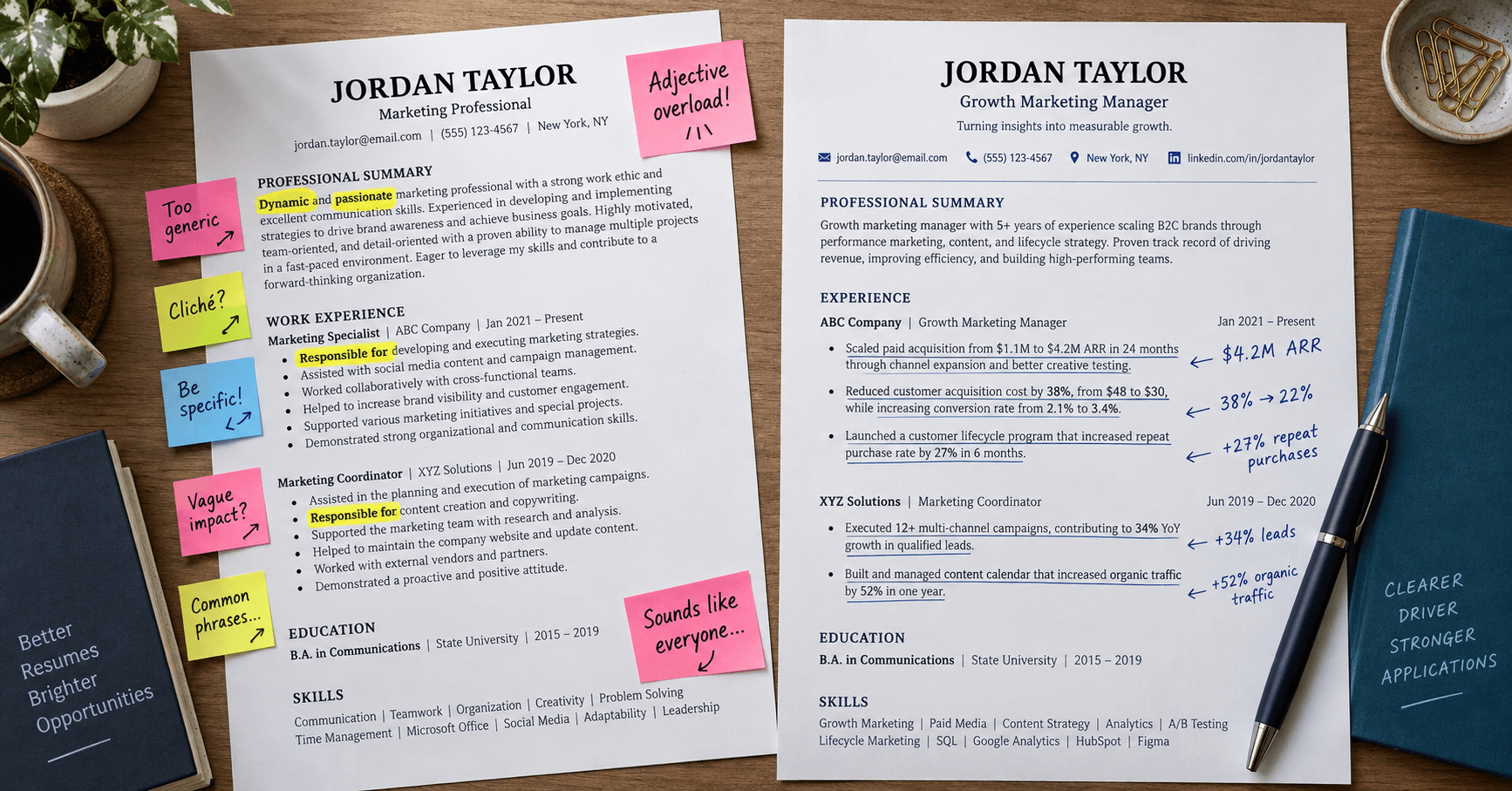
Quick answer: AI resume tells are not mysterious. Most come from one root problem: the draft has no specifics that only you could have written. The table and examples below name the 10 most common patterns and show the exact rewrite for each.
The tell that matters most is simple: the resume could describe anyone in the target field. When nothing is specific enough to prove you were the person who did the work, a recruiter can't place you and moves on.
What Actually Tips Off a Recruiter?
A recruiter who screens hundreds of resumes a month spots AI output from two things. One is vocabulary: words like "dynamic" and "seasoned" clustered in patterns that human writing rarely produces. The other is missing specificity: actual numbers and product names, the details that only come from doing the work.
In a Harris Poll conducted by Express Employment Professionals in November 2025 among 1,002 U.S. hiring decision-makers, 86% of hiring managers said AI makes it too easy to exaggerate skills on a resume. That concern has sharpened the reading. Recruiters who once skimmed are now checking, looking for the specific details that prove you were actually there.
For a broader look at how recruiters use detection tools and human pattern-matching, Can Recruiters Tell If Your Resume Was Written by AI? covers both. The focus here is narrower: every tell has a fix, and most fixes take five minutes per bullet.
The 10 AI Resume Tells: Flagged vs. Fixed
| # | Tell | What it sounds like | The fix |
|---|---|---|---|
| 1 | Generic summary | "Results-driven professional with extensive experience..." | Your real title, your top measurable result, your target |
| 2 | Adjective cluster | Dynamic, passionate, proactive, innovative | Delete adjectives with no evidence behind them |
| 3 | Vague scope | "Collaborated with cross-functional stakeholders" | Name the team, the size, the concrete outcome |
| 4 | Uniform bullet length | Every bullet is exactly 1.5–2 lines | Let important bullets be longer; minor ones shorter |
| 5 | Round or implausible percentages | "Increased efficiency by 50%" | Use the real number, or describe the change concretely |
| 6 | No product or system names | "Led development of a major platform feature" | Name the feature, product, or tool |
| 7 | "Responsible for" openers | "Responsible for managing a team of analysts" | Action verb + specific result |
| 8 | Summary contradicts bullets | Polished summary, thin bullets below it | Each summary claim needs a bullet to back it up |
| 9 | Hollow leadership verbs | "Spearheaded a strategic initiative to optimize workflows" | Replace the verb with the concrete action |
| 10 | Mirror-image cover letter | Cover letter restates the resume in different words | Explain why this company and this role, right now |
Weak and Strong: Five Bullets Rewritten
The table above names the pattern. Here is what the rewrite looks like in practice.
Tell #2 — Adjective cluster
Weak: "Highly motivated and results-driven marketing professional with a passion for brand-building."
Strong: "Built [Company]'s first paid acquisition program from $0 to $220K/month in 9 months, at a blended CAC of $31."
The weak version has no testable claim. The strong version has three: dollar figure, timeline, and a cost metric.
Tell #3 — Vague scope
Weak: "Partnered with cross-functional teams to enhance the customer journey and drive organizational alignment."
Strong: "Worked with CX and growth (11 people across 3 time zones) to redesign the onboarding email sequence, cutting 14-day drop-off from 38% to 22%."
Every word in the weak version is filler. Every word in the strong version is load-bearing.
Tell #7 — "Responsible for" opener
Weak: "Responsible for managing a portfolio of enterprise accounts."
Strong: "Managed 18 enterprise accounts ($4.2M ARR), held churn to 3% against a team average of 9%."
Cut "responsible for" from every bullet. Start with a verb. End with a number or outcome.
Tell #5 — Round percentages
Weak: "Improved team productivity by 40% through the implementation of new workflows."
Strong: "Standardized the weekly handoff to a 12-point checklist, cutting the incident count from 8 per week to 2."
If you have the real number, use it. Without it, describe the before and after concretely rather than estimating.
Tell #9 — Hollow leadership verbs
Weak: "Orchestrated a comprehensive cross-departmental strategy to maximize operational efficiency."
Strong: "Ran the quarterly planning cycle for 4 departments, locked budget 3 weeks earlier than the previous year and cut revision rounds from 6 to 2."
"Orchestrated" and "comprehensive" are placeholders. The rewrite names what actually happened.
How to De-Slop a Draft in One Pass
Go through every bullet with one question: is there something here that only I could write?
- A real number from doing the work
- The actual name of the product, system, or project
- The team or department name
- What specifically changed, before and after
Mark every bullet where the answer is no. Rewrite those first. Then check your summary: if you could swap in a colleague's name and change fewer than five words, the summary is too generic.
Once the tells are gone, Is My Resume Good? runs through 12 signs that a resume is still quietly failing, content issues that have nothing to do with AI.
For a step-by-step workflow that uses AI to build a tailored resume without producing the tells above, How to Optimize Your Resume With AI covers the full process.
What Resume Studio Does Differently
Submitting a raw AI draft without editing fails because the missing human layer is the point. PokeBot's Resume Studio, inside the Resume Builder room, takes your existing experience and tailors it to a specific job posting. Every suggested rewrite is one you review and edit. Your real numbers and product names make it through to the final version, not placeholders.
The output reads as yours because you stayed in the loop.
Frequently Asked Questions
Can recruiters really tell if a resume was written by AI?
Yes, experienced recruiters spot AI-generated resumes from specific patterns: generic professional summaries, identical bullet lengths, vague scope language, and clusters of adjectives like 'dynamic' and 'results-driven.' They don't always need a detector; the patterns stand out after seeing a few dozen AI resumes side by side.
Is using AI to write your resume bad?
AI can produce a useful starting draft. Candidates lose out when they submit that draft unchanged, without adding the specifics only they can write: actual numbers, product names, team sizes, real outcomes. An AI draft edited by a human beats both a raw AI resume and a poorly written one.
What words make a resume look AI-generated?
The most common ones: dynamic, passionate, proactive, innovative, results-driven, seasoned, spearheaded, orchestrated, and leveraged. These words cluster in AI output in patterns human writing rarely reproduces. Deleting them is necessary but not sufficient; replace them with specific results and named outcomes.
What does a generic AI professional summary look like?
Any variation of: 'Results-driven professional with extensive experience in [field], passionate about leveraging [skill] to drive [outcome].' This summary could belong to anyone in the field. A good summary names your actual role, a specific measurable achievement, and your target.
How do I fix AI tells on my resume?
Work through every bullet and ask: does this name a specific team, product, or number? If not, that bullet needs a rewrite. Add the actual figures, the department or team name, the product name, and the concrete before-and-after outcome. Those specifics are what only you can write.
Do ATS systems detect AI-written resumes?
Most ATS platforms do not run explicit AI detectors on resume content. The bigger risk is relevance failure: generic AI language maps poorly to specific job postings, so AI resumes often rank lower than tailored ones. The recruiter who reviews the shortlist is then the one who spots the pattern.
What is the fastest way to de-slop an AI-written resume?
Read every bullet and mark anything with no specific number, product name, or team name. Rewrite those bullets first. Then delete every adjective in the summary with no supporting evidence in the bullets. That single pass covers most of the common tells in about 30 minutes.
What is Resume Studio?
Resume Studio is PokeBot's tool inside the Resume Builder room. It analyzes your existing resume against a specific job posting and suggests rewrites that align your actual experience to the role's requirements. You review and edit every change, so your real numbers and context make it through.