
You Sent 200 Applications and Got 3 Interviews: The Funnel Math
Getting 3 interviews from 200 cold applications is more common than it feels. Here's how to find the stage where your funnel fails and what to fix there.
Last updated: July 2026.
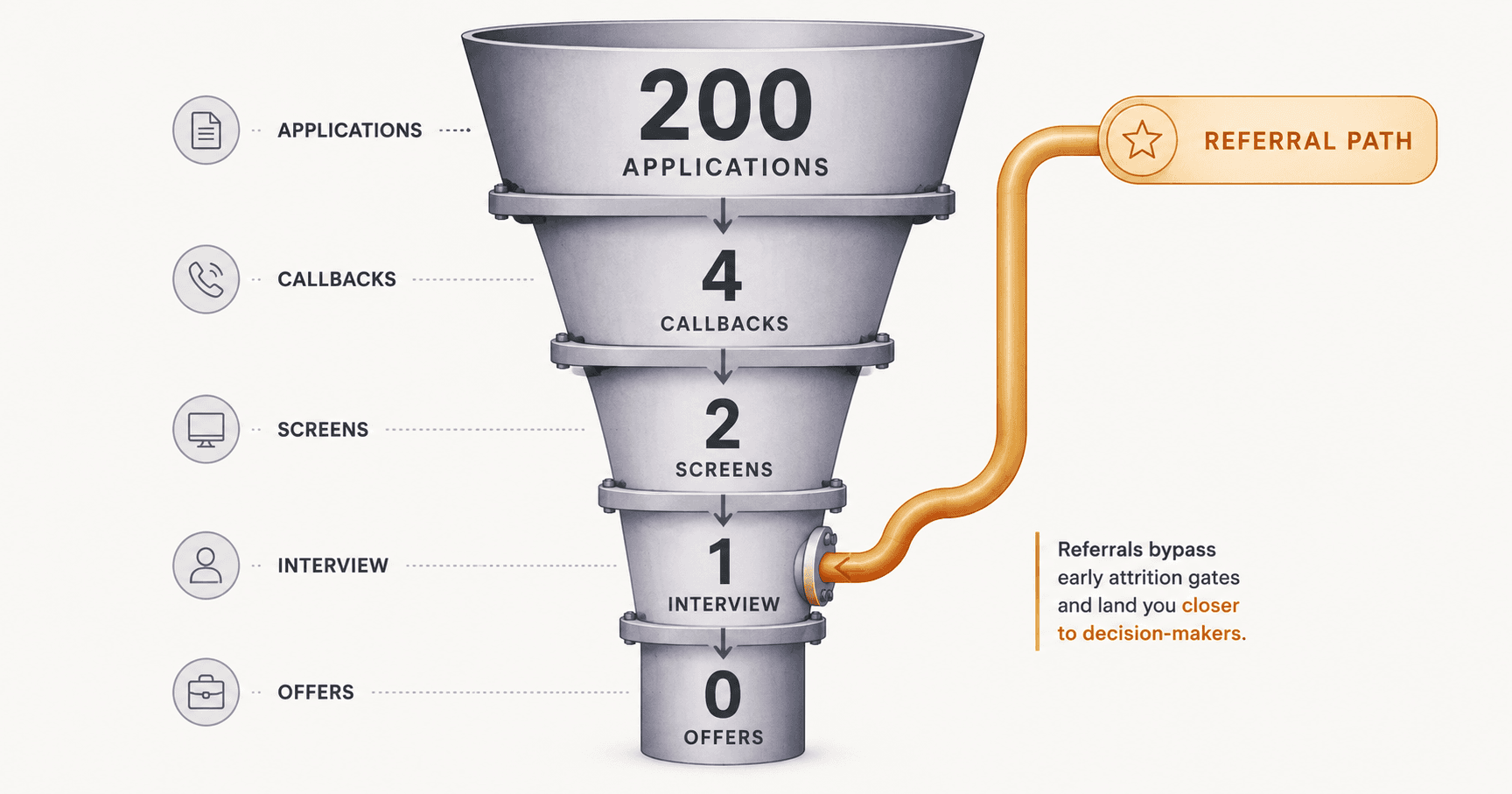
Quick answer: 3 interviews from 200 cold applications is a 1.5% callback rate, and for cold job board submissions that outcome is far more common than it feels. Applications per open job have doubled since spring 2022, according to LinkedIn research reported by Fortune. Find the stage where your applications are failing and fix the input there, because sending application 201 through the same broken stage won't raise your rate.
Three interviews from 200 applications feels like failure, but it is a common result for a cold-apply strategy. That is uncomfortable to hear, and it is also useful. A predictable result means you can work out which input to change.
Why Do 200 Applications Produce So Few Calls?
Applications per open job have doubled since spring 2022, according to LinkedIn research (Fortune, January 7, 2026). Job boards were already crowded before AI-generated applications arrived. When a single posting draws 400 or 500 submissions, the recruiter relies heavily on ATS ranking to decide who to call first. Cold board applications have always converted at low rates. The ranges below are illustrative working assumptions for diagnosis; they are not published benchmarks. Roughly, the channels compare like this:
| Application channel | Illustrative callback rate | What drives it |
|---|---|---|
| Cold board, untailored resume | Below 1% | Generic keywords, weak signal |
| Cold board, tailored resume | 1–3% | Better keyword match, relevant bullets |
| Cold board + warm introduction | 5–15% | Referral context shifts recruiter behavior |
| Recruiter reaches out directly | Much higher | Pre-screened fit before contact |
Those ranges vary by field and seniority, so the exact numbers matter less than the gap between channels. Each channel has its own typical rate, and which channel you use changes your odds more than how many applications you send.
Where in the Funnel Do Applications Drop Off?
A callback is only the first gate, and each stage after it cuts the number further.
| Stage | Illustrative conversion | What breaks here |
|---|---|---|
| Application to recruiter callback | 1–3% cold, higher referred | ATS parsing, keyword ranking, resume quality |
| Recruiter screen to hiring manager | 20–50% advance | Mismatch on level, function, or basic requirements |
| Hiring manager to final round | 30–50% advance | Depth of experience, case quality, team fit |
| Final round to offer | 20–40% receive offer | Competition, compensation fit, timing |
Work it backward. If you want two offers, you probably need five to eight final rounds. Those take ten to twenty hiring manager conversations, which take twenty to forty recruiter screens. If your cold callback rate is 2%, that's 1,000 to 2,000 applications. Most people are at 200 and wondering why the math isn't working.
The math also shows where to focus your effort. Raising your callback rate will do more for you than raising your application count.
Which Funnel Stage Is Holding You Back?
The fix is different at each stage, so finding yours will help more than applying more. Work through these questions:
Are your applications getting seen at all?
Check status updates or view counts where the platform shows them. Zero views across many applications usually means a stage-1 problem: either the resume format is breaking the parser, or your keywords don't match the terms the posting gives the ATS to rank on.
Run the copy-paste test. Open your resume, select all, paste into a plain text editor. If the output is scrambled, a parser sees the same thing. Then compare your language to the specific job description. If the posting says "cross-functional stakeholder management" and your resume says "worked with multiple teams," you may be describing the same work in words the system does not connect. Use the exact terms where they honestly apply.
For a thorough breakdown of both failure modes, Will My Resume Pass ATS? covers the parsing gap and the keyword-ranking gap separately.
Are you being seen but not called?
The resume is reaching a human, but the human isn't finding a fit. This usually comes down to one of two things: bullets that describe duties rather than results, or the same resume sent to every job without tailoring.
Ask whether a recruiter reading your resume can answer two questions in ten seconds: what role is this person targeting, and what is their strongest proof point for it? If either answer is unclear, the content is the problem.
A concrete example: "Responsible for managing social media accounts" describes a duty anyone with that title could claim. "Rebuilt the content calendar and grew engagement 38% in two quarters, generating roughly 12 qualified leads per week" is evidence. Rewrite your five most important bullets the same way and you'll usually solve most of the stage-2 problem.
Are you getting screens but no interviews?
Your resume is getting you in the door, so the issue is likely targeting: your background doesn't match the level or function the posting describes. Ten screens with no conversions points to targeting. A few screens where the conversations felt off is a different problem, usually preparation, and it needs a different fix.
Why Doesn't More Volume Fix a Stage-1 Problem?
If the failure is at ATS keyword ranking, doubling the application count doubles the stage-1 rejections. That is why the number of applications you've sent tells you so little on its own. Diagnose which stage is failing, then ask what that stage requires.
For stage-1 failures (ATS parsing, keyword ranking):
- Use a single-column layout with standard section headings
- Mirror the posting's exact terminology where it honestly applies
- Spell out acronyms and their full forms side by side (PMP and Project Management Professional)
For stage-2 failures (human reviewer does not call):
- Tailor the resume to the specific role rather than to the field in general
- Lead every bullet with what you achieved rather than what you were responsible for
- Cut anything the target posting does not ask for
For targeting failures (wrong roles for your background):
- Re-examine whether your experience matches the level and function of the roles you're applying to
- A two-year analyst applying to VP positions will get screened out before resume quality is ever a factor
For the full approach, see The Strategic Job Search, which covers how to build a target list matched to your background and focus your effort where conversion rates are highest.
What Single Variable Changes Your Rate the Most?
A warm introduction moves your application into a different conversion-rate category.
Pinpoint's analysis of 4.5 million applications found that referred candidates are seven times more likely to be hired than cold board applicants. National University's hiring research puts referrals at roughly 7% of all applicants while accounting for 30–50% of all U.S. hires. In other words, referrals produce far more hires than their share of applicants would suggest.
If your current search has zero warm introductions in the pipeline, adding some will do more for you than application 201 ever could. For the practical mechanics of how to build and convert those relationships, see What Makes a Warm Introduction Different from a Cold Application.
What Should You Track Instead of Total Applications?
Stop using your weekly application count as your progress metric. Track three numbers you can act on:
- Callback rate: recruiter calls received divided by applications sent. Below 1% on tailored applications is a stage-1 signal.
- Failure stage: are you losing people before or after the human reviewer sees the resume? Each requires a different fix.
- Relationship pipeline: how many people at target companies have you had a real conversation with this month?
That way you stop treating volume as a stand-in for effort and start checking whether your effort produces results at each gate.
For cold applications, the resume is often where the funnel breaks first. Getting it scored against a real job description shows you which keywords you're missing (a stage-1 problem) and how well your bullets show results (a stage-2 problem), faster than guessing from the silence after you apply.
Score your resume free, create your PokeBot account to find your keyword gaps and weak bullets against a real posting; the Opportunity Map then surfaces recruiter-shared roles where a warm introduction is on the table.
Frequently Asked Questions
Why am I not getting interviews after sending 100 applications?
Cold job board applications convert at very low rates for most candidates. If your callback rate is in the low single digits, 100 applications yield only a handful of callbacks by the math alone. The more useful question is which stage of the funnel is failing you: ATS keyword ranking, human resume review, or wrong-target roles. Each has a different fix, and sending more applications into the same broken stage doesn't change the rate.
What is a healthy application-to-interview conversion rate?
There is no single published benchmark, but many candidates see cold job board callback rates in the low single digits, while referrals convert far better: Pinpoint's analysis of 4.5 million applications found referred candidates are 7x more likely to be hired. If tailored applications are producing almost no callbacks at all, there's likely a format or keyword issue at stage one.
How many applications does it actually take to get a job?
It depends on the channel more than the count. At the low callback rates cold board submissions usually produce, even 100 applications may yield only a few conversations, and each subsequent gate cuts that further. Referred candidates convert far more reliably. You'll usually reach an offer faster with 30-50 targeted applications plus warm introductions than with 200 cold submissions.
Is it normal to apply to 100 jobs and hear nothing?
If those 100 were cold board submissions with an untailored resume, unfortunately yes. ATS keyword mismatch and parsing issues are among the most common reasons for that silence. The fix starts with a format and keyword audit before you send application 101.
What's wrong with my resume if I'm not getting callbacks?
The most common culprits are ATS keyword mismatch (you described skills in different words than the posting used), duty-focused bullets with no measurable results, and a format that breaks the parser. Running a resume analysis against a specific job description shows which keywords you're missing and how well your bullets show results. Pasting your resume into a plain text editor shows whether the format survives. Both are faster than trial-and-error submissions.
How do I know if my applications are being seen?
Many job boards show view counts or application status. Zero views across dozens of applications usually signals a parsing or ranking problem. Views with no follow-up means the human reviewer didn't find a fit. Once you know which stage is failing, you can fix it instead of sending more applications into the same gap.
Why do some people get interviews quickly while others send hundreds of applications?
Mostly channel and targeting. People who get interviews quickly are usually applying through warm referrals (which convert at multiples of the cold rate), targeting roles precisely matched to their background, or both. Sending a high volume of applications without either one is usually the slowest way to an offer.
What is application funnel math for job searching?
It means treating the job search like a sales funnel: applications sent times the conversion rate at each stage equals outcomes. Its practical use is showing you which stage is the bottleneck. A 1% callback rate means the problem is before the phone call. A 90% call-to-interview rate means the resume is not the issue.