
How Much Does Interview Coaching Cost in 2026? Human Coach vs Bootcamp vs AI
Interview coaching runs from free to four figures. What a human coach, a bootcamp, and AI practice each cost in 2026, and when a human is worth paying for.
Last updated: November 2026.
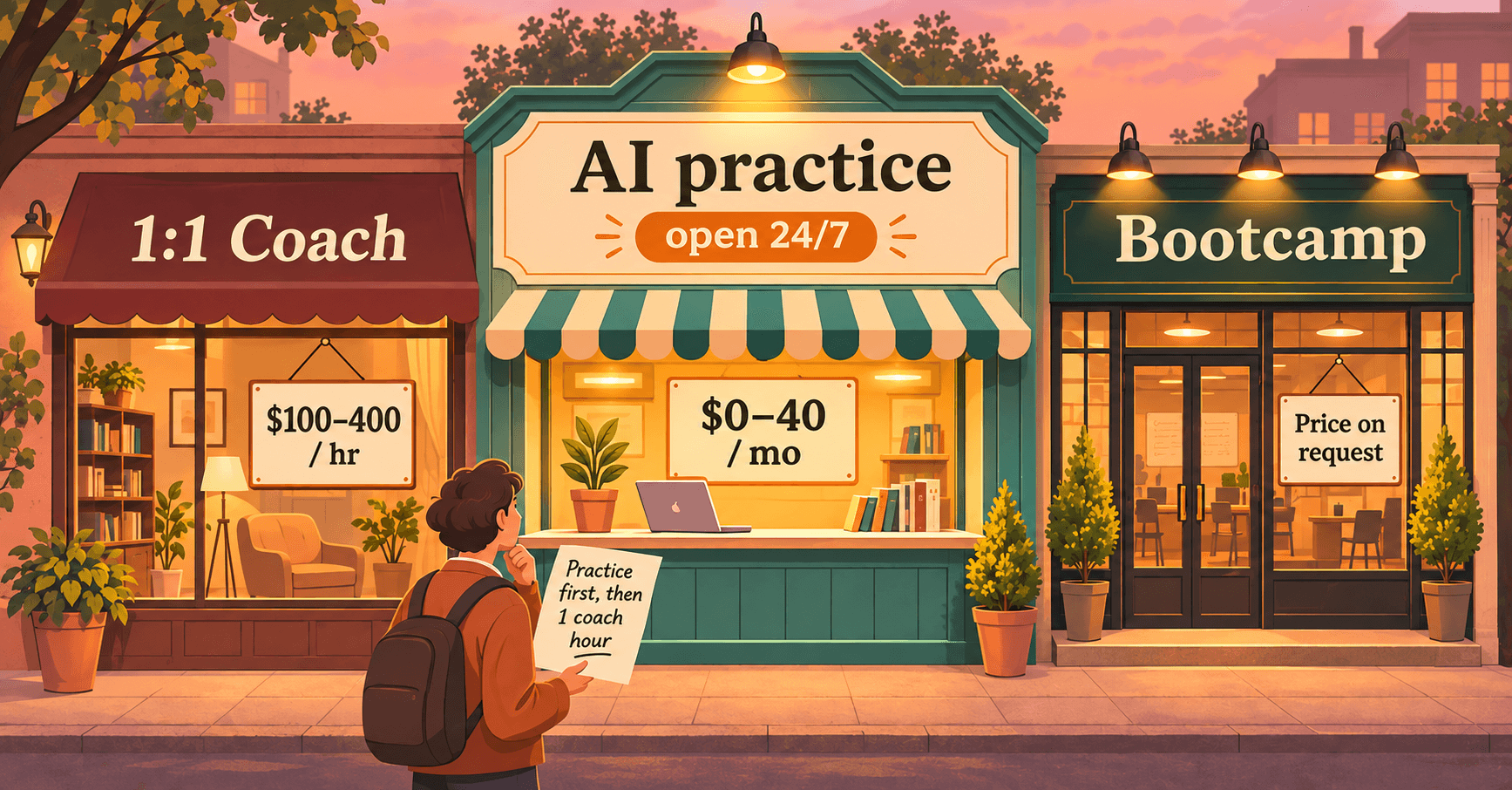
Quick answer: As of late 2026, a human interview coach typically costs $100 to $400 an hour by IGotAnOffer's estimate, and multi-session coaching programs run into four figures. Bootcamps sell months of curriculum. AI mock interviews cost far less: PokeBot runs from a free plan to $40 a month. Buy cheap reps first, then pay a human only for what reps can't fix.
The easiest way to overpay for interview coaching is to book a $200 hour before you've practiced once. The coach spends it asking "tell me about yourself" and pointing out that your answer runs four minutes long. You could have found that out alone, at 11pm, for close to nothing. The hour is better spent after that problem is already fixed.
Below is what each option costs, what the money actually buys, and how to split a budget so the expensive part goes where it counts. One disclosure up front: PokeBot sells both an AI practice platform and human consulting, so we have a stake in both columns. The advice below holds either way.
What Does Each Type of Interview Coaching Cost?
Prices move often, and every figure below comes from the provider's or publisher's own page as of late 2026. Check the live page before you pay.
| Option | Typical price | What the money buys | Best for |
|---|---|---|---|
| Free peer practice | $0 | Another candidate asks you questions | Getting used to talking out loud |
| AI mock interviews (PokeBot) | Free plan, then $10 to $40 per month | Scored practice sessions any time, with follow-up questions and feedback | High volume of reps on a budget |
| General career coach | $80 to $225 per hour (Noomii, 2026 guide) | Strategy, positioning, accountability | Career direction, not one specific interview |
| Specialist interview coach | $100 to $400 per hour (IGotAnOffer estimate) | A person who knows a specific type of hiring bar | Final rounds, senior roles, firm-specific formats |
| Coaching program | $1,499 for an assessment plus five 1-hour sessions and a year of course access (Aced, formerly Exponent) | Structured sequence of sessions with one provider | Someone who wants a plan run for them |
| Interview prep bootcamp | Some publish no price and quote after a call or webinar | Months of curriculum and a cohort | A real skill gap, not a delivery problem |
Two things in that table are worth reading twice.
The specialist range is wide because the price tracks the coach's background. A coach who used to run interviews at a firm you're targeting charges for that knowledge. If you don't need that specific knowledge, you're paying a premium for a logo.
Packages change the math more than hourly rates do. Aced lists one coach's mock interview pack at 5 sessions for $200 per session, so five hours costs $1,000 before you've learned whether the coach suits you. Buy one session first.
What Are You Actually Paying a Human Coach For?
Strip it down and a coaching hour contains two very different products.
The first is reps: someone asks a question, you answer, they react. That part is commodity work. A friend or an AI interviewer can do it, and you need dozens of reps before your answers stop sounding rehearsed.
The second is judgment, and it's the only part worth $200 an hour:
- Telling you which of your three project stories a particular kind of hiring panel will care about, and which one sounds like a junior engineer talking.
- Spotting why you keep losing in final rounds when the feedback you get is "we went with another candidate."
- Playing a hard negotiator well enough that your voice stops shaking when you counter.
- Introducing you to someone, which no software does.
If you pay a coach mostly for the first product, you're buying the cheapest thing in the room at the highest price.
When Do You Actually Need a Human Coach?
Pay for a human when the problem needs inside knowledge or a second brain, and you've already done the basic reps. In practice that means:
- Senior and executive searches. The interviews turn on positioning and politics, and a coach who has sat on that side of the table is reading the room for you.
- Formats with a narrow, specialized bar. A consulting case or a banking technical rewards knowing what that kind of interviewer listens for, and a coach who has given those interviews hears things you won't.
- Repeated losses at the last stage. If you reach finals and keep missing, something is wrong that you can't see from the inside. One sharp outside read can be worth more than ten more practice sessions.
- A big negotiation. When the gap between a good and a bad counteroffer is several thousand dollars, an hour of rehearsal with someone who negotiates for a living pays for itself.
You probably don't need one if you're early-career, interviewing for a common role, and haven't yet practiced your answers out loud ten times. Do that first. It's free, and it changes what a coach can do for you later.
Are Interview Prep Bootcamps Worth the Price?
Bootcamps sell time and structure: weeks or months of curriculum, often with live classes and a cohort. That's a good purchase if you're missing a skill. Someone who has never practiced dynamic programming, or who can't yet build a three-statement model, needs teaching before they need interview polish.
It's a bad purchase if your real problem is how you come across. You'd be paying for months of lessons to fix something that sits in the first two minutes of your answers.
Before you enroll anywhere, get these on paper:
- The total price, including any financing or deferred fees.
- The refund terms, and what counts as "getting a job" if a guarantee depends on it.
- How many hours of live time with an instructor you get, as opposed to recorded content.
If a program won't tell you the price until a sales call, go in knowing that the call is designed to close you.
What Does AI Interview Practice Do Well, and Where Does It Fall Short?
AI practice wins on volume and cost. You can run a behavioral round at midnight, get a score on every answer, try again, and watch the score move. A coaching hour can't compete with that on price, and repetition is what turns a decent answer into one you can give under pressure.
On PokeBot, Mock Interview asks follow-up questions based on what you said, probes behavioral answers for specifics, and scores each session by competency, so you see which answers are weak rather than just feeling it. You can set it up for a specific role and format, from Interview Practice to Case Interview and Pitch & Demo (how the practice modes work). Progress Tracker then shows whether your scores are moving over time. The STAR method guide pairs well with it if your stories are the weak spot.
The limits are real. An AI interviewer can't tell you, from having sat on the panel, how one particular team at one particular firm thinks. It can't introduce you to anyone. And a general chatbot with a loose prompt is weaker still, because it forgets your resume and your target role between sessions. We wrote about that difference here.
How Should You Split an Interview Coaching Budget?
Spend in order, and only move to the next step when the current one stops helping:
- Free reps. Answer your ten most likely questions out loud. Record yourself once. You'll hear the problems.
- Scored practice. Move to AI mock interviews and keep going until your scores flatten out. On PokeBot that's the free plan, then $10 to $40 a month if you need more runs. That's less than a single hour with most human coaches.
- One targeted human session. Bring the specific weakness your practice exposed, and ask the coach to work only on that. One focused hour beats a five-pack bought on day one.
- More human time only if it worked. If that first session moved you, buy more. If it didn't, try a different coach before you buy another package.
PokeBot offers Premium Career Consulting for steps three and four, pairing the platform's AI diagnosis with senior human experts, starting at $199. You don't need it to follow this plan. Any good coach fits into step three.
Score your resume free, create your PokeBot account
So How Much Should You Spend on Interview Coaching?
Less than the market will happily take from you, and later than you think. Do the cheap reps until they stop teaching you anything, then buy human judgment one hour at a time for the problem you can name. If you can't name the problem yet, you're not ready to pay someone $200 an hour to find it.
Frequently Asked Questions
How much does an interview coach cost per hour?
As of late 2026, IGotAnOffer, a coaching marketplace, estimates that hiring an interview coach costs anything between $100 and $400 per hour. Noomii's 2026 guide puts general career coaching at $80 to $225 per hour. Coaches with experience at top firms sit at the high end, and packages of several sessions usually lower the per-hour price.
Is interview coaching worth the money?
It is worth it when you buy it for the right job. A human coach earns their rate on judgment calls: telling you how a specific hiring bar sees your story, catching a pattern behind repeated final-round losses, or rehearsing a high-stakes negotiation. Paying a coach to ask you standard questions you have never practiced out loud is the expensive way to get reps you can get cheaply elsewhere.
How many interview coaching sessions do I need?
Fewer than you think, if you practice on your own first. Aced (formerly Exponent) says most of its students book 3 to 5 sessions. If you arrive with answers you have already rehearsed and scored, one or two sessions aimed at specific weaknesses can do the job of five general ones.
Are interview prep bootcamps worth it?
A bootcamp is worth it when you have a real skill gap, such as data structures for a coding round or financial modeling for a banking technical, and you need months of structured curriculum to close it. It is poor value if your problem is delivery, because you pay for teaching you do not need. Get the full price and the refund terms in writing before you enroll.
Can AI mock interviews replace a human interview coach?
For volume, mostly yes. AI practice lets you answer questions out loud at any hour, get scored on each answer, and repeat until the weak spots move, at a small fraction of a coach's hourly rate. A human still adds something AI practice cannot fully supply: firsthand knowledge of how a particular team or firm judges candidates, plus someone who can vouch for you or open a door.
What is the cheapest way to practice for an interview?
Free peer practice with another candidate or a friend costs nothing, and PokeBot's free plan includes two AI mock interview runs with scoring and no credit card. The cheapest effective setup is to do most of your reps for free or on a low monthly plan, then spend money on human time only for the problems those reps did not fix.
How much does PokeBot cost for interview practice?
PokeBot has a free plan with 2 lifetime AI runs in each service, including Mock Interview. Paid plans are $10, $20, and $40 per month, with 10, 50, and 150 AI runs per month in each service. Every paid plan has a 30-day money-back guarantee. Premium Career Consulting, which pairs the platform with senior human experts, starts at $199.