
Questions to Ask at the End of an Interview, Ranked by What Interviewers Say They Care About
A ranked guide to closing questions based on recruiter and hiring manager sources, with by-round and by-role tables, plus what to skip.
Last updated: September 2026.
Quick answer: The best closing questions show you're already thinking about how you would do the job. Ask about success criteria at 90 days and one year. Ask what the team needs most right now. Ask what would make someone fail in the role. Three or four strong questions get you further than ten generic ones.
Recruiter guidance and Glassdoor community discussions keep making the same point: interviewers use the closing questions to judge how engaged you are and how well you think. What you ask counts alongside how you answer.
How Was This Ranking Built?
The ranking below draws on Glassdoor's guides to questions to ask an interviewer, Glassdoor community discussions, and recruiter statements from published career resources. We combined what those sources say; there is no single proprietary dataset behind it. A type of question ranks higher when more sources agree on it, and each tier reflects how consistently a question type is praised or flagged across them.
What Do Interviewers Pay Attention To?
Closing questions do two jobs. They get you information you need to decide whether to accept an offer, and they show the interviewer how you think. Interviewers notice both, and it can affect the outcome: in Resume Genius's January 2024 survey of 625 hiring managers, 33% said that asking relevant questions makes them more likely to hire a candidate.
Published sources keep pointing to three patterns that impress hiring managers:
- Questions that assume you're going to be doing the job ("What does the first 90 days look like?")
- Questions that show you listened during the interview ("Earlier you mentioned the team is rebuilding the pipeline. What does that change about what the role needs in the first quarter?")
- Questions that show you're also deciding whether you want them
And three that tend to fall flat or count against you:
- Questions easily answered by the job posting or the company website
- Answering "Do you have any questions?" with "No, I think you've covered everything"
- Salary or benefits questions before the hiring manager has signaled the conversation is moving toward an offer
How Do the Closing Questions Rank, From Best to Worst?
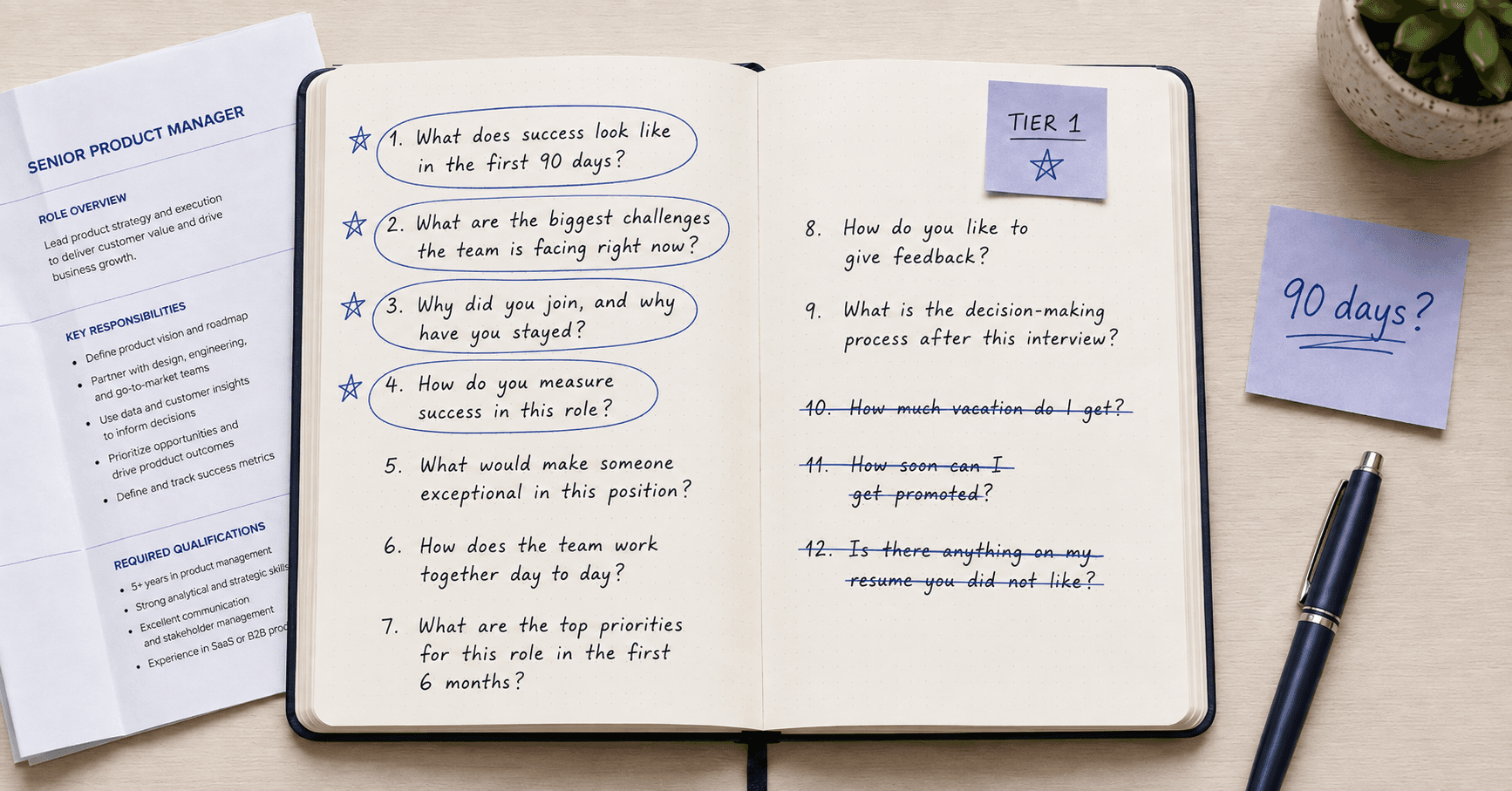
Tier 1: Questions Interviewers Consistently Praise
These come up repeatedly in recruiter guidance and Glassdoor community discussions as questions that impress interviewers.
"What does success look like in this role at 90 days and at one year?"
Recruiter guides cite it again and again as one of the strongest questions a candidate can ask. It makes the interviewer spell out what good performance looks like, and it shows you're thinking about doing the work. The answer also tells you whether the role has a clear mandate or a vague one.
"What's the biggest thing the team needs from whoever is in this role right now?"
This works better than asking what the role requires, because "right now" gets past the job description to whatever is urgent. Recruiters in published discussions say it shows awareness of the team's situation and suggests the candidate is thinking about impact as well as fit.
"What would make someone fail in this role, six months in?"
Few candidates think to ask it, and many hiring managers call it one of the most useful questions a candidate can ask. It brings out the risks and unstated expectations that can derail someone. The answer tells you more than "what does success look like" on its own, because it names the specific ways the role goes wrong.
"What made you join this company, and what has kept you here?"
Ask it of the interviewer personally. Some recruiters note that candidates who turn a personal question back to the interviewer make the conversation more memorable. The answer tells you more about culture and leadership quality than a formal culture description will. If the hiring manager pauses or deflects, that tells you something too.
Tier 2: Strong but Standard
These are reliably good questions that prepared candidates typically ask. They won't hurt you, but they're unlikely to set you apart either. Ask them when you still don't know the answer.
"What does the feedback and performance review process look like?" Shows you're thinking about growth. More meaningful in a hiring manager round than a recruiter screen, where the recruiter may not know the specifics.
"How does this team collaborate day-to-day?" Useful in engineering or cross-functional contexts. Gives you concrete information about working style. More revealing when asked of a peer than when asked of the hiring manager.
"What are the next steps, and what's the timeline?" Practical and expected. Ask it, but save it for the end of the closing instead of opening with it.
"What does the team structure look like, and who would I be working most closely with?" Useful in senior or cross-functional roles. Less impressive in a final round, where you should already know this from earlier conversations.
Tier 3: Generic, But Not Harmful
Questions interviewers have answered dozens of times. They show basic preparation but not much thought. Use them only when you've run out of better options.
- "What are the biggest challenges facing the company right now?"
- "What does the culture look like here?"
- "Where do people in this role tend to go next?"
Tier 4: Skip These
| Question | Why to skip |
|---|---|
| "What is the salary?" (in an early round) | Premature before the offer stage; raise compensation with the recruiter instead |
| "How much vacation do I get?" | Signals priorities out of order with the conversation |
| Any question the job posting answered | Shows you didn't read the listing |
| "No, I think you covered everything" | Reads as disengaged; always have backup questions |
| "Would you say this company has a good work-life balance?" | Too vague; asks for permission rather than information |
Does the Round Change What You Should Ask?
Yes. The person across the table changes, and so does what's worth asking.
| Round | Who you're talking to | Best questions |
|---|---|---|
| Phone screen (recruiter) | HR or recruiter, often first contact | Process and timeline; what the recruiter sees in strong candidates for this role; compensation range if you want to confirm fit |
| Hiring manager round | Your future boss | Success criteria at 90 days and one year; what the team needs most urgently; what would make someone fail |
| Peer or panel round | Potential teammates | Day-to-day collaboration; what they find meaningful about the work; what they'd change if they could |
| Final round | Often senior leadership | Strategic context for the role; how the team's priorities connect to the broader org; why the decision was made to fill the role now |
A question that works in a hiring manager conversation can fall flat with a recruiter who can't see into the team's dynamics. Tailor your questions to the person in front of you.
Does Your Level in the Role Change What You Should Ask?
Somewhat. Expectations for closing questions rise with seniority, and interviewers for senior roles look for sharper judgment in what you ask.
| Level | What to focus on |
|---|---|
| Entry-level or new grad | Onboarding structure; who you'd learn from; what early wins look like |
| Mid-level individual contributor | Team dynamics; technical stack or domain; how success is measured |
| Senior individual contributor | Technical direction; how priorities are set; how the team handles disagreement |
| Manager or director | The team you'd inherit; what the previous person left well-done and unfinished; how the org makes decisions |
For more on new grad-specific interview strategy, see How to Get Hired in 2026 When Entry-Level Jobs Are Disappearing.
Which Questions Are a Waste of Time?
Mostly, the ones you ask to seem curious when you won't use the answer. "Where do you see the company in five years?" is the classic example. It's vague, the answer is usually corporate boilerplate, and you learn nothing you can act on.
Asking about culture directly has the same problem. The word means almost nothing in an interview, because nearly every company describes itself as "collaborative" and "fast-paced." To understand the culture, ask a specific behavioral question instead: "When priorities shifted suddenly in the last six months, how did the team find out and how quickly?" You'll get a specific story back.
The other kind to avoid is any question that makes the interviewer feel like you're scouting an exit before you've started. Questions about internal mobility and growth trajectory are fine in moderation. Asking in the first round how quickly people move into more senior roles can read as impatience.
How Do You Ask Questions Without Sounding Like You're Reading a List?
Always write your questions down, and read them over before you go in rather than during the interview. When the moment comes, glance at your notes if you need to, but speak from them instead of reading word for word.
One approach that works: during the interview, note something the interviewer said and turn it into a question at the end. "Earlier you mentioned the team is rebuilding the data pipeline. What does that change about what the role needs to do in the first six months?" A question like that shows you were listening.
Avoid asking a question and then not reacting to the answer. Treat the closing as a conversation, and follow up when something they say is interesting or surprising. That follow-up often makes a stronger impression than anything on your list.
How Do You Practice the Closing?
Practicing your behavioral STAR answers is standard advice. Far fewer people practice their closing questions, which is why so many candidates sound stiff for the last minute of an interview.
Practice means saying your questions out loud in a mock interview setting and adjusting the ones that don't come out the way you intended. Most questions that read well on paper have a phrase or two that sounds off when spoken, and it's better to catch those before the real interview.
PokeBot's Interview Practice (see how to use it effectively) covers the answering half. For the closing, use the Mock Everything role-play tool: set up a scenario where the AI plays the hiring manager, and practice asking your questions. Run it again until they come out the way you intended.
Frequently Asked Questions
Should I always ask questions at the end of an interview?
Yes. In published guidance and community discussions, recruiters and hiring managers consistently list 'no questions asked' as a red flag, because it reads as disinterest or lack of preparation. Prepare at least five questions before any interview, since some will get answered during the conversation. You want to end with two or three that are still open.
How many questions should I ask at the end of an interview?
Two to three per round is the right range. Fewer looks disengaged; more can run over time. If several of your prepared questions get answered during the interview, say so briefly and move to the ones that are still open. Never end with zero.
What is the single best question to ask at the end of an interview?
Ask what success looks like in the role at 90 days and at one year. In recruiter guides and Glassdoor discussions, hiring managers often name it as one of the most impressive questions a candidate can ask. It shows you're already thinking about doing the work, and the answer tells you what the job requires.
Can I ask about salary at the end of an interview?
It depends on the stage. In an early screen with a recruiter, asking about the range is fine and saves everyone time. In a first hiring-manager round, it reads as premature unless they raise it. In a final round, it's fair to bring up. Frame it as making sure you're aligned, and don't make it your first question.
What if all my prepared questions get answered during the interview?
Say so briefly: 'You answered most of what I had prepared, which is reassuring.' Then follow up on one thing they said that you want to know more about. Noticing what has already been covered shows you were listening. It also helps to have a few deeper backup questions ready.
Is it okay to ask the same question to different interviewers in the same process?
Yes. Asking 'What do you find most rewarding about working here?' to a peer and a hiring manager will get different answers, and both are useful. Compare them. If the answers line up, that usually points to a well-run team. If they differ, that tells you something too.
How can I practice asking closing questions before an interview?
Say your closing questions out loud before the real interview, because questions that read well on paper often sound different when spoken. In PokeBot, run a mock interview to practice your answers, then use the Mock Everything role-play tool to rehearse the closing: set up a scenario where the AI plays the hiring manager, ask your questions, and run it again until the wording sounds right.