
Resume With No Experience: What to Put Instead
What to put on a resume with no work experience: section templates, a weak/strong example, and how to write projects that get read.
Last updated: September 2026.
Quick answer: When there's no job history, build the page around projects and education. Write a two-line summary at the top naming the role you want and your strongest proof. A focused one-pager with concrete project work beats a padded resume with vague accomplishments every time.
"No experience" means no full-time paid work history in the field. Most students have project work and leadership roles that can fill that gap, but the material goes undersold or not on the page at all. Here's what to include and how to write it.
What Does "No Experience" Actually Mean for a Resume?
No full-time, paid role in your target field. That is the gap most people mean. It is real, but it does not leave you with nothing to put on a page.
Two sections carry most of the weight when work history is thin:
- Projects — the most underused section for students, and the most credible substitute for job history when done right
- Education — with specific coursework, a strong GPA, and academic recognitions that count
Skills, internships, and leadership roles fill in below those two. If you have any paid or formal internship work, that goes into a standard Experience section. Without it, projects and education are enough to build a real one-pager.
Which Sections Belong on a No-Experience Resume?
Section order matters more than most candidates realize. When your most relevant material is projects and coursework, those belong near the top where they get seen in the first scan.
| Section | Include | Position |
|---|---|---|
| Targeted summary | Always | Top of page |
| Education | Always | Right after summary |
| Projects | Any class, personal, or hackathon work | Immediately after education |
| Skills | Technical tools, languages, methods you know well | After projects |
| Experience | Any paid or formal internship work | After skills |
| Leadership / Activities | Clubs, officer roles, competitive teams | After work history |
| Volunteer | If relevant or shows initiative | Last substantive section |
Skip references on the resume itself. Skip a high school job list unless you're a first-year student. The goal is one page of material that points directly at the role you're targeting.
How Do You Write Each Section?
Targeted Summary
Two lines. Name the role you're going for and your best proof for it. An objective statement ("seeking a challenging role where I can contribute") is not a summary. It describes what you want, not what you offer.
Template:
[Role] with a background in [major/field] and [strongest relevant skill or project outcome]. Targeting [specific type of role or team].
Example:
Software engineering candidate with a background in computer science and two deployed web apps. Targeting backend roles at product-focused startups.
Education
Name your degree, institution, and expected graduation. Include GPA if it's above 3.5. Then list relevant coursework: the specific classes a hiring manager in your field would recognize. "Computer science" is a major; "Data Structures, Algorithms, Database Systems" is evidence.
Template:
[Degree], [Major] | [University] | Expected [Month Year]
GPA: [X.X] (include only if 3.5 or above)
Relevant coursework: [three to five specific course names]
Honors: [Dean's List, named scholarship — if applicable]
Projects
This is the most important section in a no-experience resume, and the most often undersold. Treat it exactly like a job entry. Each project gets a header line and 2–3 bullets.
Template:
[Project name] | [tech stack or method] | [link if public]
- Built [what it does and key technical components]
- [Metric: users, accuracy rate, test coverage, performance benchmark, or data scale]
- [What problem it solved or what you would add next]
Use real numbers. No external users? Use the technical metric: model accuracy at 91%, tests passing at 97%, page load under 1.2 seconds. These are evidence. "Class project" in parentheses is not.
Skills
List only what you would be comfortable being asked about in an interview. Group by type and keep it specific. A skill listed without a project behind it invites follow-up questions you might not be ready for.
Template:
Languages: Python, SQL, JavaScript
Frameworks/Tools: React, FastAPI, Git, Docker
Methods: statistical modeling, regression analysis
Languages (human): Spanish (conversational), Mandarin (native)
Experience (Part-Time Work or Internships)
Even a retail or food service job belongs on the resume with two bullets, but only if you write them as result-oriented lines. "Operated cash register" is a duty. "Handled $3,000 in daily transactions with zero reconciliation errors over eight months" is a result.
Template:
[Job title] | [Company] | [Dates]
- [Action verb + what you did + measurable result or scale]
- [Skill that transfers directly to your target role]
What Does a Weak No-Experience Resume Look Like Compared to a Strong One?
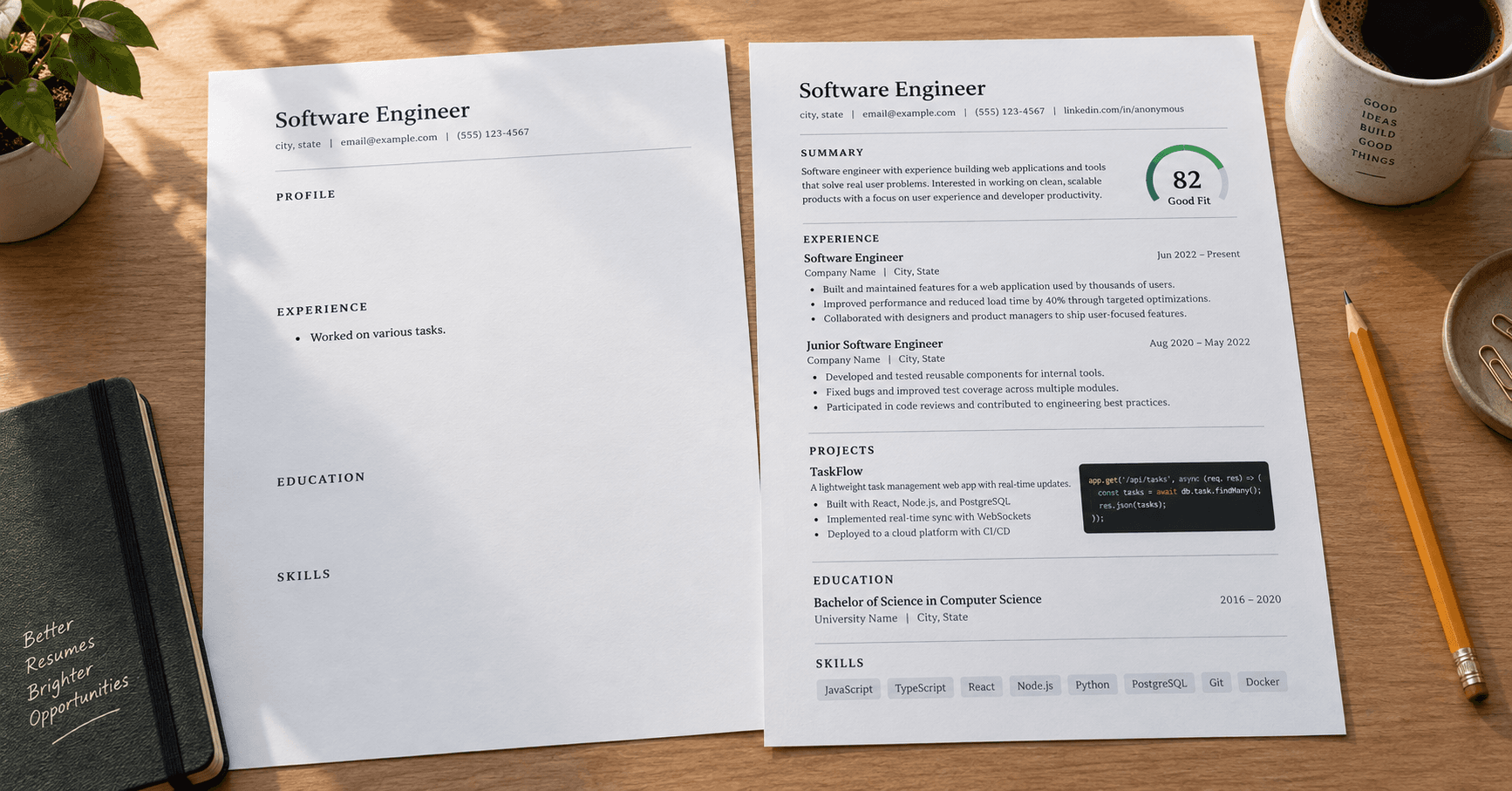
Here's the same student in two versions. Background: computer science junior, deployed a personal finance web app, worked retail part-time, leads the finance club's technology committee.
Weak version:
Education
B.S. Computer Science, State University (expected 2027)

Projects
- Personal finance app (Python)

Experience
Sales Associate, Target, Summers 2024–2025
- Helped customers and operated register

Activities
Finance Club member
Strong version:
Summary
Software engineering candidate with a 3.7 GPA in CS and two deployed web apps.
Targeting backend roles at product-focused companies.

Education
B.S. Computer Science, State University | Expected May 2027 | GPA: 3.7
Relevant coursework: Data Structures, Algorithms, Database Systems, Linear Algebra

Projects
Personal Finance Tracker | Python, PostgreSQL, Plaid API | github.com/[handle]
- Tracks and categorizes transactions across four linked accounts with monthly spending charts
- Reduced Plaid API sync latency from roughly 4s to under 0.8s by caching responses with Redis
- 35 active users; adding OAuth2 refresh-token flow in the next release

Skills
Languages: Python, SQL, JavaScript
Tools: PostgreSQL, Redis, Git, FastAPI, Docker

Experience
Sales Associate | Target | Jun 2024 – Aug 2025
- Handled $3,500+ in daily transactions with zero cash-reconciliation errors over 14 months
- Trained four new hires on the store's inventory management system

Activities
Finance Club | Technology Subcommittee Lead | Fall 2025 – Present
- Built and maintain the club's member directory and event registration tool (React + Supabase)
The underlying facts are mostly the same. The second version names a target, leads with measurable work, and shows a builder with real deliverables. The first is a list of activities.
Where Do Most No-Experience Resumes Break Down?
Two places.
First, projects get buried under Education as a single-line note. If you have built something real, Projects deserves its own section and belongs above Skills and any part-time work. A personal project with real users and a technical metric tells a hiring manager more about your capability than any coursework listing.
Second, the summary gets skipped or replaced with an objective statement. A summary that names your target role and best proof gives a reader a reason to keep reading in ten seconds. An objective statement gives them nothing.
The frame to hold onto: your resume at this stage is evidence, not biography. The reviewer is asking one question: can this person do the work? Projects and specific skills answer it. Soft skills and activity lists do not.
If you are still working out which signals actually matter for your specific target, How to Get Hired in 2026 When Entry-Level Jobs Are Disappearing breaks down what is moving for new grads by job category and how to build a search strategy around it.
For the mechanics of writing stronger individual bullets, especially when your metrics feel thin, How to Quantify Resume Bullets covers that with 30 before/after examples.
And once you have a draft, do not guess whether it is working. Will My Resume Pass ATS? explains exactly how screening software reads your resume and what gets you ranked.
Score your resume free, create your PokeBot account — Resume Studio scores your resume against a real job description and shows exactly what to fix.
Frequently Asked Questions
What do I put on a resume if I have no work experience?
Focus on education (with relevant coursework and a strong GPA), projects, and specific technical or subject-matter skills. A project section showing what you built or analyzed is more useful than a list of soft skills. Write a targeted two-line summary at the top framing your background for the specific role.
Should I include a projects section on a resume?
Yes, and it should sit near the top when you have no full-time experience. A project with real deliverables and a technical metric tells a hiring manager more about your capability than coursework titles do. Treat each project like a job entry: name, tools, and 2–3 accomplishment-style bullets.
Is it OK to have a one-page resume with no experience?
One page is correct for students and new grads with no full-time history. Fill it with sections that show relevant capability — education, projects, skills — and keep every line earning its space against the target role.
What is the difference between a resume objective and a resume summary?
An objective describes what you want; a summary describes what you offer. A two-line summary naming your target role and your strongest proof is almost always more effective than 'seeking a challenging opportunity to grow.'
Should I include high school jobs on a resume?
For most college students after the first year: no. High school jobs consume space that should go to college projects, coursework, and activities. The exception is when the work is directly relevant to the role you're targeting.
How do I write strong resume bullets without real accomplishments?
You likely have more than you think. Scope your projects honestly: a mobile app with 35 active users is a real metric. Quantify what you can, including team size, users, accuracy rate, or data scale. Use action verbs that describe what you built or improved rather than what you 'helped with.'