
How to Answer 'Tell Me About Yourself' (Script + Examples)
Most candidates treat this as a resume recap. Here's a 3-part framework with a fill-in script and before/after examples, so your opener lands.
Last updated: July 2026.
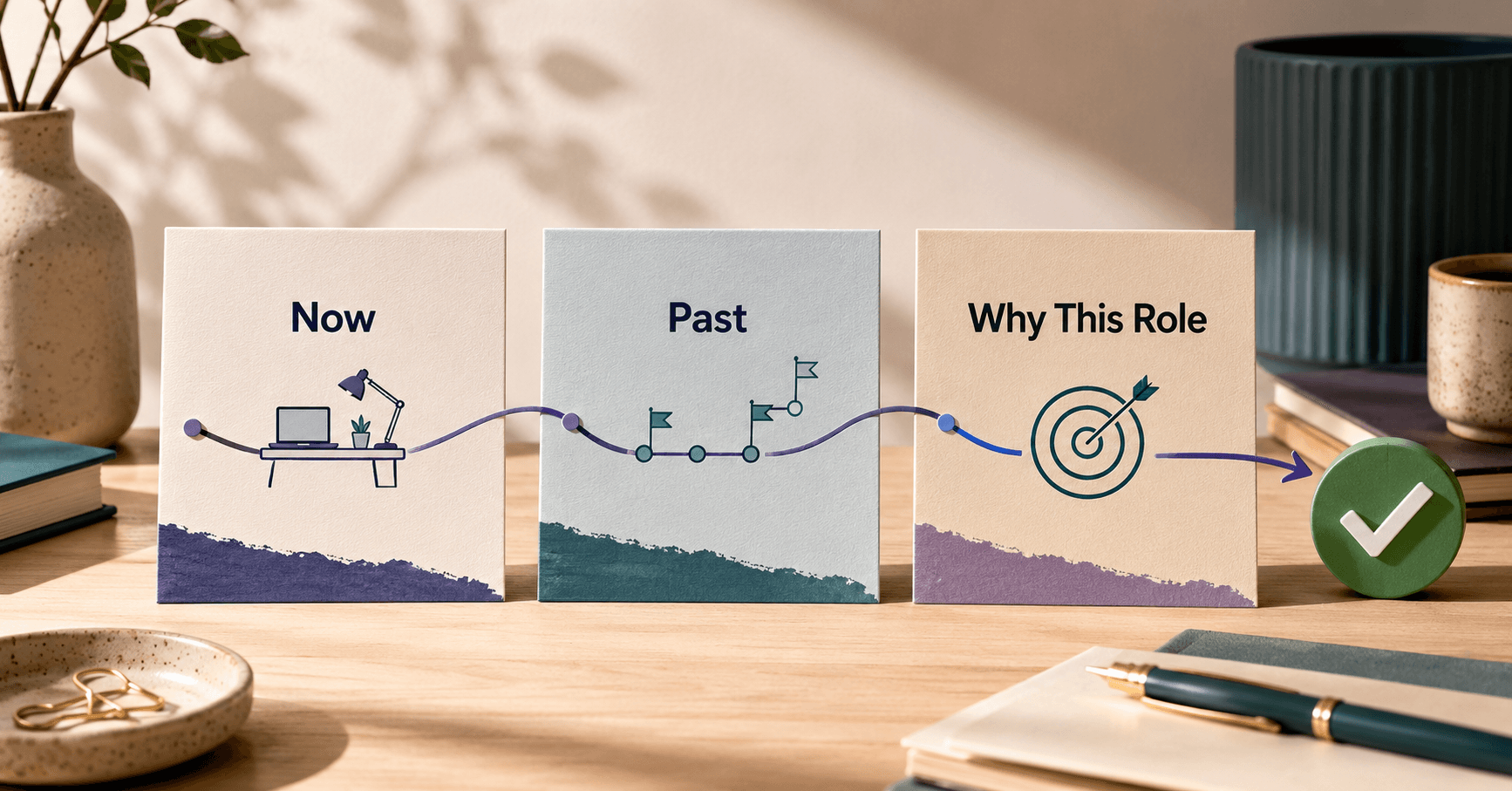
Quick answer: Start with who you are now and the one thing you own or are most responsible for. Pull in the experiences that connect your background directly to this job. Close with a specific reason this role is the right next move. That's three parts in 60 to 90 seconds, tailored to each interview.
"Tell me about yourself" comes first in most interviews and sets the tone for what follows. A clear, relevant answer gives the interviewer a reason to listen closely from the start. Answer it like a resume walkthrough and the interviewer may spend the rest of the conversation wondering whether you understood the job.
Why Do Most Answers Miss?
The instinct is to start at the beginning: "I graduated in 2019 and my first job was..." and then walk forward through your history until you reach today. That structure makes sense to you because you lived it. To the interviewer, it sounds like a life story, and it doesn't answer what they asked.
The question tests self-awareness. The interviewer wants to know two things: do you understand what this role needs, and is your background a clear fit for it? A chronological recap answers neither.
What's the Right Structure?
Build your answer in three connected parts, each with its own job:
Present. Your current title and the one concrete thing you own or are most responsible for. "I manage the data pipeline for a team of four engineers" works. "I work in tech" does not. Be specific enough that the interviewer can place you.
Relevant past. The experiences that explain how you got here and that connect directly to what this new role needs. Skip the full history. Pick the thread that runs from your past to this specific job and follow only that thread.
Future. Why this role, at this company, now, in one or two sentences. Skip generic ambition ("I want to grow"). Name something specific: a problem this company is solving that you want to work on, or a direction that lines up with where you've been deliberately heading.
Leave out anything that doesn't fit one of those three parts.
How Long Should It Be?
Aim for 60 to 90 seconds, roughly 150 to 200 words at a normal conversational pace. Under a minute and you seem underprepared. Much longer and the interviewer starts to wonder whether you prioritize well.
Time yourself out loud, not in your head. The gap between "this feels right" and "this actually takes three minutes" is usually bigger than you expect.
What Goes In and What Gets Cut?
| Include | Cut |
|---|---|
| Current title and one concrete responsibility | Personal history unrelated to the role |
| The experiences that connect your past to this job | Every position you've ever held |
| Skills or outcomes tied to the role's core requirements | Vague trait claims ("hard worker," "team player") |
| A real reason this company or role interests you | Why you left your last job (unless asked) |
| A clear thread from past to this next step | Unrelated hobbies or life events |
What Does a Strong Answer Look Like?
Here's a structure you can fill in directly:
"I'm a [current title] at [type of company], where I focus on [one specific area or responsibility]. Over the past [timeframe], I've [one concrete thing you've built or improved]. Before that, [one or two relevant moves that connect your background to this role]. What draws me to this position specifically is [a real, concrete reason tied to the company or the work]."
Read it out loud with your own details. Cut any sentence that sounds like a resume, and add back anything that sounds like you.
Before (the common version):
"I've been in marketing for about six years. I started at a small agency, then moved to a startup where I was doing content and social media. Then I joined my current company and I handle marketing campaigns. I'm looking for new opportunities because I want to grow."
After (same background, reframed):
"I'm a senior content marketer at a B2B SaaS company, where I own the blog and SEO strategy. Over the last two years I've built the editorial pipeline from scratch and grown organic traffic month over month. Before that I spent three years at agencies, which gave me a foundation in campaign work across several industries. I'm specifically interested in this role because you're moving upmarket into enterprise, and the positioning work that transition requires is exactly where I want to focus next."
Both versions cover the same six years. The second one tells the interviewer what's relevant, shows the candidate understands where the company is right now, and explains why this role in particular.
What Kills an Otherwise Good Answer?
Starting too far back. Your first job or college experience is rarely what this role cares about. Unless it connects directly, start with the last three to five years.
Confidence drain. Weak hedges ("sort of," "I guess") and filler words ("um," "like") sound worse out loud than they look on paper. They make you sound less credible even when the content is strong. Practice out loud until the words come without them.
Skipping the "why this role" close. Many candidates cover present and past and then stop. The close is what tells the interviewer you want this job, on top of being able to do it. One specific sentence about what draws you to this company or this problem can be what tips the decision.
How Do You Make It Sound Natural?
Memorizing a script backfires, because a scripted delivery sounds rehearsed. Know your story well enough to tell it without visibly searching for the words. That comes from practicing out loud; reading it over silently won't get you there.
To check whether your answer works, get feedback on a spoken run-through. PokeBot's mock interview practice lets you run your "tell me about yourself" and hear where the answer runs long or loses focus before you give it in a real interview. For the questions that come after your intro, the STAR method breakdown covers the behavioral format many interviewers move to next. And if you're curious how AI-powered prep compares with older methods, this overview of AI interview prep tools covers what's changed.
Score your resume free, create your PokeBot account
So, How Should You Answer It?
"Tell me about yourself" is the one interview question where you decide how to frame yourself, so don't spend it on a chronological recap. Use the three parts, tailor the middle to each interview, and close with a specific reason you want this role.
Frequently Asked Questions
How do you answer 'Tell me about yourself' in a job interview?
Use a three-part structure: who you are now and what you do, the relevant experience that led you here, and why this specific role is the right next step. Keep it to about 60 to 90 seconds. The goal is to show the interviewer that you understand what the job needs and that your background is a clear match.
How long should 'tell me about yourself' be?
Aim for 60 to 90 seconds, which is roughly 150 to 200 words spoken at a conversational pace. Shorter feels underprepared, and longer loses the interviewer's attention. Time yourself out loud, not in your head.
What should you not say in 'tell me about yourself'?
Skip personal background unrelated to the role. Don't walk through your resume chronologically from the beginning. Avoid filler like 'I'm a hard worker' or 'I'm a people person.' And don't bring up why you left your last job unless directly asked.
Should you memorize your answer to 'tell me about yourself'?
Memorize the structure and your key points, but not a word-for-word script, because a scripted delivery sounds rehearsed. Practice out loud until you know your story well enough to tell it conversationally.
How do you tailor 'tell me about yourself' to different roles?
Read the job description before the interview and identify what the role cares most about. Adjust the middle section of your answer to highlight the experience that speaks directly to those priorities. Your opening, and the shape of your close, can stay consistent from one interview to the next.
What's the best opening line for 'tell me about yourself'?
State your current role and one specific, concrete thing you own or are responsible for. 'I'm a product manager at a mid-size SaaS company, where I own the mobile roadmap' gives the interviewer something concrete to work with. Avoid vague openers like 'I'm a passionate leader.'
Can you use AI to practice 'tell me about yourself'?
Yes. In PokeBot's Interview Practice, you can say your answer out loud and get scored feedback on how clearly you communicate and how well your content is structured. It helps you catch where you're rambling or sounding too scripted before the interview itself.