
How to Show AI Fluency in an Interview: Sample Answers for SWE, PM, and Analyst Roles
What interviewers test when they ask about AI skills, with sample answers and weak and strong pairs for software engineers, product managers, and analysts.
Last updated: August 2026.
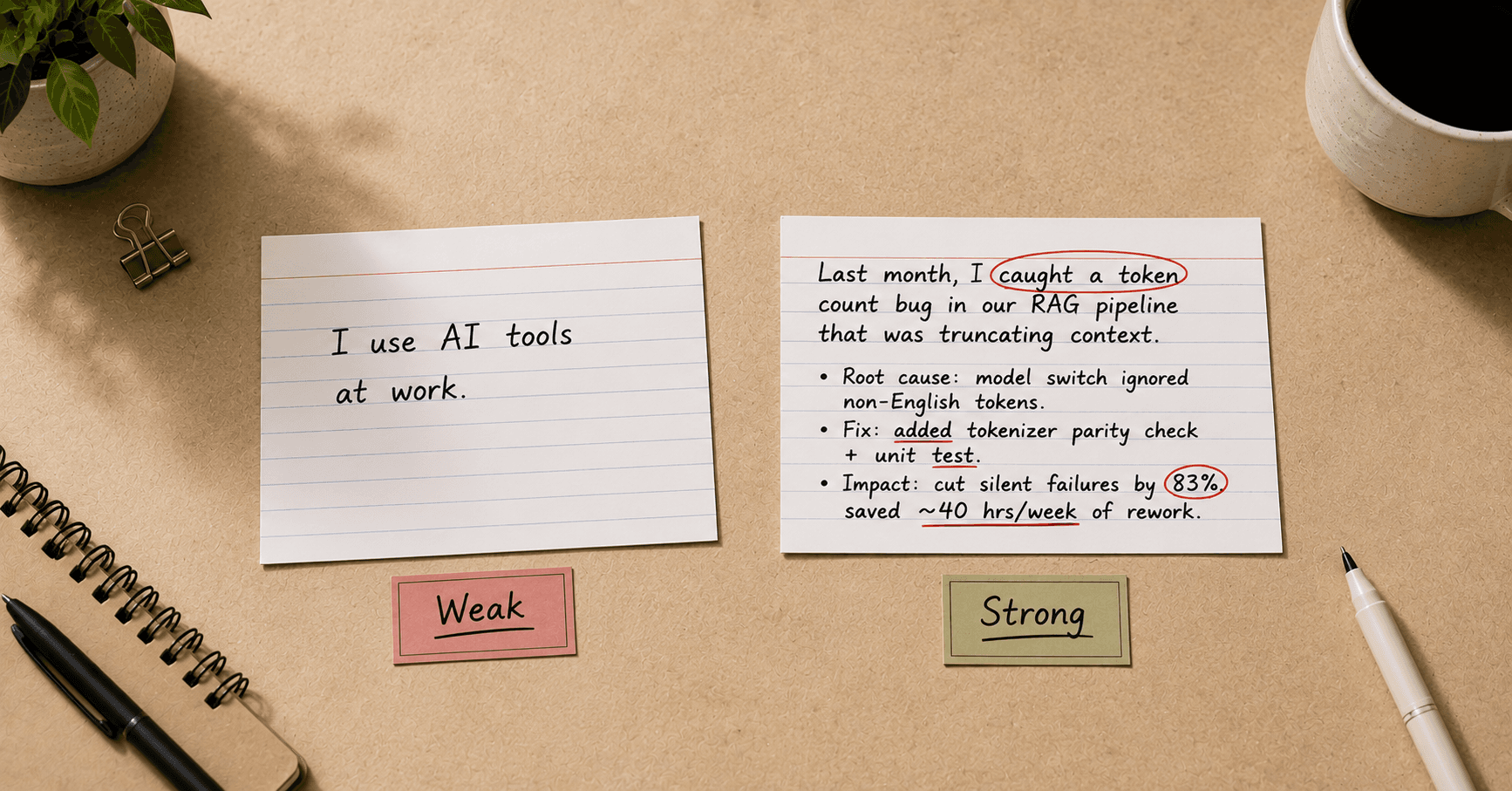
Quick answer: Show AI fluency by describing one concrete example where you used an AI tool, naming what it produced, and then explaining what you checked or corrected. That last step matters most. Interviewers ask these questions to find out whether you use AI to think more clearly, or whether you let it think for you.
The AI question sounds different in each role, but it tests the same thing: whether you treat AI output as a first draft that needs your judgment or as an answer you pass along. The weak and strong versions below show that difference for software engineers, product managers, and data analysts.
What Do Interviewers Mean by "AI Fluency"?
AI fluency in an interview is about how you think when tools produce wrong output, or when you are deciding whether to use one at all. The names of the specific tools matter less than what you do with them.
Behind most AI fluency questions is another one: "How do you know when to trust the output?" That is a judgment question. A candidate who says "I verified it against the source data" is showing something useful. A candidate who says "I asked it a few times and the answers were consistent" is showing something worrying, because getting the same answer several times does not make it right.
Treat AI fluency as a variant of critical thinking. Your answer should always include what you checked as well as what the tool did.
What Makes the Difference Between a Weak and a Strong AI Answer?
Weak answers name a tool and stop. Strong answers name a tool, describe the task, and then explain the review step. The review step (what you looked for and what you caught) is where the interviewer sees your competence.
| Element | Weak version | Strong version |
|---|---|---|
| Tool mentioned | "I use ChatGPT" | "I used Claude to draft the first-pass summary" |
| Task described | "for my work" | "on the quarterly market review for the exec team" |
| What you verified | (absent) | "I checked every company-specific figure against the 10-Q because the model produced two revenue numbers that did not match" |
| Your judgment | (absent) | "I rewrote the conclusions section entirely; the model's framing was too hedged for what the audience needed" |
| Outcome | "It saves a lot of time" | "Cut prep time from four hours to under two, with no reduction in accuracy" |
The bottom row matters less than the middle rows. Interviewers asking about AI are looking at what you do when the output is wrong.
How Do Software Engineers Answer AI Questions in an Interview?
The SWE version of this question often comes up in behavioral rounds or in the debrief after a system design exercise. Common framings: "Tell me about a time you used AI in your development workflow." Or: "How do you decide when to use a code-generation tool versus writing something from scratch?"
Weak answer: "I use GitHub Copilot constantly. It is great for boilerplate code, and I would say it saves me a couple hours a week."
That answer tells the interviewer you have accepted a suggestion a few times. It says nothing about whether you are a more careful or capable engineer for it.
Strong answer: "I use Copilot for the parts of a feature where the pattern is well-established, scaffolding and standard CRUD endpoints. I do not accept its suggestions in the auth layer without reading them carefully, because it tends to miss context specific to our token validation flow. On the last project, it generated a function that would have passed malformed tokens through. I caught it in review, rewrote it, and added a test case for that exact shape. The tool is fast and mostly right. Mostly is the part that keeps you sharp."
The difference is in the last three sentences: what got caught and what changed because of it. Those tell the interviewer this candidate pays attention.
If you do not have a story with a caught mistake, structure the answer differently: describe a task where you used an AI tool, explain what you built, and be specific about what the tool produced and what you shipped. The difference between the two shows your engineering judgment.
For more on structuring behavioral answers, Behavioral Interview Questions and the STAR Method covers the format that works here, too.
How Do Product Managers Answer AI Questions in an Interview?
PM interviewers usually approach AI in one of two ways. The first is behavioral: "Tell me about an AI-powered feature you worked on." The second is product sense: "How would you decide whether to add an AI component to this product?" The strong answer to both requires thinking about failure before talking about benefit.
Weak answer: "We added an AI-powered recommendation engine that personalized content for users. Engagement went up significantly."
That sounds good until you realize it says nothing about how you built it, what tradeoffs you made, or what happens when the recommendation is wrong.
Strong answer: "We shipped a role-based content recommendation feature. The central design question before launch was what the user sees when the model gets it wrong, because early testing showed it was confusing adjacent roles in ways that were not obvious from the outside. We added a lightweight dismiss-and-tell-us-why interaction to surface misfires. Within two weeks we had a clear signal on the two most common failure patterns, which we used to tune the ranking. Engagement went up, but what I am most proud of is that trust scores held. Users were not confused by what they were seeing."
Notice what this PM thought about: the failure mode, a way to surface it without breaking trust, and a signal to track. The engagement win is the outcome, but the interviewer is looking for the product thinking behind it.
When asked to evaluate an AI feature as a product sense question, name the experience when the AI is wrong. Many candidates describe only the success state. If you name the failure state and explain how you designed around it, your answer shows product sense instead of just describing a feature.
How Do Data Analysts Answer AI Questions in an Interview?
Analysts usually get asked about AI as a workflow-efficiency question, but the interviewer is testing data quality and critical thinking. "How do you use AI in your analysis work?" stands in for another question: do you catch errors in AI-generated output?
Weak answer: "I use ChatGPT to help me structure my analysis and write SQL queries. It has really cut down on the time I spend on repetitive tasks."
Writing SQL with an AI tool is fine. What is missing is whether the SQL ran correctly and whether the logic matched the business question.
Strong answer: "I use it for first-pass SQL and for drafting the narrative sections of reports. I treat every generated SQL query as a draft. On a revenue analysis last quarter, the model produced a join that was technically correct but grouped at the wrong granularity for what we were measuring: net revenue by region instead of by product line. I caught it by checking the output totals against our source of record before the report went out. Now I build a spot-check into every AI-assisted query: pick three rows at random and trace them back to the underlying source. It adds ten minutes and has caught two logic errors that would have shipped."
That answer gives the interviewer something concrete: what the error was, how it was caught, and what process change followed.
If you want to know what interviewers flag when AI is used during the interview itself, Is Using AI in an Interview Cheating? covers where the line falls.
What If You Have Not Used AI Tools Much at Work?
Be honest about it. Say what you have tried, what you noticed, and what you are working on. An answer that shows curiosity and one honest first attempt is stronger than a vague claim that you are familiar with AI.
Avoid saying you use AI tools unless you have an example ready. The interviewer can test it right away ("walk me through one"), and recovering from that mid-interview is awkward.
What works instead:
- A personal project where you used an AI tool to solve a real problem, even a small one
- A task you did manually that you later tried automating, and what you found
- A specific limitation you ran into and how you worked around it
One specific attempt tells the interviewer more than general enthusiasm, because they are testing how you think.
Practice helps close that gap. In PokeBot's Interview Practice, add the AI questions above under "I have my own interview questions" in a Behavioral session, and you get scored feedback on your answer's structure and specificity. Getting from "I use ChatGPT" to answers like the strong ones above is what mock practice is for: you start with the vague version, and if you turn on follow-up questions, the interviewer asks about what your answer left out (up to two follow-ups per question), so you can push it toward something concrete.
Practice your AI interview answers free, create your PokeBot account
What Do All Three Roles' Answers Have in Common?
In every role, a strong answer names a real task, describes what the AI produced, and explains the step where your own thinking took over.
The vocabulary changes from role to role, but the verification step stays. Whether you are reviewing generated code or tracing a SQL result back to its source, you are showing that you treated the tool's output as a draft and applied your judgment to it.
For the broader argument that AI raises the bar for human judgment, AI Won't Replace You, It Raises the Bar is worth reading before you go in.
Frequently Asked Questions
How do you show AI fluency in an interview?
Pick one concrete example where AI sped up or improved your work, explain what the tool produced, and then describe specifically what you checked or corrected. Interviewers want to see that you can evaluate AI output as well as generate it. A vague claim about 'using AI tools' tells them very little.
What do interviewers mean when they ask about AI skills?
Usually they are testing judgment. Knowing the tools matters less than whether you use AI to make faster, better decisions or hand your thinking over to it. The follow-up question is usually some version of: 'How did you know the output was right?'
What should a software engineer say about AI in an interview?
Describe a specific task where you used a code-generation tool, name what kind of output it produced, and then explain the review step: what you caught, what you changed, or why the suggestion did not fit your codebase. That last part shows you review what the tool gives you instead of accepting it by default.
How should a product manager talk about AI features in an interview?
Show that you think about failure modes before benefits. Name the user scenario where the AI feature gets it wrong, describe how you would surface that gracefully, and explain what signal you would track to know if users trust it. A PM who leads with 'it will improve the experience' has not thought about the failure case.
How can a data analyst demonstrate AI fluency in an interview?
Describe a specific analysis task, name the AI tool you used, and then explain how you validated the output. Did the model misclassify something? Did it produce the wrong granularity? Did you have to reframe the prompt several times to get a usable result? Any of those shows you thought critically about the output, which 'AI helps me work faster' does not.
What if I have not used AI tools much at work?
Be honest about it, and then pivot to what you have tried on your own. Even a personal project where you used an AI tool to solve a real problem counts. Pick the most substantive thing you have done, describe the result, and be clear about what you do not know yet. Interviewers tend to respond better to honesty than to false confidence.
Is it okay to say I am still learning AI tools in an interview?
Yes, if you pair it with evidence of active learning. 'I am still learning, but I have been working through X and here is what I have noticed' is a strong answer for roles that do not require deep AI expertise. Saying 'I am still learning' with nothing behind it reads as disengaged.
What is the biggest mistake candidates make when answering AI questions?
Claiming competence without showing judgment. Saying 'I use GitHub Copilot every day' tells an interviewer nothing useful. Saying 'I use it for boilerplate, but I always review the generated code because it tends to miss edge cases in our auth layer' shows the interviewer that you use a fast tool and still review its work.