
Is Using AI in a Live Interview Cheating? Where Interviewers Draw the Line
It depends on the employer and the use. What gets you disqualified, what is accepted, and why live AI coaching backfires even when nobody catches you.
Last updated: August 2026.
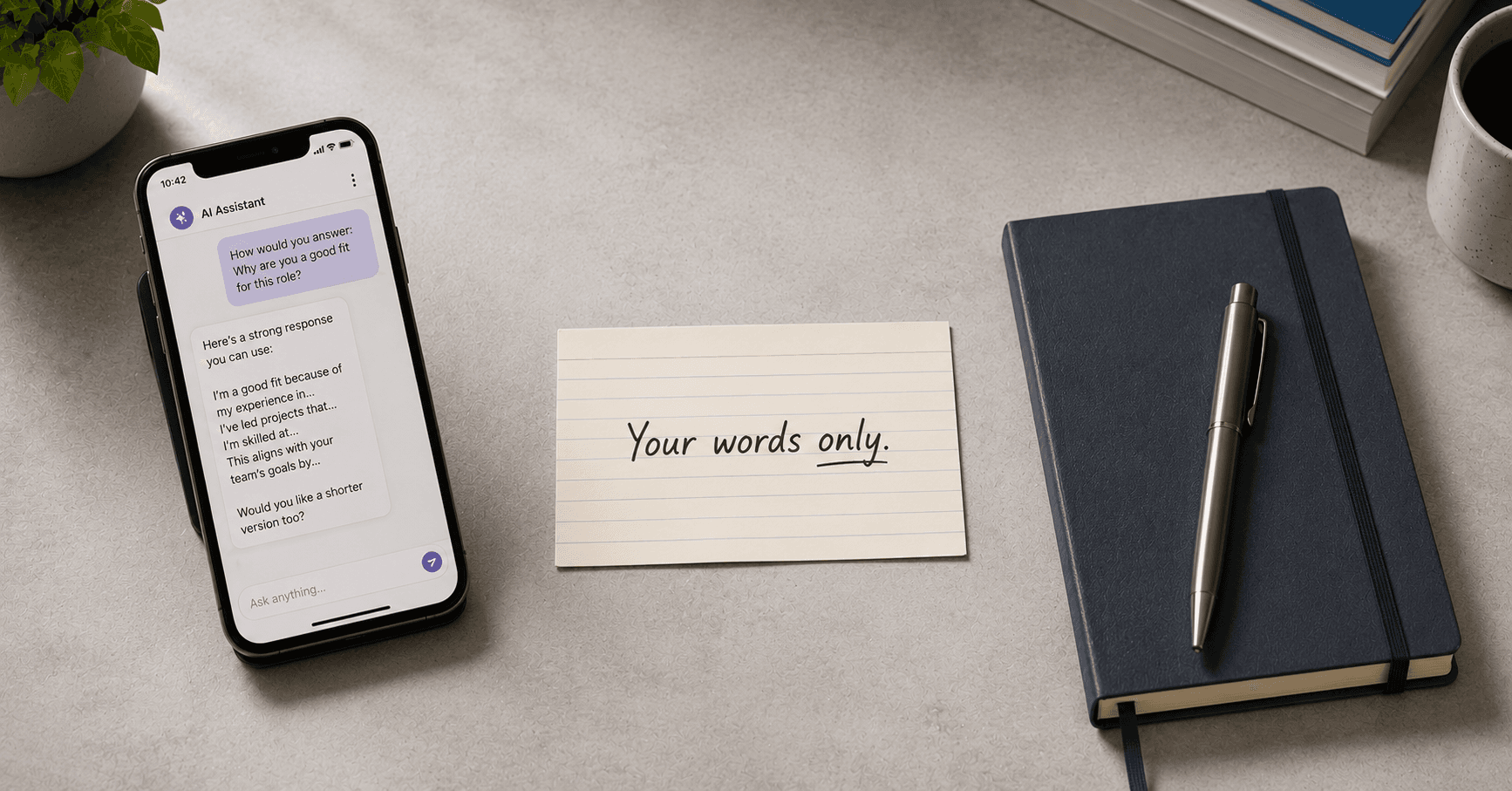
Quick answer: Using AI during a live interview is cheating when the employer hasn't authorized it. When they have, it's legitimate within the scope they define. Either way, real-time AI coaching tends to backfire. It can get you the offer, but then the job tests the skills it covered for.
Employers disagree sharply on this. Some ban all AI assistance during interviews. Others design their rounds specifically to test how well candidates use it. Many fall somewhere in between, with no formal policy and interviewers whose views vary widely.
What Counts as "Using AI" in an Interview?
The phrase covers a wide range of behavior, and treating it as one thing leads to bad decisions.
At one end: AI-powered company research, mock interview practice, and coaching on how to structure your answers. Nobody calls this cheating, and serious candidates have always done some version of it.
At the other end: a hidden window feeding you scripted answers in real time while the interviewer watches you appear to think. That's deception, and it is cheating for the same reason whether the source is an AI or a friend whispering through an earpiece.
In between sit take-home technical assessments and AI-allowed coding rounds. Some candidates also run transcription tools and disclose that they're doing so. The ethics and the practical risk of each differ substantially.
Where Do Employers Draw the Line?
The table below shows how employers typically treat different kinds of AI use, based on what they say in application materials, recruiter guidance, and candidate-facing policies. It draws on the positions employers have made public. It is not based on a survey.
| Type of use | How employers typically treat it |
|---|---|
| AI for research, mock practice, and pre-interview prep | Widely accepted |
| Reviewing your own notes before the call begins | Generally fine |
| Running a transcription tool (disclosed upfront) | Grey area; disclose proactively if you do it |
| Real-time AI feeding scripted answers (hidden) | Disqualifying at most employers |
| Using AI on a take-home assessment without disclosure | Often disqualifying when detected |
| Using AI tools in a round that explicitly authorizes them | Explicitly permitted |
| Submitting AI-generated work as your own in an assessment | Disqualifying: fraud, no ambiguity |
What ties the rows together is disclosure and authorization. When an employer defines the scope, staying inside it is legitimate. When they have given no authorization, hidden use is deception.
Some firms communicate this restriction explicitly in their application materials, stating that they want to hear from candidates in their own voice and that outside assistance is prohibited during interviews. Some finance and consulting employers are especially direct about this. At the other end, some technical employers have redesigned their interview rounds to evaluate AI-assisted reasoning, because that is how the job gets done.
Can Employers Tell?
They catch it more often than candidates expect, and in more than one way.
Some video interview platforms monitor behavioral signals, most often response pacing and off-screen attention. Some live coding environments flag AI-generated code patterns and timing anomalies. Interviewers themselves often notice when an answer sounds like polished output instead of a person working through a question. The pacing is too even, the structure is too clean, and the answer often falls apart under a follow-up question.
Detection is imperfect, but "I probably won't get caught" is still weak reasoning when the downside is immediate disqualification and possibly a flag in a recruiter's system that follows you.
If the Employer Allows AI, How Should You Approach It?
Read the instructions carefully. Authorization covers only the uses the employer named. An AI-allowed coding round does not extend to behavioral questions. An open-notes assessment does not mean running your analysis through a language model.
When AI use is permitted, treat the round as an evaluation of how you think alongside the tool. Employers who design AI-integrated rounds are grading your judgment: what to prompt, how to assess the output, what to revise before submitting. They care more about the reasoning behind your choices than about the output those choices produced.
Why Does Live AI Coaching Fail Even When Nobody Catches You?
Set ethics aside for a moment. The practical problem with relying on AI in a live interview is that you still have to do the job afterward.
Onboarding and day-to-day work show whether your interview answers matched what you can do. Candidates who misrepresent their depth tend to have rough early months, and the people evaluating their first 90 days are often the same people who interviewed them, so they notice the gap.
A better use of AI is to prepare with it before the interview. That's what AI-powered mock interview practice is for: behavioral and technical rounds at whatever depth you need, structured feedback, and enough repetition that your answers come from your own thinking. For behavioral questions, build a bank of stories with the STAR method before the interview, so you can draw on them instead of improvising under pressure.
Frequently Asked Questions
Is using AI in a live interview cheating?
It depends on what you're doing and what the employer's rules say. Using AI covertly to feed yourself scripted answers in real time is disqualifying at most employers. Using AI tools in a round that explicitly permits them is legitimate. What decides it is disclosure and whether the employer authorized that specific use.
Can employers tell if you're using AI during an interview?
Increasingly, yes. Some video interview platforms monitor behavioral signals like response pacing and off-screen attention, and some live coding environments flag AI-generated patterns and timing irregularities. Interviewers themselves often notice when answers sound too polished and then fall apart under follow-up questions.
Do any companies allow AI use during interviews?
Yes. Some employers now explicitly permit or require AI tools in technical rounds, because they treat the ability to reason alongside AI as a core skill to evaluate. Those employers define the scope. Using AI beyond what they authorized still violates their rules.
Is using AI to prepare for an interview cheating?
No. Using AI for practice, research, mock interviews, and refining how you frame your experience is preparation. Employers draw the line at the live interview itself. How seriously you prepare beforehand is up to you.
What happens if you get caught using AI in an interview?
Many employers disqualify the candidate on the spot. Some also flag the candidate in their internal recruiting systems. In industries with formal conduct expectations, the incident can follow a candidate's reputation across hiring networks.
Why is covert AI coaching a bad strategy even when you don't get caught?
Because you still have to do the job, however you got it. Onboarding and daily work quickly show whether your interview answers matched what you can do. If you overstated your depth, the gap shows up fast, and the people judging your early performance are often the same people who interviewed you.
What is the best way to use AI for interview prep without relying on it during the interview?
Use AI to run realistic mock interview rounds again and again until your answers come from your own preparation, so there is nothing left to prompt for during the interview. The practice is there to build the skill in you. PokeBot's mock interview modes are designed for this: structured practice that builds your ability through repetition and feedback.
How should I handle an interview round that explicitly allows AI?
Read the instructions carefully and use only what they authorize. Treat the round as an evaluation of how you think alongside the tool. The judgment behind your prompts and the quality of your reasoning matter as much as the output you produce.