
Case Interview Practice Without a Partner: Drills That Replace a Casing Buddy
No casing partner? Most of what a partner does can be drilled alone. Solo drills for structure, math, exhibits, and synthesis, plus a weekly practice loop.
Last updated: November 2026.
Quick answer: You can practice most of a case interview without a partner. Structure and case math need only a timer, and exhibit reading and the final recommendation need a voice recorder. What solo work can't copy is an interviewer who pushes back, so pair the drills with an interactive mock: an AI case tool or a few live cases.
Waiting for a casing partner is an easy way to lose weeks of prep. Schedules don't line up, and when they do, the partner may spend half the session reading the prompt badly. Meanwhile the skills that decide a case sit untrained, and nearly all of them can be practiced alone tonight.
What Does a Casing Partner Actually Do for You?
Break the partner's job into pieces and the problem gets smaller. A good partner does four separate things:
- Holds information back so you have to ask for it.
- Hands you exhibits and data when you ask the right question.
- Pushes back on your structure and your conclusion.
- Tells you what went wrong afterward.
Only one of those needs another mind in the room. Holding information back can be done with a sheet of paper over the casebook. Exhibits can come from anywhere. Feedback can come from comparing your recording against a sample answer. Pushback in real time is the hard one, and it's the only piece worth spending your scarce partner time on.
| What a partner does | Solo replacement | How close it gets |
|---|---|---|
| Holds back case information | Cover the casebook page, reveal one section at a time | Close |
| Provides exhibits | Charts from annual reports, earnings slides, news articles | Close |
| Times your math | Phone timer and a daily drill set | Close |
| Gives feedback | Record yourself, then compare to the sample answer | Partial: you miss what you can't hear |
| Pushes back live | An AI case interviewer, or a live partner | Needs something interactive |
Which Case Interview Drills Can You Run Alone?
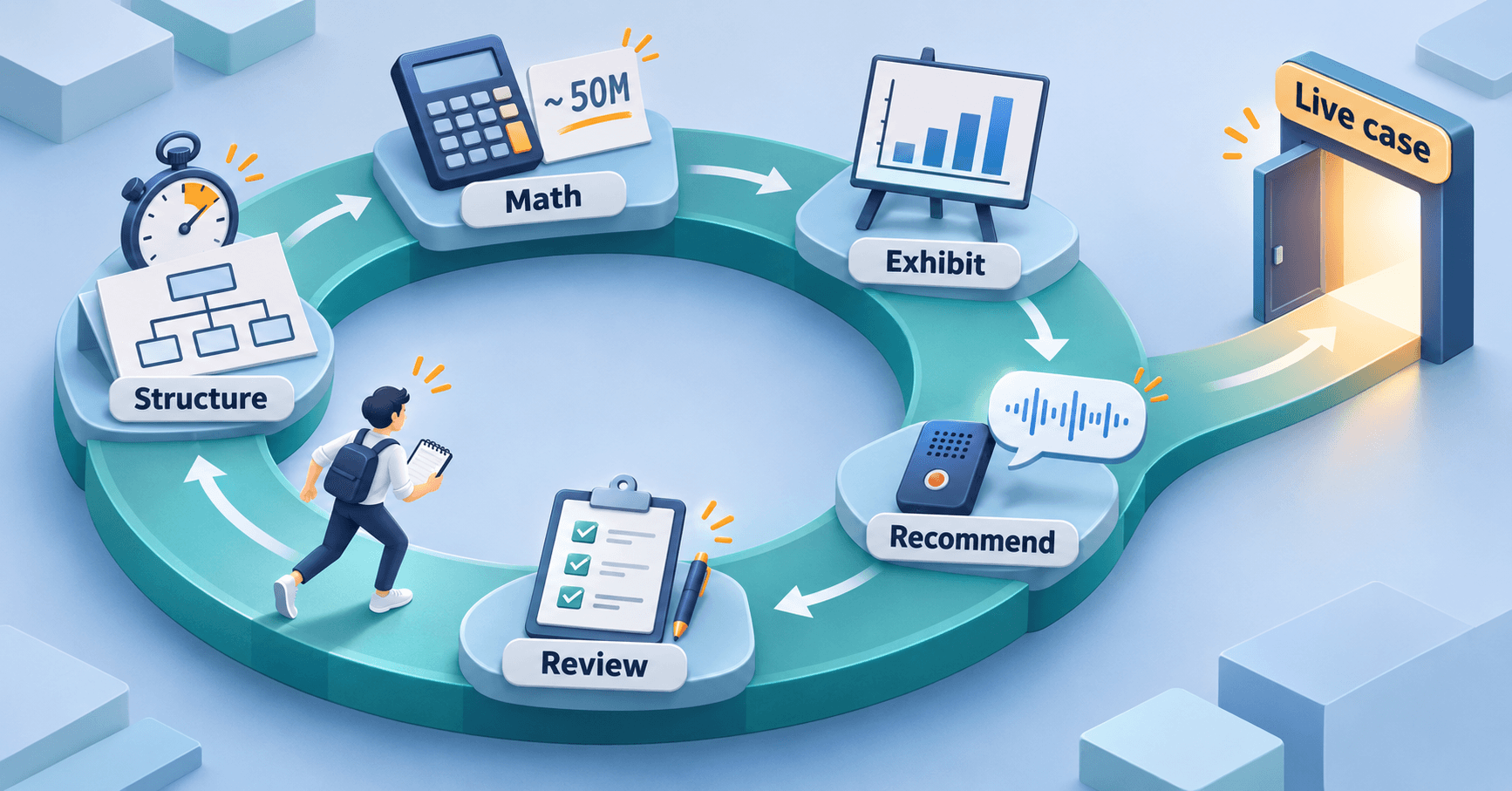
These four drills cover the skills a case leans on hardest. Each takes 10 to 20 minutes, so you can do one on a weekday without blocking out an evening.
Structure sprints
Take a one-line prompt ("A regional gym chain's profits fell this year. Why?") and give yourself one minute to draw a structure on paper. Then explain it out loud in under a minute, as if to an interviewer.
Pull prompts from casebooks, or turn business headlines into prompts. Afterward, check two things. Do any of your branches overlap? Would each branch lead to a question you could answer with data? A branch labeled "external factors" fails the second test. "Did new competitors open within driving distance?" passes it.
Do five of these in a row. By the fourth, you'll notice yourself reaching for the same generic buckets, and that's the habit to break.
Case math under a clock
Case math comes from a narrow set of calculations. Drill exactly these:
- Percentages and growth rates
- Margins and break-even
- Multiplying and dividing big round numbers
A typical prompt: "A product sells for $40 with a variable cost of $25. Fixed costs are $3 million. How many units to break even?" Margin is $15 per unit, so the answer is 200,000 units.
Two rules make this drill transfer to the real interview:
- Say every step out loud. Bain's own case interview prep page tells candidates to think aloud, including their calculations. If you only practice silently, the first time you narrate math will be in front of an interviewer.
- Write units and zeros every time. A dropped zero turns a $3 million answer into $300,000, and an interviewer will remember it. Clean notation costs a few seconds and saves the whole case.
A few minutes daily does more than a long weekly session, because what you're building is reflex.
Exhibit reads
Open any company's investor presentation or a chart from a business news article. Give yourself 30 seconds, then say one sentence that starts with "So what this tells me is..." and one sentence about what you'd ask next.
Most candidates describe the chart ("revenue went up in the Northeast"). The interviewer wants the implication ("the Northeast grew while every other region shrank, so I'd want to know what's different about that market"). Practicing on real, messy charts beats practicing only on clean casebook exhibits.
Recorded synthesis
At the end of every practice case, record a 60-second recommendation on your phone: the answer first, then two supporting reasons, then the main risk and a next step. Play it back once.
You'll hear things you never notice live:
- Opening with a recap of the case instead of the answer
- A string of "um"s while you search for the recommendation
- Ending on analysis, with no clear call
This is the cheapest feedback loop available, and most candidates skip it because listening to yourself is uncomfortable.
How Do You Run a Full Case Without Someone Reading It to You?
Use a casebook, and make yourself work at the casebook's pace instead of skimming it. Business school consulting clubs publish casebooks with full sample cases, and firms post official ones too. Bain's case interview page, for example, offered Coffee Shop Co. and FashionCo. when we checked in November 2026.
The method:
- Read only the prompt. Cover everything below it.
- Write your clarifying questions and your structure before you look further.
- Reveal the next section only after you've said out loud what you would ask for next.
- When an exhibit appears, do your exhibit read before reading the case's interpretation.
- Do the math on paper, out loud, before checking the answer.
- Record your final recommendation.
- Compare your structure and your recommendation against the sample answer, and write down the one biggest gap.
Step 7 does most of the work. If you skip the review, you've practiced the case without learning from it.
One warning: casebook answers vary in quality, and some sample structures are clumsy. If your structure differs from the book's and you can defend every branch, keep yours.
What Does a Weekly Solo Practice Loop Look Like?
Here's a week that fits around a job or classes:
| Day | Drill | Time |
|---|---|---|
| Monday | Structure sprints (five prompts) + math set | 25 min |
| Tuesday | One full casebook case, covered-page method | 45 min |
| Wednesday | Exhibit reads (five charts) + math set | 20 min |
| Thursday | One interactive mock (AI case tool or live partner) | 45 min |
| Friday | Review: replay recordings, list repeated mistakes | 20 min |
| Weekend | One more full case, aimed at your worst area | 45 min |
The Friday review turns the week into a loop. Keep a running list of mistakes you repeat ("jumped into math before stating what the number would tell me") and pick next week's drills from that list. If your math is clean and your structures are weak, stop doing math sets for a week.
For ideas on keeping a short daily practice habit going, see the daily career growth habit.
Where Does Solo Practice Fall Short?
Interruptions are the gap. In a live case, an interviewer cuts in halfway through your structure to ask why you skipped costs, or hands you a number that breaks your hypothesis. If you've only practiced alone, those moments throw you off, because nothing in your drills ever disagreed with you.
That's also why some screening formats feel strange. Several prep guides describe BCG's Casey, a chatbot-run online case used in some offices, as fully interviewer-led, with the chatbot driving each step. If all your practice has been free-form, a format that sets the order of every question can catch you off guard.
Two ways to cover the gap:
- An interactive AI case. It responds to what you actually say, hands over exhibits when you ask, and questions your reasoning. You can run one whenever you like, which a partner can't offer.
- A few live cases before your final round. If you can line up a partner even twice, save those sessions for full cases. Don't spend them on math drills you could do alone.
If you're weighing paid help for that last stretch, what interview coaching costs breaks down when a human coach is worth paying for.
How Does PokeBot's Case Interview Mode Fit In?
In the PokeBot app, Case Interview sits in the Mock Interview room. It runs a full consulting-style case. You clarify the prompt and lay out a structure, and exhibits come when you ask for them. Then you run the numbers and give a recommendation, while the interviewer questions your reasoning along the way. The session is scored against the case's answer key, so you see which part of the case went wrong.
Use it as the Thursday slot in the loop above. The solo drills build the skills, and the Case Interview session checks whether they hold up when something is pushing back. Case types include Pricing and Market Sizing, so you can aim a session at whichever area your Friday review flagged. For how the other practice formats work, see how PokeBot mock interviews work.
A case interview only happens once your resume gets you on the list, so check that first against the consulting roles you're targeting.
Frequently Asked Questions
Can you practice case interviews without a partner?
Yes, for most of the skills a case tests. Structuring and case math can be drilled alone with a timer, and exhibit reading and the final recommendation with a voice recorder. The one thing solo drills can't fully copy is an interviewer who reacts to what you say and pushes back, so add an interactive mock, either an AI case tool or a live partner, for that part.
How do I practice a casebook case alone?
Read only the prompt, then cover the rest of the page. Write your clarifying questions and your structure before you uncover anything. Reveal one section at a time, and commit to your next step out loud before you read what the sample answer did. Comparing your structure to the book's afterward is where most of the learning happens.
How do I get faster at case math?
Drill the specific calculations cases use, mainly percentages and break-even, plus multiplying large round numbers. Do short timed sets daily, say each step out loud as you would in an interview, and write numbers with units and zeros clearly. Speed comes from repetition on the same kinds of problems, so a few minutes every day beats one long session a week.
What is the best way to practice structuring a case?
Run structure sprints: take a one-line business prompt, give yourself about a minute to draw a structure, then explain it out loud in under a minute. Pull prompts from casebooks or from business news headlines. Check that your branches don't overlap and that each one would lead to a question you could actually answer with data.
Is an AI case interview tool a good substitute for a casing partner?
It covers the part solo drills can't: an interviewer who hands you data when you ask for it and questions your reasoning. PokeBot's Case Interview mode runs a full consulting-style case with exhibits, pushes back on your answers, and scores you against the case's answer key. Before a final round, it's still worth doing a few live cases with a person as well.
How many practice cases do I need before a consulting interview?
There's no reliable number, and counting cases can mislead you. Twenty cases where you reviewed every mistake will teach you more than fifty you rushed through. Track the parts that keep going wrong, such as math errors or weak synthesis, and keep practicing until those stop showing up.