
Data Science Interview Topics in 2026: Classic Stats vs GenAI
DS interviews in 2026 split into two tracks: classic statistics and GenAI engineering. Here's the topic map, a company-type breakdown, and how to prep for both.
Last updated: October 2026.
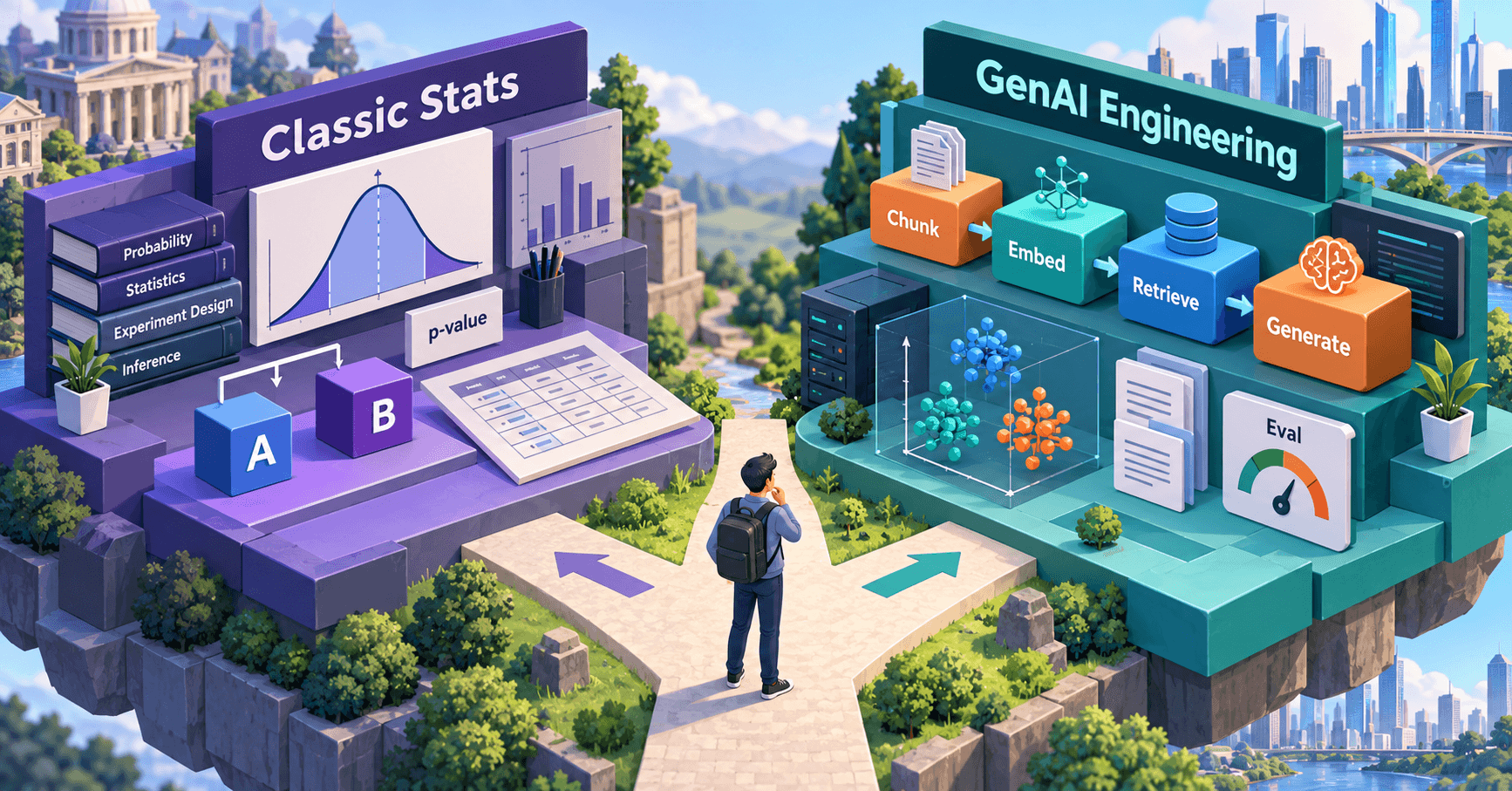
Quick answer: Data science interviews in 2026 test two parallel tracks. The classic track covers SQL, Python, statistics, and ML model design. The GenAI track covers transformer fundamentals, embeddings, RAG pipelines, fine-tuning trade-offs, and LLM evals. Finance firms and product analytics roles weight the classic track heavily. Companies building AI products add the GenAI track, especially for senior and ML-forward roles. If you don't know which track your target company weights, it's easy to spread your prep too thin.
The interview content has shifted, but not evenly. A statistics-first finance firm and a GenAI-forward tech startup will weight very different subjects. Most prep guides hedge by covering everything, which doesn't help much if your interview is in three weeks.
What Are the Two Tracks in a 2026 DS Interview?
Think of them as two skill sets that coexist, with different companies weighting them differently.
Track 1: Classic data science. This has been stable for years: SQL and Python fluency, probability and statistics, A/B testing and experiment design, and ML model selection and evaluation. These skills are tested at nearly every company.
Track 2: GenAI engineering. For roles at companies actively building AI products, interviewers also test: how LLMs are trained at a conceptual level, what embeddings are and how vector search works, how to design a RAG pipeline, when to fine-tune instead, and how to evaluate an LLM feature in production. A 2026 data scientist interview guide from KORE1 notes that LLM and MLOps questions now appear regularly in senior loops, and TechInterview calls choosing between RAG, fine-tuning and prompting one of the most-asked AI/ML interview questions of 2026.
The tracks are not mutually exclusive. A senior DS role at a tech company will test both.
What Does the Classic Stats Track Cover?
This is the part most candidates prep for. It is still the majority of the interview at many companies.
Hypothesis testing and A/B testing draw the most questions, and the questions tend to be practical rather than definitional. Knowing what a p-value is gets you through the screen. Knowing how to design a test, set guardrail metrics, handle unbalanced traffic, and correct for multiple comparisons gets you through the final rounds.
A/B testing questions almost always extend into edge cases. What do you do when you're running 40 tests simultaneously? How long do you run a test before calling it? What happens when your primary metric improves but a guardrail metric degrades? Those edge cases are where candidates who prepped only the mechanics fall short.
Probability and distributions show up at every level. The depth scales with seniority: early-career questions test distributions, expected value, and basic combinatorics; senior questions test experimental power calculations, Bayesian inference, and causal identification.
ML model design covers model selection, bias-variance trade-offs, regularization, cross-validation, and evaluation metrics. These are applied: given a business problem and dataset, which approach makes sense and why? A good answer weighs the trade-offs instead of naming the most sophisticated option.
SQL and Python remain a baseline expectation everywhere. Some companies use SQL as a filtering round that happens before any modeling conversation. Getting screened out on window functions before you reach the statistics discussion is an avoidable way to lose the loop.
What Does the GenAI Engineering Track Cover?
For roles at companies building with LLMs, a second set of topics has appeared. For most roles, they sit on top of classical statistics rather than replacing it.
LLM fundamentals. You should be able to explain how a transformer processes input, what embeddings represent, and why cosine similarity is used to find similar content. Interviewers want conceptual understanding; you don't need to memorize architectures.
RAG pipelines. A typical senior interview question asks you to design or critique a retrieval-augmented generation system. The standard pipeline runs: chunk documents, generate embeddings for each chunk, index the vectors, retrieve the nearest neighbors for a query, optionally rerank them, then pass the retrieved context to the model. Interviewers follow up on failure modes: what breaks when the chunks are too large or too small, how you handle access control so users cannot retrieve content they shouldn't see, when this approach fails and fine-tuning would work better instead.
Fine-tuning approaches. You do not need to have fine-tuned a model in production, but you should be able to explain when it makes sense to fine-tune instead of using RAG, and what parameter-efficient fine-tuning methods (like LoRA) offer over full fine-tuning.
Evals. How do you judge whether an LLM feature works? Common evaluation approaches include labeled reference sets, LLM-as-judge (using a stronger model to grade outputs against a rubric), and task-specific benchmarks. Interviewers ask candidates to design an eval suite for a new feature, explain what makes a judge prompt unreliable, and detect when a deployed model drifts.
MLOps and model drift. For senior roles, you should be able to walk through how you would diagnose a degradation in model performance: did the input distribution shift, did the feature pipeline break, or did data quality degrade upstream?
How Do DS Interview Topics Vary by Company Type?
| Company type | Topic weight | Typical format | Key differentiator |
|---|---|---|---|
| Big Tech | Metrics, experimentation, scalable ML, GenAI system design at senior levels | Recruiter screen, then a multi-round onsite | Behavioral round tied to company principles |
| Finance / Fintech | Classical stats, probability, risk modeling, A/B testing rigor | Screens, then a multi-round loop, often with a take-home | Statistical precision over applied judgment |
| Startup | Applied judgment, end-to-end ownership, business framing | Short loop, often built around a take-home | Take-home is often central to the decision |
| Research lab | ML depth, research reasoning, domain knowledge | Varies widely | Technical depth over breadth |
Finance interviews, especially at banks and quantitative firms, weight statistics heavily. A/B testing questions focus on methodological rigor rather than product framing. Risk modeling and causal inference appear in ways that differ from tech-product roles. Treat the finance DS track as close to quant interview preparation in its emphasis on statistical correctness.
Startup loops are often the least predictable. The take-home case tends to carry the most weight, and strong candidates frame their solutions around business impact rather than algorithmic sophistication.
Which Track Should You Prep First?
Prep the track your target company emphasizes. Look at the job description: does it mention LLMs, RAG, or evals? Or does it emphasize experimentation, metrics, and statistical modeling? That tells you more than any general guide.
If you are targeting Big Tech, both tracks matter. Classical statistics and metrics remain the core of the analytics and experimentation rounds; GenAI system design appears in technical and design rounds for senior roles. Do not skip either.
If you are targeting finance, go deep on classical statistics and probability. GenAI topics come up much less often here, unless the role sits on an AI product team.
For SQL and Python: these are never optional. Build fluency with window functions, CTEs, and pandas data manipulation before the interview loop starts.
How Do You Practice Both Tracks?
The classical statistics track responds well to deliberate case practice: pick an A/B testing scenario with an edge case (low power, multiple comparisons, conflicting metrics) and work through it out loud. Behavioral interview prep with the STAR framework helps for the rounds that test how you communicate decisions.
The GenAI track is harder to practice with flashcards. The questions are applied: design a pipeline, critique an eval setup, debug a drift scenario. Practice them in mock technical interviews where you explain your reasoning out loud and get pushed on trade-offs. In PokeBot's Interview Practice, you can run Technical and DS Project Deep-dive sessions out loud and get scored feedback, with optional follow-up questions that push on what your answer left out.
Where Should You Start If You Have Three Weeks?
Three weeks is enough to cover the essentials if you are focused. Week one: SQL fluency and Python data manipulation, plus hypothesis testing mechanics. Week two: A/B testing edge cases, ML model selection, and LLM fundamentals. Week three: RAG pipeline design, evals, and mock interviews that force you to apply everything under time pressure.
Aim to reason through an applied problem in any of these areas out loud, without backtracking. That takes practice as well as reading.
Treat the three-week schedule above as your starting point, and adjust the time on each area based on what your target company emphasizes.
Frequently Asked Questions
What do data science interviews actually test in 2026?
Most DS interviews test a classic track with three layers: SQL and Python fundamentals (these rarely disappear), classical statistics (hypothesis testing, A/B testing, probability), and model design (selecting and evaluating ML models for a business problem). At companies building GenAI products, a second track has appeared: LLM fundamentals (RAG pipelines, embeddings, fine-tuning approaches, and evals). Which layers receive the most weight depends heavily on the company type and the specific role.
Do I need to know GenAI topics for a data science interview?
If the role is at a company actively building AI products, yes. RAG vs. fine-tuning trade-offs, how embeddings work, and how to evaluate LLM outputs are now regularly tested in senior loops at technology companies, according to 2026 interview guides from KORE1 and TechInterview. If the role is at a finance firm or in a classical analytics function, classical statistics and experiment design still dominate and GenAI topics may not appear at all.
What statistics topics come up in data science interviews?
Hypothesis testing (including p-values, Type I and Type II errors, and statistical power), A/B testing and experiment design (sample size, test duration, multiple comparisons corrections), probability distributions, confidence intervals, and causal inference. For finance and product analytics roles, A/B testing questions often include tricky edge cases: what happens when you run dozens of tests simultaneously, or when traffic is unbalanced.
What is RAG and why does it appear in DS interviews?
RAG (Retrieval-Augmented Generation) is an architecture for grounding LLM outputs in a specific document set. The standard pipeline runs: chunk documents, embed each chunk, index the vectors, retrieve the nearest neighbors for a query, optionally rerank them, then pass the retrieved context to the model with the query. DS interviews at GenAI-forward companies ask candidates to design or critique this pipeline, compare it to fine-tuning, and explain where it fails.
How do DS interview topics differ between tech companies and finance firms?
Big Tech and tech-adjacent companies lean heavily on metrics and experimentation (defining success metrics, diagnosing metric regressions, designing scalable A/B tests) and increasingly add GenAI system design to senior loops. Finance firms (banks, hedge funds, fintech) emphasize classical statistics, probability, and risk modeling; A/B testing questions tend to focus on statistical rigor rather than product impact. Startups usually have shorter loops and weight applied judgment heavily, often via a take-home.
How do I prep for A/B testing interview questions?
Start with the mechanics (t-tests, p-values, power calculations, sample size formulas). Then practice the edge cases that tend to separate candidates: multiple comparison corrections when running many tests in parallel, what to do when the treatment group converts faster but also churns faster, and how to set guardrail metrics that must not degrade. Strong answers tie the experiment to a specific business decision as well as to the statistical result.
What is an LLM eval and why do DS interviews ask about it?
An eval is a method for judging whether an LLM feature works correctly, before launch and after it. Common approaches include reference-based metrics (comparing outputs against a labeled set), LLM-as-judge (using a stronger model to grade outputs against a rubric), and task-specific benchmarks. DS candidates are increasingly asked how they would design an eval suite for a new feature, what makes a good judge prompt, and how to detect when a model drifts after deployment.
Is SQL still tested in data science interviews in 2026?
Yes. SQL fluency (joins, window functions, aggregations, CTEs) remains a baseline expectation at virtually every company type. Some interviews use SQL as a screening round that comes before anything else. Even at companies focused on GenAI, the ability to query a database efficiently is assumed. Getting eliminated on SQL when you have strong modeling or stats skills is an avoidable outcome.