
The 20 Quant Interview Questions That Keep Appearing
The 20 quant interview questions that show up repeatedly, from probability puzzles to put-call parity, organized by type, with how to practice them.
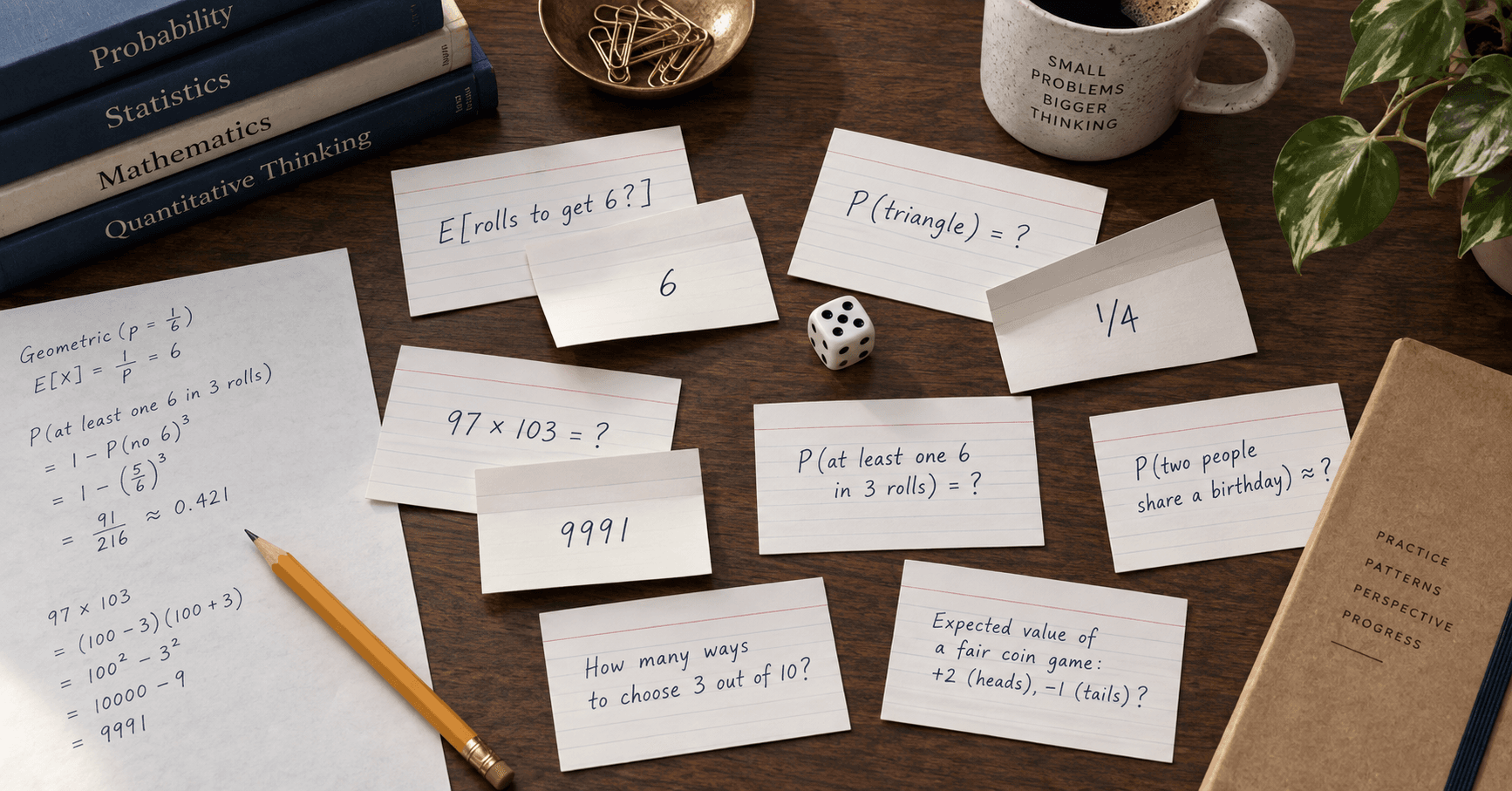
Last updated: October 2026.
Quick answer: Probability dominates quant interview questions. Expected value and mental math come next, with derivatives basics rounding out most loops. Master the core reasoning techniques and you will recognize the setup of almost every question on this list before the interviewer finishes asking.
Quant interviews have a reputation for being impossible. That reputation comes mostly from candidates who studied only the exotic questions from old forums, the ones tricky enough to be worth posting about, and skipped the 20 that appear at nearly every firm.
Most first-round screens test whether you can reason clearly under mild time pressure. The math rarely goes beyond undergraduate probability. What trips people up is the silence problem: interviewers want to follow your thinking, and a verbal almost-correct answer is worth more than a quiet right one.
What Categories of Questions Will You Actually See?
Quant firms vary in style, but the questions that surface repeatedly in publicly shared candidate accounts cluster into four types:
| Category | What It Tests | Typical Difficulty |
|---|---|---|
| Probability and combinatorics | Geometric distribution, conditional expectation, Bayes | Moderate to hard |
| Expected value and optimization | Linearity of expectation, stopping rules, game theory | Moderate |
| Mental math | Arithmetic shortcuts, estimation, counting arguments | Easy to moderate |
| Finance and derivatives | Put-call parity, Greeks, no-arbitrage arguments | Moderate |
Quantitative research and data science roles often add a Python or statistics coding screen as a separate round. For what firms actually grade in a coding interview, see the AI-allowed coding interview guide.
Which 20 Questions Keep Showing Up?
These questions come from publicly shared interview accounts across the industry. None are attributed to specific firms: the same problems circulate widely, and interviewers swap parameters on the fly anyway.
| # | Question | Category |
|---|---|---|
| 1 | Roll a fair die until you get a 6. What is the expected number of rolls? | Probability |
| 2 | Two players alternate flipping a fair coin. First to flip heads wins. What is the probability the first player wins? | Probability |
| 3 | Flip a fair coin until you see two consecutive heads. What is the expected number of flips? | Probability |
| 4 | Break a stick at two uniformly random points. What is the probability the three pieces form a triangle? | Probability |
| 5 | Place three points uniformly at random on a circle. What is the probability all three lie in some semicircle? | Probability |
| 6 | Toss a fair coin 10 times and see exactly 3 heads. What is the probability the 10th toss was heads? | Probability |
| 7 | Roll two fair dice. Given the sum exceeds 7, what is the probability the sum is exactly 9? | Probability |
| 8 | Toss a fair coin until one side appears twice in a row. What is the probability it stops on heads? | Probability |
| 9 | Roll a die; you are paid the face value. After seeing the result, you may pay $0.50 to replace it with one new roll. What is the optimal strategy and expected value? | Expected value |
| 10 | Flip a fair coin until tails. You earn $2ⁿ for n heads before the first tails. How much should you pay to play? | Expected value |
| 11 | Roll a fair die up to three times. After each roll you may keep the current value or continue. What is the optimal stopping rule and expected payoff? | Expected value |
| 12 | A game pays $n² when a fair die shows n. What is the expected payout? | Expected value |
| 13 | What is 97 × 103 without a calculator? | Mental math |
| 14 | How many arrangements of a 52-card deck have both the top and bottom cards as aces? | Combinatorics |
| 15 | In how many ways can 8 people sit around a round table? | Combinatorics |
| 16 | Explain put-call parity. Prove it without calculus. | Finance |
| 17 | What is the delta of an at-the-money European call option? Give the value and the intuition. | Finance |
| 18 | A stock follows geometric Brownian motion with drift μ and volatility σ. What does the log-return over one year look like? | Finance |
| 19 | You are market-making a fair coin flip and a customer wants to bet $100 on heads. What is a reasonable bid/ask spread, and why? | Finance |
| 20 | What is the price of a forward contract on a non-dividend-paying stock with current price S, strike K, maturity T, and risk-free rate r? | Finance |
How Should You Practice After This?
The 20 questions above split into two types of preparation. The finance questions (16–20) are largely learned: study the standard derivations, understand why they hold, and you can reconstruct them under pressure. The probability and expected-value questions (1–12) are different. Memorizing specific answers is the wrong preparation, because interviewers routinely swap parameters: they change the die to a coin, add a third player, or adjust the cost. Internalizing the techniques is what lets you handle variants on the spot.
For probability: the recursive structure in questions 1, 2, 3, and 11 is the same logic applied to different setups, so get that pattern in your hands. The geometric-argument approach in questions 4 and 5 handles continuous sample spaces. Questions 6 and 7 test conditional probability; make sure Bayes' theorem is automatic. Question 8 rewards spotting the symmetry before you write any algebra.
Mental math: drill under time pressure. In a live round, say what you are doing before you do it.
Behavioral rounds are real at quant firms. The STAR framework for structuring those answers is in behavioral interview questions and the STAR method, and how AI practice tools are changing the way candidates prepare is covered in how AI is changing interview prep.
Once you have worked through this list on paper, the next step is drilling under timed conditions until the setups feel immediate.
Practice quant interview questions on PokeBot's Quant Interview Workbook →
Frequently Asked Questions
What types of questions come up in quant interviews?
Probability and combinatorics dominate. Expected value and optimization problems come next, then mental math, then derivatives and market-making basics. A small number of canonical questions appear at firm after firm. Knowing those setups well beats wide but shallow coverage.
How hard are quant interview questions?
The probability problems range from geometric-distribution questions any statistics student can handle to genuinely tricky conditional expectation and optimal-stopping problems. The math rarely exceeds undergraduate probability or calculus. What separates strong candidates is speed and verbal clarity, not exotic formulas.
What is the expected number of rolls to get a 6?
Six. A fair die has probability 1/6 of showing 6 on any given roll. The expected number of trials for the first success is 1/p = 6. You can also derive it recursively: let E be the expected rolls. Then E = 1 + (5/6)E, which gives E = 6.
What is the probability that three random pieces of a stick form a triangle?
1/4. Break a unit stick at two uniformly random points. The three pieces satisfy the triangle inequality exactly when each piece is shorter than 1/2, because the total is 1 and no single piece can exceed the sum of the other two. That event has probability 1/4.
What is put-call parity?
Put-call parity says C minus P equals S minus the present value of K, where C and P are the prices of a European call and put with the same strike K and expiry, and S is the current price of a stock that pays no dividends before expiry. Two portfolios that pay identically at expiry must cost the same today, and that no-arbitrage constraint gives you the equation.
What is the optimal strategy for the die-reroll problem?
If you see the first roll and may then pay $0.50 to replace it with one new roll, keep the initial roll if it is 4, 5, or 6, because those values exceed the reroll's net expected value of $3.00. The expected value of optimal play is $4.00.
Do quant firms ask behavioral interview questions?
More than most candidates expect. Technical screens filter first, but behavioral rounds carry real weight at most quant firms. Intellectual curiosity, composure under pressure, and honest reasoning about mistakes matter. A strong technical performance with weak behavioral answers is often not enough.
How should I prepare for the probability section of a quant interview?
Master the core techniques before drilling: geometric distribution, recursive expectation, Bayes' theorem, symmetry arguments, and basic counting. Technique beats memorization because interviewers routinely modify problems on the fly. PokeBot's Quant Interview Workbook has 56 current-style questions, each with a step-by-step worked solution, if you want structured reps.