
'What's Your Greatest Weakness?' Answers That Don't Backfire
The honest-weakness formula interviewers look for, with strong and weak examples across four categories and the scoring logic behind each.
Last updated: July 2026.
Quick answer: Name a real weakness that won't disqualify you from the role. Show you've recognized it through a specific situation, describe what you're actively doing to improve it, and give one piece of evidence that it's working. The rest of this guide covers how to choose the right weakness and deliver the answer well.
Many interviewers treat the question as a structured test with a clear rubric. Once you know what's on that rubric, the answer is much easier to plan.
What Is This Question Testing?
Interviewers ask this question to find out if you have two things: self-awareness and a growth orientation.
Self-awareness means you can name an honest gap between where you are and where you should be. A strength dressed up as a weakness doesn't count. Growth orientation means you're doing something about the gap as well as admitting it. Interviewers read those two qualities as a sign of how you'll handle feedback on the job, which is why the question comes up in so many behavioral rounds, across levels and industries.
Organizational psychologist Tasha Eurich found in her research on self-awareness that 95% of people believe they are self-aware, while only 10 to 15% actually are by external measures (published in Insight, Crown Business, 2017, and summarized in HBR, January 2018). This question exposes that gap quickly, which is one reason interviewers keep asking it even though candidates hate it.
A candid answer works in your favor. Saying "I tend to over-explain in writing, so I've been practicing tighter editing by cutting the first two sentences from every draft" tells an interviewer far more about your judgment than a polished answer that names no real flaw.
Which Answers Never Work?
Before the formula, here are the most common ways people get this question wrong:
| Answer type | Why it backfires |
|---|---|
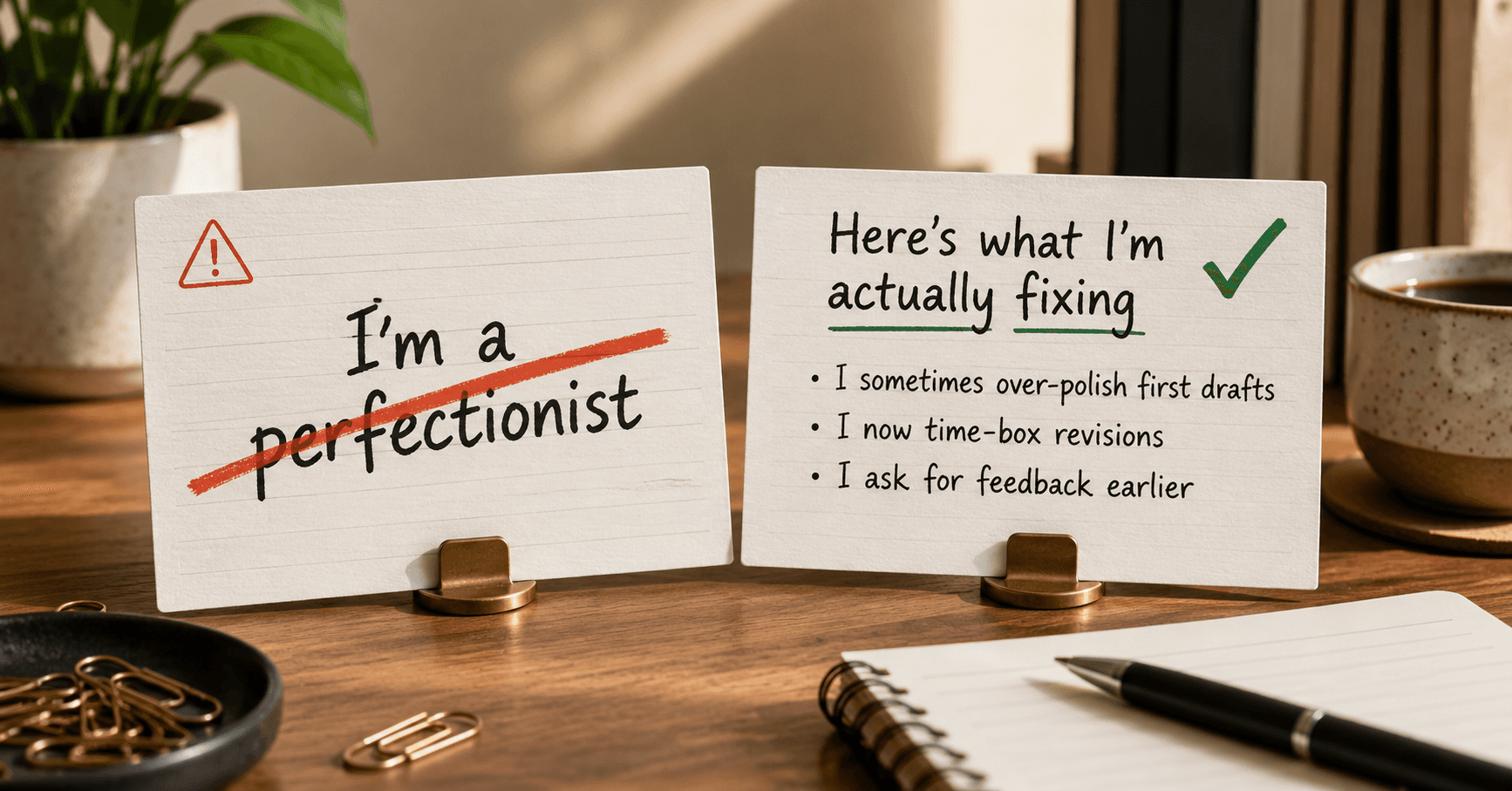
| "I'm a perfectionist" | Heard in nearly every interview; reads as evasion, not self-awareness |
| "I work too hard / care too much" | Same problem: these are compliments, not weaknesses |
| Core job requirement | If you're applying for a finance role and you say 'I'm bad at Excel,' you've raised a real red flag |
| Vague character flaw | "I can be impatient sometimes" with no story or improvement steps sounds unfinished |
| Laundry list | Three weaknesses with no depth reads as padding, not honesty |
| Ancient history | "I used to struggle with X years ago" with no present-tense improvement suggests you're still avoiding the question |
Each of these is either too dishonest to be taken seriously or too undeveloped to be useful, and experienced interviewers recognize them quickly.
How Do Interviewers Score This Question?
Whether or not they use a formal rubric, many interviewers are rating you on four things:
| Dimension | What they're looking for | Red flag |
|---|---|---|
| Specificity | A named, concrete weakness, not a category | Vague, abstract, or clearly manufactured |
| Self-awareness | Evidence you discovered this through real experience | "People tell me" instead of your own observation |
| Action | Something you're actively doing to improve right now | Past tense only, or no action at all |
| Proportion | The weakness is real but manageable for this role | It's a direct threat to core job performance |
A top-scoring answer hits all four. A mediocre answer hits specificity and self-awareness but doesn't describe active improvement steps. A failing answer hits none and offers a disguised strength instead.
What's the Formula?
Structure your answer in four steps:
- Name it. State the weakness directly in one sentence. Don't build up to it.
- Situate it. Give one concrete example of when it created a real problem or when you first noticed it clearly.
- Say what you're doing. Name a specific, current action: a course, a process you've added, a habit you're building.
- Show a signal. One early result or piece of feedback that suggests it's working.
The whole answer should run about 60 to 90 seconds out loud. Done well, it shows the interviewer how you judge your own work.
What Do Weak and Strong Answers Look Like?
Skill gap
Weak: "I'm not very good at public speaking."
Strong: "Presenting to senior stakeholders is an area where I've had to push myself. Early in my last role I would over-prepare slides to avoid having to field questions off-script, which slowed down our team's decision-making. I've been joining a weekly Toastmasters session for the past four months and deliberately leaving one slide undone per deck so I practice explaining things live. My manager flagged in my last review that I've gotten noticeably more fluent in leadership meetings."
What changed: the strong answer names a concrete consequence (slowed decision-making), a current action (Toastmasters plus deliberate practice), and evidence from someone else (manager's review).
Work-style tendency
Weak: "I tend to be a bit disorganized."
Strong: "I naturally work in bursts and can under-communicate mid-project when I'm in deep on something. I first noticed this when a cross-functional partner felt blindsided by a change I'd already decided on and hadn't flagged. I added a standing Tuesday Slack update of three sentences: what I shipped, what I'm working on, what I need. Three teammates have specifically said it's improved how we coordinate."
Details like "Tuesday Slack update" and "three sentences" make this credible. A general promise to "communicate better" wouldn't.
Technical gap (non-core)
Weak: "I'm not the strongest at SQL."
Strong: "I came up in a role where reporting was handled by a dedicated analytics team, so my SQL fluency is shallower than I want it to be. When I joined my current team I noticed I had to ask colleagues for queries I should be running myself. I've been working through a structured course on my own time and now write all my own ad-hoc queries. I still Google the window function syntax, but I'm no longer blocked."
The phrase "I still Google the window function syntax" is honest and makes the rest of the answer believable.
Delegation
Weak: "I sometimes have trouble letting go and trusting others."
Strong: "I default toward doing over delegating, especially under time pressure. I realized it was becoming a bottleneck when two of my direct reports told me in a check-in that they felt underutilized on high-stakes work. I've started assigning one high-visibility deliverable per quarter to each of them with minimal check-ins from me, and I've seen both of them grow into it faster than I expected."
The feedback from direct reports is what makes the self-awareness convincing. "I felt like I should be doing it all" is only your own view; "two colleagues told me they felt underutilized" is evidence.
How Do You Pick the Right Weakness?
You probably have four or five real candidates. Run each one through these questions:
- Will it make the interviewer question my ability to do the core job? If yes, pick another one.
- Do I have a concrete story about when I noticed it? If not, it's too abstract.
- Am I doing something about it right now? If it's past tense, it's harder to develop.
- Can I say what "better" looks like? If you can't define progress, the improvement step will sound hollow.
The best weakness is usually something adjacent to the role: important enough that improving it matters, far enough from the core that naming it doesn't raise a flag.
How Do You Practice This Answer?
Knowing a good formula doesn't mean you can deliver it in an interview. The question often comes early, right after "tell me about yourself," when you're still settling in. If you haven't said your answer out loud before, the interview will be the first time you hear it, just when you're most nervous.
Set up a Behavioral session in PokeBot's Mock Interview practice, add this question under "I have my own interview questions", and it will ask you exactly that and give you scored feedback on your answer, so you hear where it stays too abstract or runs too long. It uses the same feedback loop described in our guide to behavioral interview questions and the STAR method, applied to a question many candidates underprepare for.
Practice this question out loud: free AI mock interview →
What Do the Best Answers Have in Common?
Candidates who answer this question well have usually thought about their weaknesses before the interview and are already working on one of them. Their answers come from noticing where they aren't good yet and doing something about it, which is what gives them specific details to talk about.
If that's not you right now, pick something real and start improving it today, so you have a current action to describe when the question comes. For more on prepping your full opening sequence, see how to answer 'Tell Me About Yourself'. The two questions are often asked back to back.
Frequently Asked Questions
What's a good answer to 'What is your greatest weakness?'
Name a real weakness that won't disqualify you from the role, show you've recognized it through a specific situation, describe what you're actively doing to improve, and give one piece of evidence that it's working. Skip the 'I'm a perfectionist' answer; interviewers hear it constantly and it reads as evasion.
What weaknesses should I avoid mentioning in an interview?
Don't name a core requirement of the job (applying for an analyst role and saying 'I struggle with data'). Don't mention anything that suggests poor judgment, dishonesty, or interpersonal toxicity. And don't disguise a strength as a weakness; interviewers are judging self-awareness, and a fake weakness suggests you have none.
Can I say 'I'm a perfectionist' as my greatest weakness?
Only if you follow it with a specific story about how perfectionism caused a real problem and exactly what you changed. On its own, 'I'm a perfectionist' is one of the most overused answers in interviewing and makes it sound like you're dodging the question.
How long should my greatest weakness answer be?
About 60 to 90 seconds spoken aloud: long enough to cover the weakness, context, and improvement steps, short enough to stay concrete. If you're still talking after two minutes, you've either explained too much backstory or drifted into a different answer.
Is 'I work too hard' an acceptable weakness?
No. Experienced interviewers listen for 'I work too hard,' 'I care too much,' and 'I have high standards' because these answers are compliments in disguise. They backfire by making you look like you lack the self-awareness to name a real weakness.
What if my real weakness is something serious?
You don't have to disclose serious personal struggles, mental health history, or anything that belongs outside the professional context. Pick a professional weakness you're actively working on, such as a skill gap, a work-style tendency, or a communication habit. Everyone has a few of those.
How do I practice answering the greatest weakness question?
Write out three or four real weakness candidates, pick the one with the best 'this is what I'm doing about it' story, then say your answer out loud, not in your head. Set up a Behavioral session in PokeBot's Interview Practice, add this question under 'I have my own interview questions', and it will ask you exactly that, then score how specific and structured your answer is (Audio Mode also reports your speaking pace), so you hear it before the real interview.
Should I mention multiple weaknesses?
No. One specific, well-developed weakness works far better than a list. A list suggests you either didn't prepare a real answer or are hoping quantity will make up for depth. Pick one, develop it fully, and stop.