
How Assessment-Center Group Discussions Are Scored, and How to Practice Without a Group
What assessors write down in a group discussion and how they score it, with the moves that earn credit and solo drills you can run this week.
Last updated: October 2026.
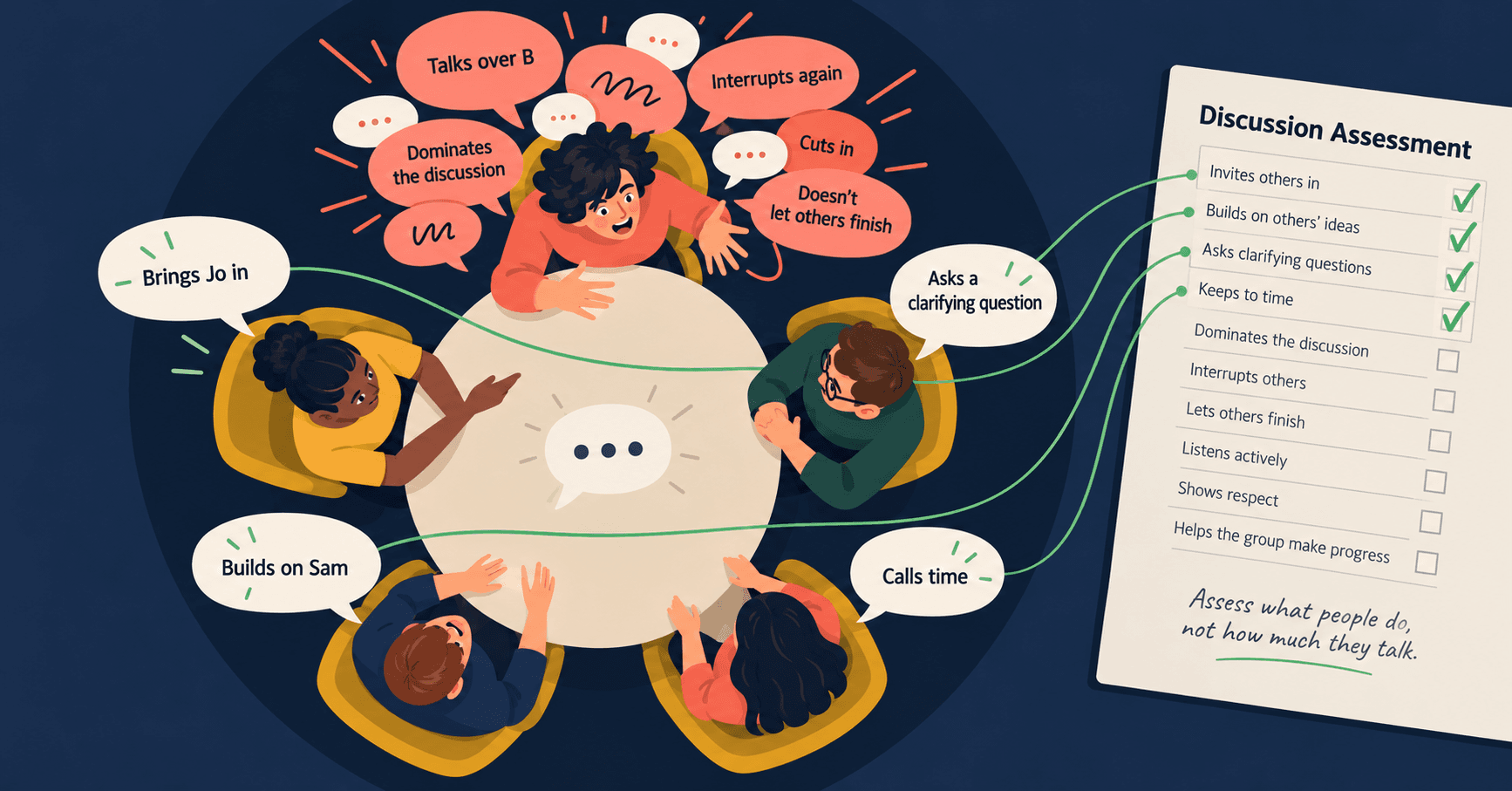
Quick answer: In an assessment-center group discussion, assessors write down what you say and do, then rate that evidence against a short list of behaviors the employer picked in advance. Talking the most rarely wins. Points come from building on what others say and from moving the group to a decision. You can drill each of those moves alone.
The group exercise can look like the one part of an assessment day that depends on strangers. Once you know what goes on the assessor's sheet, you can prepare for it the same way you prepare for an interview question.
What Are Assessors Writing Down During a Group Discussion?
They write down behavior. An assessor is usually assigned a small number of candidates and spends the exercise writing down what each one said and did, as close to word for word as they can manage. "Proposed ranking by cost first." "Asked B what she thought of option 3." "Interrupted C twice."
After the exercise, they sort those notes under the employer's criteria and give each criterion a rating. The criteria come from the employer's own competency or values framework, so they vary by company. One employer might weigh structured reasoning more heavily, and another might care more about working with others.
Two things follow from this, and both should change how you behave in the room:
- Anything the assessor cannot write down does not count. A good idea you thought of and never said scores zero. A point you made but did not tie to the brief is hard to file under "reasoning."
- You are rated against the criteria, and the other candidates are not your opponents. In principle, every person in the group can score well. The candidates who treat it as a debate to win usually hand the assessor evidence against themselves.
What Does a Group Discussion Scoring Rubric Look Like?
Employers set their own criteria, so treat this as an illustrative rubric. It is not any firm's actual sheet. The behaviors in the left column line up with familiar competency headings such as teamwork and problem solving, even when an employer names them differently.
| What is scored | Evidence that earns credit | Evidence that loses credit |
|---|---|---|
| Contributing ideas | Puts forward a clear proposal with a reason from the brief | Repeats a point already made, or stays silent for long stretches |
| Listening and building | "Building on what Sam said about cost, that rules out option 2" | Ignores the previous speaker and restarts on their own idea |
| Reasoning | Uses figures or facts from the brief to support or test a point | Argues from opinion when the brief has the data |
| Bringing others in | Asks a quiet member for their view by name | Talks over people, or answers for them |
| Steering to an outcome | Calls time, proposes a structure, asks the group to commit | Lets the discussion circle with ten minutes left |
| Handling disagreement | Names the disagreement and suggests how to settle it | Digs in, or drops a good point the moment someone objects |
Look at the right column before the day. Most of it is ordinary nervous behavior, like talking too much or freezing. Practice is what stops it from showing up.
Does Talking the Most Help or Hurt Your Score?
It usually hurts. Airtime is not on the sheet. A candidate who talks constantly fills one box, contributing ideas, and leaves the assessor with notes like "spoke over D" and "did not respond to B's objection."
The opposite failure costs you too. A candidate who says three thoughtful things in forty minutes gives the assessor very little to write. If you are naturally quiet, set yourself a floor before you walk in: speak within the first few minutes, and plan to contribute in every phase of the discussion.
Grabbing the marker and appointing yourself chair is the most overrated move in the room. Chairing earns credit only if you actually run the discussion well, bringing people in and moving to a decision. Grabbing the role and then pushing your own answer reads as dominance, and the assessor writes it down that way.
Which Moves Score Well, and What Do They Sound Like?
Each of these produces a specific line on the assessor's sheet. Learn the exact sentence, because under pressure you will reach for whatever is already rehearsed.
- Opening with structure. "We have 30 minutes and four options. Could we spend ten agreeing what matters most, then rank them?"
- Building on a point. "Adding to Priya's point, if the budget is capped, option C is out regardless of its reach."
- Bringing someone in. "Tom, you mentioned the timeline earlier. Does that change your view on option A?"
- Using the brief. "The appendix says the pilot cost twice the estimate. That makes me less confident in B."
- Disagreeing without stalling. "I see it differently, mainly on risk. Can we each give one reason and then vote?"
- Calling time. "We have about eight minutes. Can we lock the top choice now and use the rest for the second?"
- Summarizing. "So we agree on A first, mainly on cost. B and C are still open."
A weak and a strong version of the same contribution, side by side:
- Weak: "I think option B is best because it's the most innovative and I've always liked that kind of approach."
- Strong: "I'd put B first. The brief says it reaches the target audience at half the cost of A. Does anyone see a risk in it I'm missing?"
The strong version gives the assessor a proposal backed by the brief, plus an invitation to the group. The weak one gives them a preference.
What Should You Do When the Group Goes Wrong?
Groups go wrong in a few predictable ways, and each one is a chance for you to show a scored behavior.
| What happens | What to say |
|---|---|
| One person dominates | "Good point, Alex. I'd like to hear from Jo and Sam before we decide." |
| Two people deadlock | "We're split between A and C. What would make either of you change your mind?" |
| The group ignores the brief | "Before we go further, the brief gives the costs on page 2. Can we check them?" |
| Time is nearly gone with no decision | "Let's commit to what we agree on and list what's still open." |
| Someone shoots down your idea | "Fair. If cost is the issue, does a smaller version of it work?" |
Do not fight the dominant person for the floor. Bringing other people in around them scores better and looks calmer than a battle over who gets to speak.
How Can You Practice a Group Discussion Without a Group?
Getting four friends on a call for an hour is hard, so this exercise is easy to leave unpracticed. You can drill the individual moves alone, then put them together in a full run. Friends or a careers-service practice session are worth doing if you can get them. These drills work when you can't.
Solo drills (10 to 15 minutes each):
- The build drill. Play a recorded panel discussion or debate. Pause after each speaker and say out loud one sentence that starts with their name and builds on their point.
- The summary drill. Every five minutes of the same recording, pause and summarize where the panel agrees and where it doesn't, in two sentences.
- The brief drill. Take any short case or news article with numbers in it. Give yourself ten minutes to pick a position and two reasons, each tied to a figure in the text.
- The time-call drill. Set a timer for random intervals. When it goes off, say a time-call and a proposed next step for whatever you are discussing.
- The disagree drill. Take a strong opinion you disagree with and respond out loud in under 20 seconds, naming the disagreement and offering a way to settle it.
Say everything out loud. The skill being tested is speaking into a live conversation, and silent rehearsal does not carry over to a live discussion well. If you have dealt with nerves after earlier rejections, these short reps are also a low-stakes way to rebuild confidence. This piece on interview anxiety covers that side in more detail.
The hard part is choosing the right move in real time while other people talk, and for that you need a full discussion.
How Do You Run a Full Practice Discussion in PokeBot?
PokeBot's Mock Interview room has a Group Discussion format where AI participants discuss a topic with you. You argue your position and steer the discussion alongside them, then get scored feedback at the end. You type your contributions, so say each one out loud before you send it. It's one way to run a full rehearsal without organizing people.
The setup screen gives you the levers that matter for assessment-center practice:
- Discussion Topic: pick a Quick Start Template, such as Business & Ethics or Society & Policy, or choose Custom Topic and write a short version of the case you expect. The field takes a few sentences, so keep the options and the key numbers and leave out the rest.
- Group Size: from 2 people (you + 1 AI) up to 5 people (you + 4 AI). Two people is closer to a conversation than a group exercise, so move up to 4 or 5 quickly.
- Difficulty: three levels, from Easy to Hard.
- Who Starts First: "I Start" lets you practice opening with structure. "AI Starts" makes you find a way in once the discussion is already moving, which is the harder skill.
- Customize AI Participant: optionally give each AI participant a name and role, for example a cost-focused finance lead.
A progression for the week before your assessment day:
- Day 1: 3 people, Medium, I Start. Focus on opening with structure and one summary.
- Day 3: 4 people, Medium, AI Starts. Focus on getting in early and building on others.
- Day 5: 5 people, Hard, AI Starts, with a custom topic that sums up a sample brief in a few sentences. Focus on calling time and pushing for a decision.
Read the feedback after each run and pick one thing to fix next time. Your Group Discussion scores also show up as a trend in the Performance Dashboards inside Progress Tracker, so you can see whether the week of practice actually moved anything. For the rest of the assessment day, the interview stage often asks for structured stories, and the STAR method guide covers those.
Score your resume free, create your PokeBot account
What Should You Prepare the Night Before?
Read the employer's published values or competencies again and translate each one into a sentence you might say in the room. "Collaborative" becomes "Building on what you said...". "Commercial awareness" becomes "The brief says the margin on that is..." Write those sentences on one card.
Then decide your two personal rules for the day. If you tend to dominate, one rule might be "ask one person a question before every second point I make." If you tend to go quiet, it might be "speak in the first three minutes." Keep it to two, so you can still remember them once the clock starts.
Frequently Asked Questions
How are assessment center group discussions scored?
Assessors watch a small set of candidates each and write down what those candidates say and do. After the exercise they sort those notes under the behaviors the employer chose in advance, such as working with others or reasoning from the brief, and rate each one. Your score comes from the evidence on that sheet, so a few well-timed contributions can outscore a lot of talking.
Does talking the most help in a group discussion?
Rarely. Airtime is not one of the things on the sheet. A candidate who talks constantly usually produces evidence for one behavior, putting forward ideas, and loses credit on listening and on bringing others in. Aim for fewer contributions that each do a clear job, like building on someone's point or pushing the group toward a decision.
Am I competing against the other candidates in the group?
Each candidate is rated against the employer's criteria, so in principle everyone in the room can score well. In practice the other candidates are the material you work with. Building on their points produces evidence for you, and so does inviting a quiet person into the discussion.
Should I volunteer to be the timekeeper or note-taker?
Only if you will use the role. A timekeeper who calls out the remaining time and uses it to push the group toward a decision shows steering. A note-taker who later reads back a clear summary shows structure. Taking either role and then going quiet behind it earns nothing.
What if the group never reaches a decision?
The outcome matters less than what you did to move toward one. If time is running out, propose a decision on the points the group already agrees on and name what is still open. That one sentence is strong evidence of steering, even if the group runs out of time.
How can I practice a group discussion on my own?
Use short solo drills for the individual moves, such as pausing a recorded panel discussion and saying out loud a sentence that builds on the last speaker. Then run full rehearsals against an AI-run group. PokeBot's Group Discussion format seats you with one to four AI participants on a topic you choose and scores the session afterward.
How should I prepare in the week before an assessment center?
Read the employer's published values or competencies and write down what each one would look like as something you say in a discussion. Run the solo drills daily. Then do two or three full practice discussions with more participants and a harder difficulty each time, and read the feedback after each one.