
How to Ask for a Warm Intro: Word-for-Word Templates That Don't Feel Awkward
Referrals beat cold applications, but most people ask wrong. Word-for-word templates, timing rules, and a weak/strong example to get it right.
Last updated: July 2026.
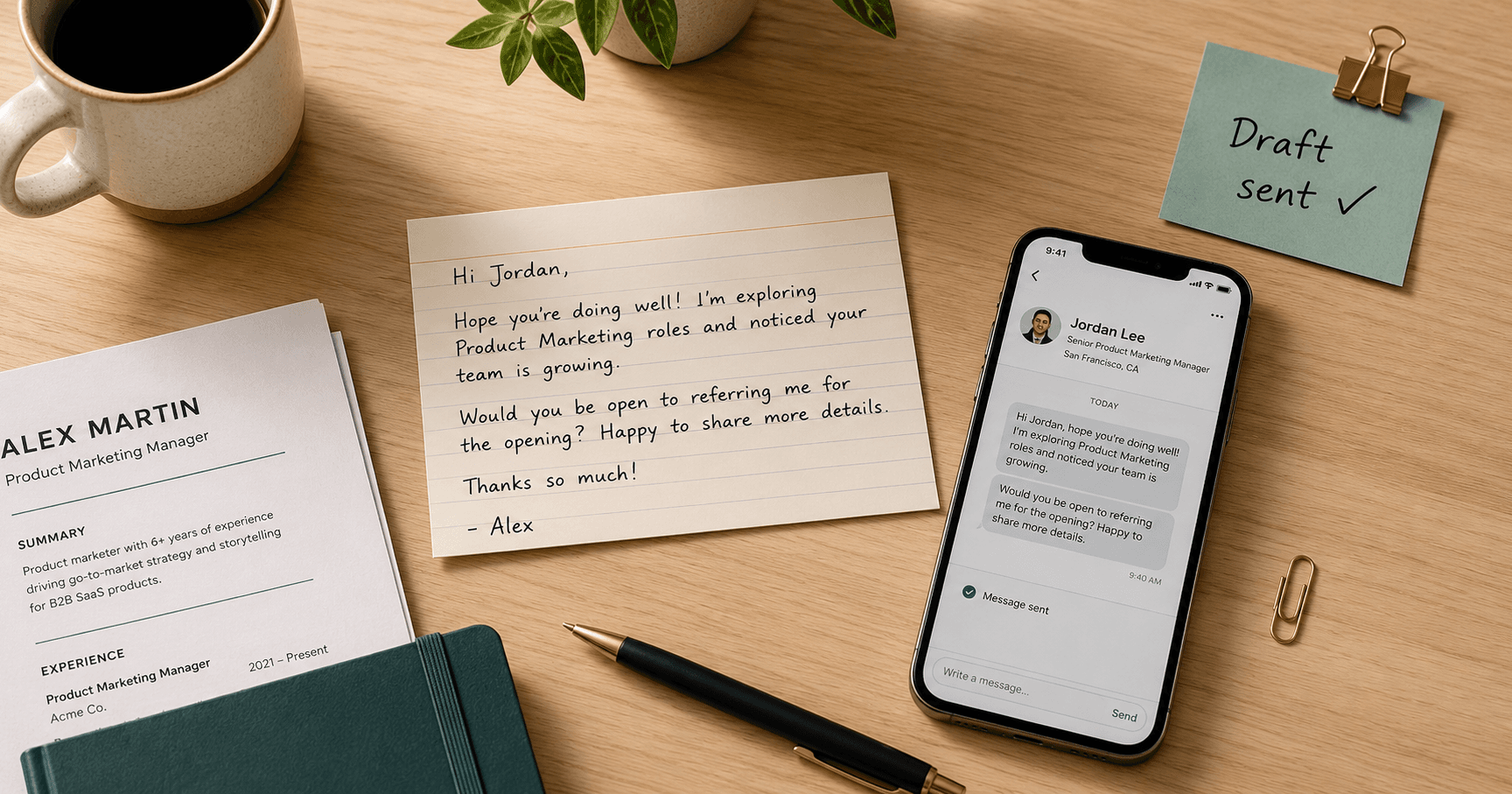
Quick answer: Before applying, send a short note that does two things: names the exact role and includes a draft intro your contact can forward to the recruiter in 30 seconds. Add a genuine out and keep the whole thing under 100 words. Most people who can help will say yes to that version.
The front door of most job searches is overcrowded: applications per open job have doubled since spring 2022, according to LinkedIn research (Fortune, January 7, 2026). A warm intro sidesteps that pile. Pinpoint's analysis of 4.5 million applications found referred candidates are 7x more likely to be hired than job board applicants, and National University's hiring research puts referrals at about 7% of all applicants while accounting for 30-50% of U.S. hires.
That gap is widening, not closing, as AI-generated applications flood recruiting inboxes and drive down the signal value of cold submissions. The referral is the direct counter-move, and most people already know it. The hard part is asking in a way that feels natural rather than forced or transactional.
Why Do Most Referral Requests Go Unanswered?
The ask usually fails before word choice even matters: it arrives vague and leaves all the work to the other person.
"Can you refer me?" forces them to figure out how, whether they're comfortable vouching for you, and who to contact. Most people don't say no — they just don't get around to saying yes.
Close the gaps before they can stall:
- Name the exact role and include the job link
- Write the intro message they'd forward (30 seconds to send, not an open-ended task they'll defer)
- Give them a genuine way out
Turn the request into a forward, not a project.
Who Should You Ask First?
Former colleagues now at the company. This is the warmest path. They've worked alongside you and can vouch for something real. An internal referral from a current employee carries more weight than any networking message you could write.
Classmates or conference contacts at the company. You have shared context even without direct work history. Name that context specifically in your note — the vague "we connected on LinkedIn" doesn't do what "we were in the same cohort at X" does.
Mutual connections who know someone there. You're asking them to introduce you to their contact, which means their own name is on it. It works, but it asks more. Make it especially frictionless for this group.
And your own network is only one channel: PokeBot's Opportunity Map surfaces roles shared by real recruiters, where an introduction is already on the table through the Warm Intro feature — so while you work your personal contacts with the templates below, a parallel set of doors is open that requires no contact-mining at all.
The Template Bank
Close contact, direct referral
Hi [Name],
I saw [Company] posted the [exact role title] role (link: [URL]). My background in [specific area] maps directly to what they're describing.
Would you be comfortable putting in a referral, or just letting the recruiter know I've applied? Happy to draft a short intro note you could forward — whatever makes it easier.
No pressure if the timing's off.
[Your name]
Weaker contact, same company
Hi [Name],
Hope things are going well. We [brief shared context — worked together at X / met at Y].
I'm applying for the [exact role title] at [Company]. [One sentence on your relevant background and why this role is a fit.] Would you be comfortable flagging my application to someone on the team, or making a quick intro to the recruiter?
I can write a short note you could forward if that makes it simpler. Totally fine if the timing isn't right.
[Your name]
Asking for a mutual introduction
Hi [Name],
Quick question — I'm applying for the [exact role title] at [Company] and I noticed you know [Contact's name] there. Would you be up for a short intro?
Here's a draft you could use:
"Hey [Contact], connecting you with [Your name] — they're applying for [role] at [Company] and their background in [specific thing] is a strong match. Worth a quick chat. CC-ing them here."
No problem at all if this puts you in an awkward spot.
[Your name]
What Does Weak vs. Strong Look Like in the Same Scenario?
You went to the same business school as someone now at your target company. You haven't spoken in two years. Here's the same ask done two different ways.
Weak:
"Hey! I saw you're at [Company] now, congrats! I'm currently job searching and would love if you could refer me. Let me know!"
Strong:
"Hi [Name], it's been a while. I noticed [Company] posted the [role title] and it's a direct fit with my [specific background]. Would you be comfortable giving the recruiter a quick nudge, or flagging that I've applied? Happy to draft a short note you could send. No worries if the timing's off."
The weak version asks for a "referral" with no role named and no reason the contact should vouch for you. The strong version names the role and makes the fit case in one sentence. It offers a pre-drafted message and gives a genuine out. The contact who's on the fence will act on the second version and let the first slip.
When Should You Ask, and When Do You Follow Up?
| Step | What to do | When |
|---|---|---|
| Before applying | Send the intro request | Day 0 — before or same day as your application |
| After applying | Let them know you've submitted; include application ID if you have it | Same day or next |
| No response | One brief follow-up | 5–7 days after your first message |
| They agreed but nothing happened | Check in, re-offer to draft the message | 1 week after they agreed |
| You got the intro, recruiter is silent | Follow up directly with the new contact | 5 days after the intro |
The hardest rule for most people to follow: one follow-up, then move to the next contact at the company. Chasing further doesn't convert reluctance — it costs goodwill you might need later.
The other timing mistake worth naming: waiting until after you apply to ask. Some companies attach referrals only to applications submitted through the referral link. Ask first, or at minimum the same day.
What Is the Move Most People Skip?
Offer to write the message for them. Say it explicitly in your note: "Happy to draft a short intro you could forward."
A contact who's willing but stretched will send a pre-drafted message in 30 seconds. They'll postpone indefinitely writing something from scratch. This single offer converts more stalled "I'll see what I can do" responses into real introductions than any other change you could make to the ask.
While you're at it, attach your resume and the job link directly. Don't make them search for either one.
Why Are Referrals the Right Counter-Move Right Now?
The case for warm intros over cold applications has always been solid. With AI-generated submissions flooding inboxes, it's now close to a structural advantage. Many recruiters are relying more heavily on referral lists and flagged applications to find signal in the volume. A warm intro doesn't just improve your position in the pile. In many cases it routes you around it entirely.
If the funnel math behind why cold applications underperform is still fuzzy for you, those numbers are worth understanding. And if you want the full strategic picture of where warm outreach fits across your whole search, The Strategic Job Search covers that directly.
Frequently Asked Questions
How do I ask for a referral without feeling like I'm using someone?
Frame it as giving them a decision, not extracting a favor. Keep the message short, name the exact role, explain your fit in one sentence, and say clearly that no is fine. Most referral requests feel off because the message leaves the other person figuring out the how, the who, and whether it is appropriate to help. Specificity removes that friction.
What if I haven't spoken to the person in years?
It's fine to reach out after a gap. Don't spend a paragraph pretending it didn't happen, and don't spend a paragraph re-warming them either. A brief acknowledgment works: 'We haven't spoken in a while, so I'll keep this short.' Most people will help or won't based on whether they think you're a strong candidate, not based on whether you checked in last quarter.
When should I ask — before applying or after?
Before, if at all possible. Some companies track referrals only to applications submitted through a referral link. If you apply first and ask later, the referral may not attach to your application. Send the message the same day you plan to apply, or preferably a day or two earlier.
What if they say they'll help but then nothing happens?
One follow-up is appropriate, about a week after they agreed. Offer again to draft a message if you haven't already. If there's still no movement after that, find another contact at the company rather than pushing further. They likely can't pull it off right now, and pressure doesn't change that.
Should I offer something in return for a referral?
Don't make an explicit trade. That turns a simple ask into a negotiation. What works better over time is being the kind of contact who gives before they ask: shares useful information, makes introductions for others, and doesn't only appear when they need something. You can't manufacture that retroactively, but it's worth building as a habit.
How many people should I ask at the same company?
One or two, with different relationships. If you have a former colleague and a mutual connection at the same company, reaching out to both is fine — they'll rarely compare notes. Beyond two contacts at one company, you risk awkwardness if people cross paths in the process.
What if I get the intro but the recruiter goes silent?
Follow up with the recruiter directly five days after the introduction. Mention the person who connected you and ask if sharing your resume or a work sample would be useful. Keep it to two sentences. If there's still no response after one follow-up, the role may already be filled or on hold.