
The Interview Questions AI Can't Answer for You: Judgment, Ownership, and Taste
Some interview questions test choices only you made. Here's how to spot them and how to practice answers that hold up under follow-up questions.
Last updated: October 2026.
Quick answer: The interview questions AI can't answer for you are the ones about decisions you personally made, like a trade-off you weighed or a mistake you owned. Prepare for them by collecting real decisions with the options you rejected, then practicing out loud against follow-up questions.
If you want the bigger picture first, AI Won't Replace You, It Raises the Bar makes the case that AI is shifting the value of skilled work toward judgment. That essay is the why. This post is the practical part: which questions test that judgment in an interview, and what to do about them.
A lot of interview prep still runs on scripts: write polished answers to the common questions, then memorize them. That works for some questions. For the ones below, a script will hurt you, because the interviewer's second and third questions are where the scoring happens.
Which Interview Questions Can't AI Answer for You?
Any question whose honest answer depends on something only you know. A chatbot can explain what a good answer to "tell me about a trade-off" looks like. It can even invent one. What it can't supply is the actual trade-off you made last spring, or the colleague who thought you were wrong.
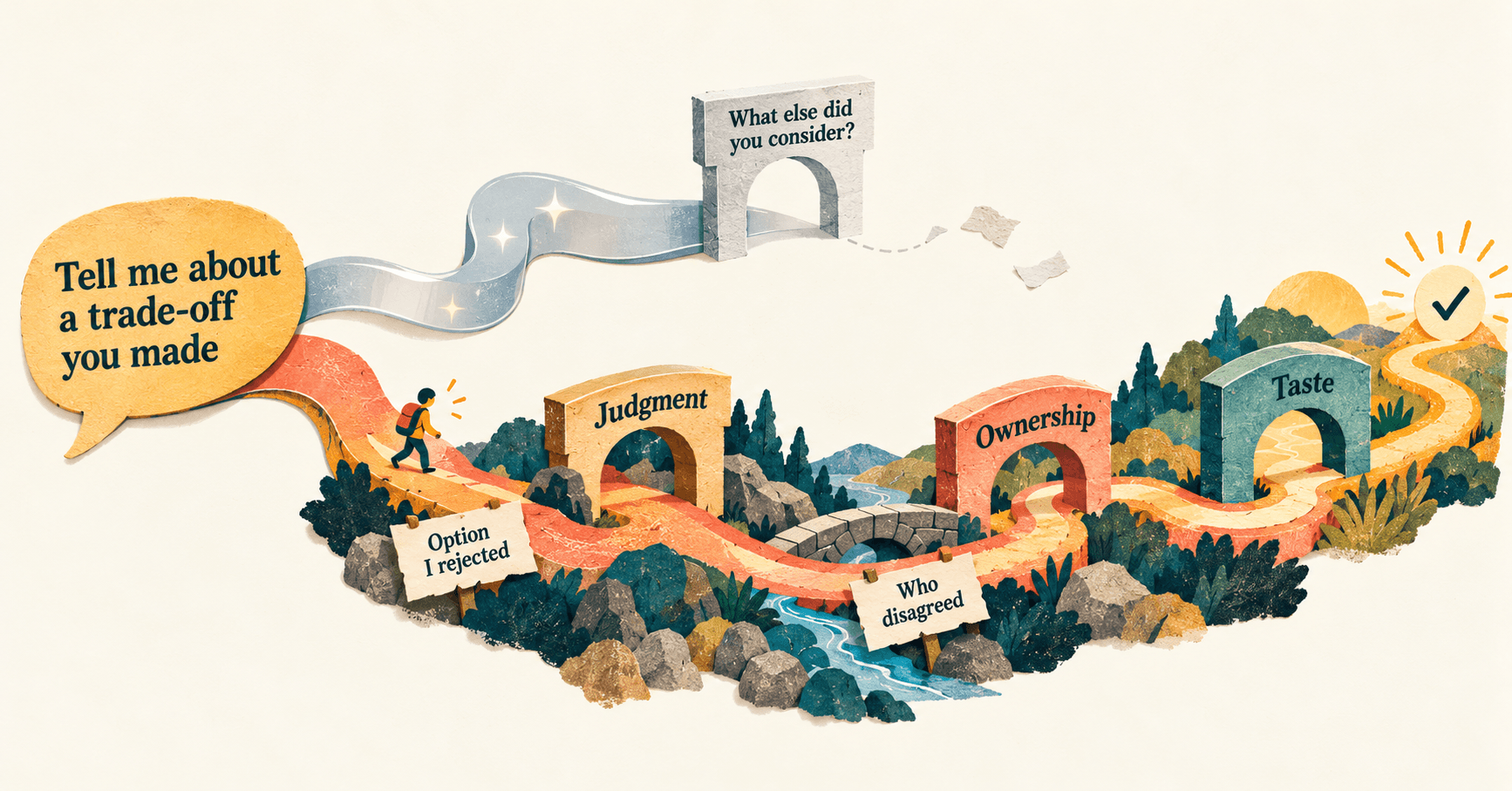
These questions fall into three families:
- Judgment: how you decide when the right answer isn't obvious and the information is incomplete.
- Ownership: what you do when something goes wrong and it's at least partly yours.
- Taste: whether you can tell good work from mediocre work and explain the difference.
These are old questions. The case for giving them more of your prep time is simple: anyone can now generate a fluent answer to "what are your strengths," so the questions that need lived detail do more of the work of separating candidates.
What Do These Questions Sound Like in a Real Interview?
They rarely announce themselves. Here is how each family tends to show up, and what the interviewer is listening for.
| Signal | Sample questions | A strong answer contains | What gives a weak answer away |
|---|---|---|---|
| Judgment | "Tell me about a decision you made with incomplete information." "Walk me through a trade-off on a recent project." | The options you rejected and why, the information you had at the time, and what you'd change now | Only one option is ever mentioned, so there was no decision |
| Judgment | "How would you prioritize if you had three urgent requests and time for one?" | A rule you actually apply, plus the cost of what you dropped | "I'd talk to stakeholders and align on priorities" with no actual choice |
| Ownership | "Tell me about a mistake you made." "Describe a project that failed." | A plain statement of your part, then the fix and what changed afterward | The mistake quietly becomes someone else's, or the story is about being too dedicated |
| Ownership | "Tell me about something you did that wasn't your job." | A gap you noticed, why it mattered, and what it cost you to fill it | A list of extra tasks with no reason behind them |
| Taste | "What's a product you think is badly designed?" "Show me work you're proud of." | Concrete details and why they matter to the user or the outcome | General praise or complaint ("it's clunky," "it's clean") |
| Taste | "What would you change about our product?" | One specific change, the reason, and the downside you accept | A feature wishlist |
Notice the right-hand column. Most weak answers in that column are vague. They describe the shape of a good answer without anything inside it.
Why Does a Polished Generic Answer Fail Here?
Because the first answer is only the opening move. On judgment and ownership questions, interviewers usually dig. Typical follow-ups:
- "What else did you consider?"
- "Who disagreed with you, and what was their argument?"
- "Knowing what you know now, would you make the same call?"
- "How did you find out it had gone wrong?"
A rehearsed answer survives the first question and runs dry on the second. If you memorized a story built around a generic structure, you have nothing to add when asked about the option you didn't take, because that option was never part of the story. A real decision, even a small one, has layers you can keep peeling.
This is also why borrowing a generated answer is risky. The text can sound fine. Then the follow-up asks for a detail it never contained, and you either invent one on the spot or go blank. Both are visible.
How Do You Answer a Judgment Question?
Structure the answer around the decision itself, in this order:
- The call you had to make, in one sentence.
- The options on the table, including at least one you rejected.
- What you knew and didn't know when you decided.
- What you chose and why, stated as a reason someone could disagree with.
- How it turned out and what you'd change.
Step two is the easiest to skip, and it's the one that makes the answer about judgment at all.
Here is a hypothetical pair for "Tell me about a trade-off you made."
Weak: "On a recent launch, timelines were tight, so I worked with the team to prioritize the most important features and we delivered on time. It taught me the value of focus."
Strong: "Two weeks before a launch, we could either ship the reporting page with live data or ship it on time with yesterday's data. Engineering said live data needed another sprint. I picked the delayed data, because the people using that page check it once a morning, and a slip would have pushed us past a customer commitment. Our sales lead argued that 'live' was the selling point. In hindsight that was partly right: two prospects asked about it. I'd make the same call, but I'd tell sales a week earlier so they could set expectations."
The strong version gives the interviewer something to push on. That's the point.
If you need a foundation for structuring stories in general, the STAR method guide covers it. Treat STAR as the skeleton, then put the rejected options and the disagreement inside the "Action" step, where the judgment shows.
How Do You Answer an Ownership Question?
Pick a mistake that was clearly yours. That sounds obvious, and it's the easiest place to go wrong. A story where the fault was shared tends to turn into two minutes of politely distributing blame.
A workable shape:
- Say what you got wrong in one plain sentence. "I approved the vendor contract without checking the renewal terms."
- Give the cost. What broke and who noticed.
- Spend most of your time on the response. Who you told and what you did to contain it.
- End on the change. The habit or process you put in place so it wouldn't happen again, and whether it has held.
The "wasn't my job" variant tests the same trait from the other direction. A good answer names a gap nobody owned and why you decided it was worth your time. Then it's honest about what you stopped doing to make room. Ownership with no cost attached sounds like a performance review written by yourself.
The strongest ownership stories are often a little embarrassing. If your story makes you look flawless, it isn't answering the question.
How Do You Answer a Taste Question?
Taste questions ask whether you can judge quality and explain why. They come in two forms. The interviewer asks you to critique something ("What's a badly designed product you use?"), or asks you to defend your own work ("Walk me through something you're proud of. What would you change?").
You can't cram for these the night before, but you can prepare raw material:
- Have two or three opinions about work in your field, with reasons. A product decision you think was wrong, say, or a report format that wastes everyone's time.
- Tie each opinion to a consequence. "The settings page buries notification controls three levels deep, so users mute the whole app instead of one channel" is taste. "The settings page is confusing" is a complaint.
- Know the downside of your preferred fix. Taste includes knowing what your better version costs.
- Critique your own work first. If you can't name what you'd change about the project you're proudest of, the interviewer will assume you haven't looked closely.
"What would you change about our product?" deserves a specific note. Pick one change, small enough to be credible, and say what you'd give up to get it. A wishlist of five features tells the interviewer you used the product for ten minutes.
How Do You Build These Skills Before the Interview?
The work happens before you schedule a single practice session. Use this as a checklist:
- Write down four or five real decisions from the last two years. For each, list the option you didn't take.
- For each decision, write who disagreed and what their best argument was.
- Pick one mistake that was clearly yours and write the fix and the lasting change.
- Write two opinions about work in your field, each with a concrete consequence.
- For the project you're proudest of, write the one thing you'd do differently.
- Practice each answer out loud, then answer three follow-up questions on it without notes.
Don't skip the last item. Saying an answer out loud exposes gaps that look fine on paper.
If you're not sure which of these skills is your weakest, PokeBot's Career Planning runs a Skill Gap Analysis against your target role, which tells you where to aim your practice. Then set up a session in Interview Practice and add your own judgment and ownership questions under "I have my own interview questions." It asks them and scores how specific and structured your answers are. Audio Mode also reports your speaking pace, which helps when a nervous answer starts racing. If AI skills are part of what your target role screens for, pair this with how to show AI fluency in an interview, since the strongest answers there are judgment answers too: what you handed to a model and what you checked before trusting it.
Score your resume free, create your PokeBot account
What Should You Take Into Your Next Interview?
Bring a handful of real decisions with the options you rejected, and one mistake you can describe without flinching. Nobody can generate that for you, but you can have it ready by next week.
Frequently Asked Questions
What are interview questions that test judgment?
They ask you to explain a decision: what you chose and what you turned down. Common versions are 'Tell me about a time you had to decide with incomplete information' and 'Walk me through a trade-off you made on a project.' The interviewer is listening for the options you weighed and the reasoning behind your call, so a strong answer names the alternatives you turned down.
Why can't AI answer judgment and ownership questions for me?
Because the answer is a record of something you did. A chatbot can draft a plausible story, but it can't know which option you rejected or who pushed back. Interviewers ask follow-ups on exactly those details, and a generated answer has nothing underneath it to draw on.
How do I answer 'Tell me about a mistake you owned'?
Pick a mistake that was clearly yours, state it in one plain sentence, then spend most of the answer on what you did next: how you fixed the damage and what you changed so it wouldn't recur. Skip stories where the fault was really someone else's. Interviewers notice when 'my mistake' turns into a story about a teammate.
What does 'taste' mean in a job interview?
Taste is the ability to say why one piece of work is better than another, in specifics. It shows up in questions like 'What's a product you think is badly designed?' or 'Show me work you're proud of and tell me what you'd change.' A strong answer names concrete details and the reason they matter, rather than general praise or complaint.
How do I prepare for interview questions I can't predict?
Prepare the raw material instead of scripts. Write down four or five real decisions from your work, each with the options you didn't take and what you learned, plus two or three opinions about work in your field with reasons attached. Then practice answering out loud while someone, or a mock interview tool, asks follow-up questions.
Can I use AI to practice for judgment questions?
Yes, as a sparring partner. Use it to ask you questions and push back with follow-ups, then answer in your own words. PokeBot's Interview Practice lets you add your own questions under 'I have my own interview questions' and scores how specific and structured your answers are, which is useful for these rounds.