
What Does My Resume Score Actually Mean? Why 100% Is Worse Than 82%
A resume score measures how well your resume fits one job. What each dimension means, why gaming it to 100% backfires, and how to read the breakdown.
Last updated: June 2026.
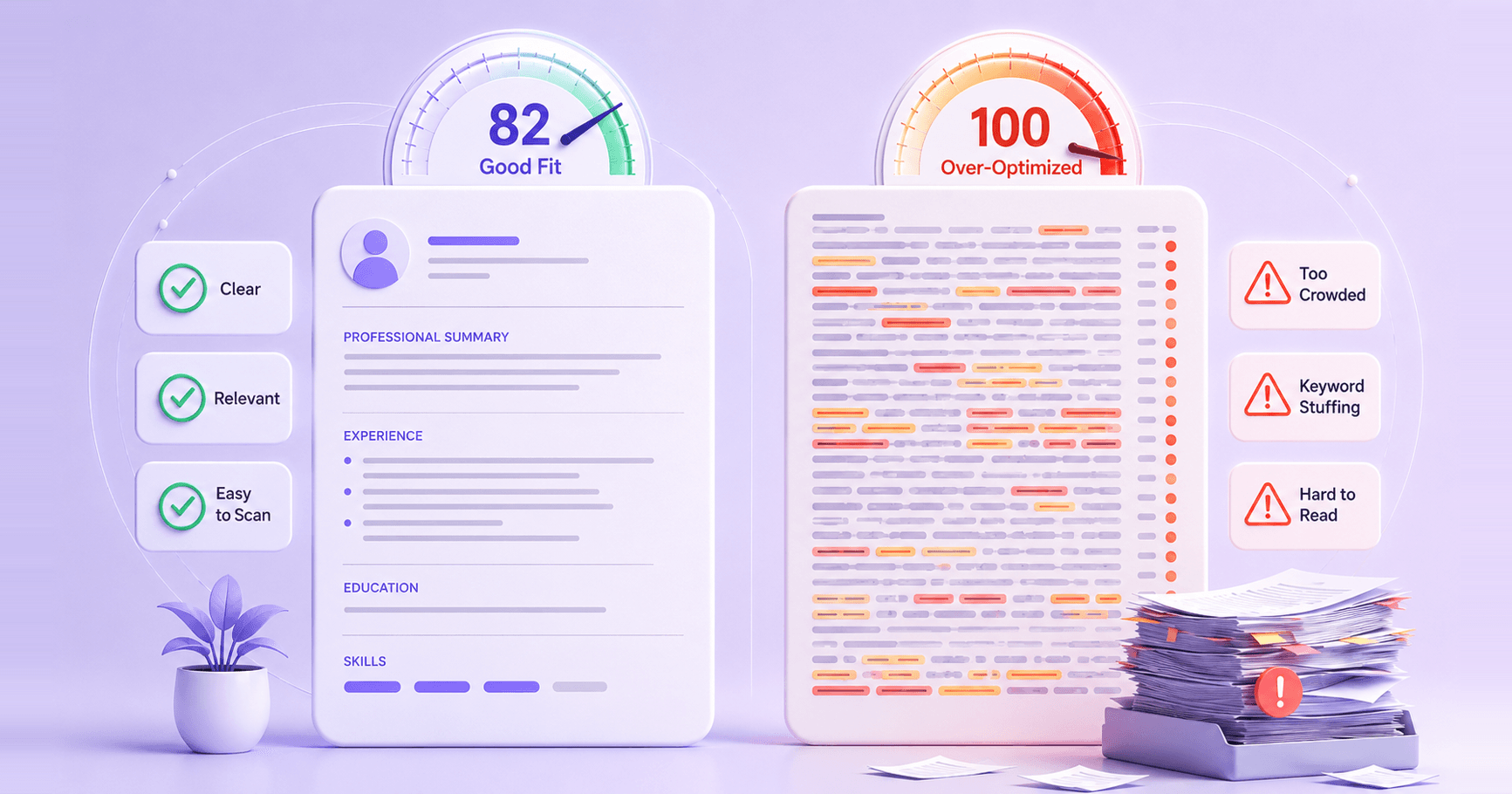
Quick answer: A resume score measures how well your resume aligns with one specific job description right now, which is a narrower question than your overall value as a candidate. An 82% on a well-written, targeted resume is more useful than 100% on a document padded with every keyword from the posting. The breakdown by dimension tells you far more than the number itself. Here's how to read it.
When the number appears, the first instinct is to push it higher, and following that instinct without checking it tends to produce worse resumes.
What Does a Resume Score Measure?
A resume score is a comparison: your resume against one job description, right now. The same document can score 65% against a product marketing role and 88% against a content strategy role because what it measures is how strongly your resume matches each role.
Many resume analysis tools break this into three areas. Format measures whether the software can parse your document cleanly. For keyword match, the question is how well your experience uses the specific language in the posting. Content quality measures whether your bullets show results or just describe the responsibilities that came with the title.
Each area points to a different problem with a different fix. If you treat them as one number and try to raise it across the board, you can end up with a keyword-stuffed resume that gets through filters and then reads badly to a person.
Why Does a Perfect Score Usually Backfire?
A perfect keyword match score means your resume covers every significant term in the job description. That sounds like the goal. In practice, it almost always reflects one of two things: you hold every listed qualification (uncommon, especially for senior roles that include aspirational requirements), or you padded the document until the score responded.
Recruiters read the text itself. A resume that says "demonstrated stakeholder management in cross-functional stakeholder environments while managing stakeholder expectations" won't hold up when a person reads it, even though the score went up.
There's a subtler version of this problem. If your summary and skills section carry every keyword from the posting but your experience bullets don't back them up, a hiring manager will notice the mismatch fast, and the higher score won't turn into an interview.
Honest, well-targeted work tends to score 80 or above without hitting 100: high enough to clear the filter, and coherent enough to read like a real person wrote it.
Which Part of the Score Gets You Interviews?
Format and keyword scores decide whether you get through screening. If your format score is low, fix it first. A partly unparseable document means your strongest content may never get read at all. The mechanics of clean formatting are in ATS-Friendly Resume Format.
Content quality is what turns a screening pass into a phone call. A resume that clears the keyword filter and then says "responsible for managing client relationships" gets passed over. One that says "rebuilt the enterprise onboarding sequence, cutting time-to-first-value from nine weeks to four" gets a callback.
A low content score almost always means the same thing: bullets that describe duties rather than outcomes. The fix is to rewrite your most important lines with a result attached; swapping in a better synonym won't do it. The five mistakes that most often filter resumes out covers this in more detail.
How Do You Read a Score Breakdown?
| Dimension | What a low score signals | Where to start |
|---|---|---|
| Format / parsing | The ATS is misreading your layout | Switch to single-column; remove tables and text boxes |
| Keyword match | Your language doesn't match the posting | Find the 5-7 most prominent terms in the JD and use each once, in context |
| Content quality | Your bullets describe duties, not results | Add a measurable outcome to your three strongest experience bullets |
A single aggregate number strips out this information. If a tool gives you a breakdown, read the dimensions separately. They rarely fail for the same reason, and the fixes are different.
What Does a Useful Score Look Like?
The score is doing its job when the breakdown gives you something specific to act on. Low format means the parser is struggling with your layout and some of your content may be getting lost before it's evaluated. Low keyword match means your language doesn't align with the posting's. Low content quality is the hardest to fix but usually the one that matters most once the format is clean.
A uniformly high score with no breakdown gives you nothing to act on. That's fine if your resume is strong, but "looks good overall" doesn't tell you what to sharpen before your next application.
If you're scoring 80 or above across dimensions against your target roles, your resume is probably ready to submit and you can stop tuning it. If one dimension is pulling the aggregate down, focus there before sending anything else out.
How Do You Improve the Score Without Gaming It?
Keyword alignment doesn't require cramming. Read the job description and identify the qualifications that appear most prominently. Then check whether your resume names each one. Often the gap is just terminology: you wrote "account oversight" where the posting says "account management." Using their term where it honestly applies is fair, and it helps both the software and the reader recognize your experience.
For content quality, rewriting is the only fix. Pick your three most important bullets, add a measurable result to each, and see if the score reflects the improvement. If it doesn't, the gap may be in how the tool evaluates quality. In that case, go by whether the bullets themselves got better.
How Does PokeBot's Resume Score Work?
PokeBot's Resume Studio scores your resume in four areas: Content Quality, Structure & Format, Writing Quality, and Relevance to the target roles you enter. You don't need a job description for this. If you add one, Resume Studio runs a job-match analysis instead: Job Match takes the place of Relevance, and you see which of the posting's keywords your resume covers and which it misses. Each area gets its own score next to the overall number, so you can see what's holding you back.
Each area's score is color-coded: green at 80 and above, yellow from 60 to 79, and red below 60. Getting every area to 80 or above is a good target. An overall score of 75 or above is also one of the conditions for earning Power Intro. With Power Intro, your introductions go out marked as interview-ready.
Score your resume free, create your PokeBot account
If you haven't confirmed your format parses correctly yet, that's the first check: Will My Resume Pass ATS? covers what clean parsing looks like.
Frequently Asked Questions
What does a resume score mean?
A resume score measures how well your current resume aligns with a specific job description. The same resume can score 62% against one posting and 89% against another, depending on how well your experience matches each role. The score is only meaningful relative to the job you're targeting.
What is a good resume score?
There's no universal cutoff, but 80 or above from a balanced analysis is a healthy target. In PokeBot's Resume Studio, that's where an area's score turns green (60 to 79 shows yellow, below 60 red), and an overall score of 75 or above is one of the conditions for Power Intro status. You want to score high enough to surface when a recruiter filters candidates, while still reading naturally to a human reader. Scores near 100% sometimes signal keyword stuffing, which makes the document read mechanically.
Why is a 100% resume score a warning sign?
If every keyword from a job description appears in your resume, either you have all those skills (uncommon, especially for senior roles with aspirational requirements) or you padded the document to hit each term. Recruiters read the text itself. A resume that repeats a term multiple times to boost a score reads as padding, and it doesn't count as evidence.
What dimensions does a resume score measure?
Many resume analysis tools score across three areas: format (can the system parse your document), keyword match (do your skills and experience use the posting's language), and content quality (do your bullets show measurable achievements). The breakdown by dimension tells you far more than the aggregate number.
Should I try to improve my score to 100%?
Focus on raising each dimension to a reasonable level instead of chasing a perfect score. A low format score signals the parser is struggling with your layout. A low content quality score means your bullets are describing duties rather than results. For keyword match, aim for alignment without repetition. Use each important term once, in context.
Can a low score mean the tool is wrong?
Sometimes. If your qualifications are strong but your score is low, the most common causes are a terminology mismatch (you wrote 'project leadership' where the job says 'program management') or a partly unparseable format that caused the tool to miss some content. Fix the format first, then review the language gap.
How does PokeBot's Resume Studio score a resume?
Resume Studio scores your resume across four areas: Content Quality, Structure & Format, Writing Quality, and Relevance to your target roles. Add a job description and its job-match analysis replaces Relevance with a Job Match score, which carries the most weight, and lists the posting's keywords your resume covers and misses. Each area gets its own score next to the overall number, along with specific suggestions so you know what to fix and why.