
A 4-Week Practice Plan for Your AI/ML Interview, LLM System Design Included
A week-by-week AI/ML interview plan: ML fundamentals, LLM internals, classic and LLM system design, then full mock loops. Includes a readiness checklist.
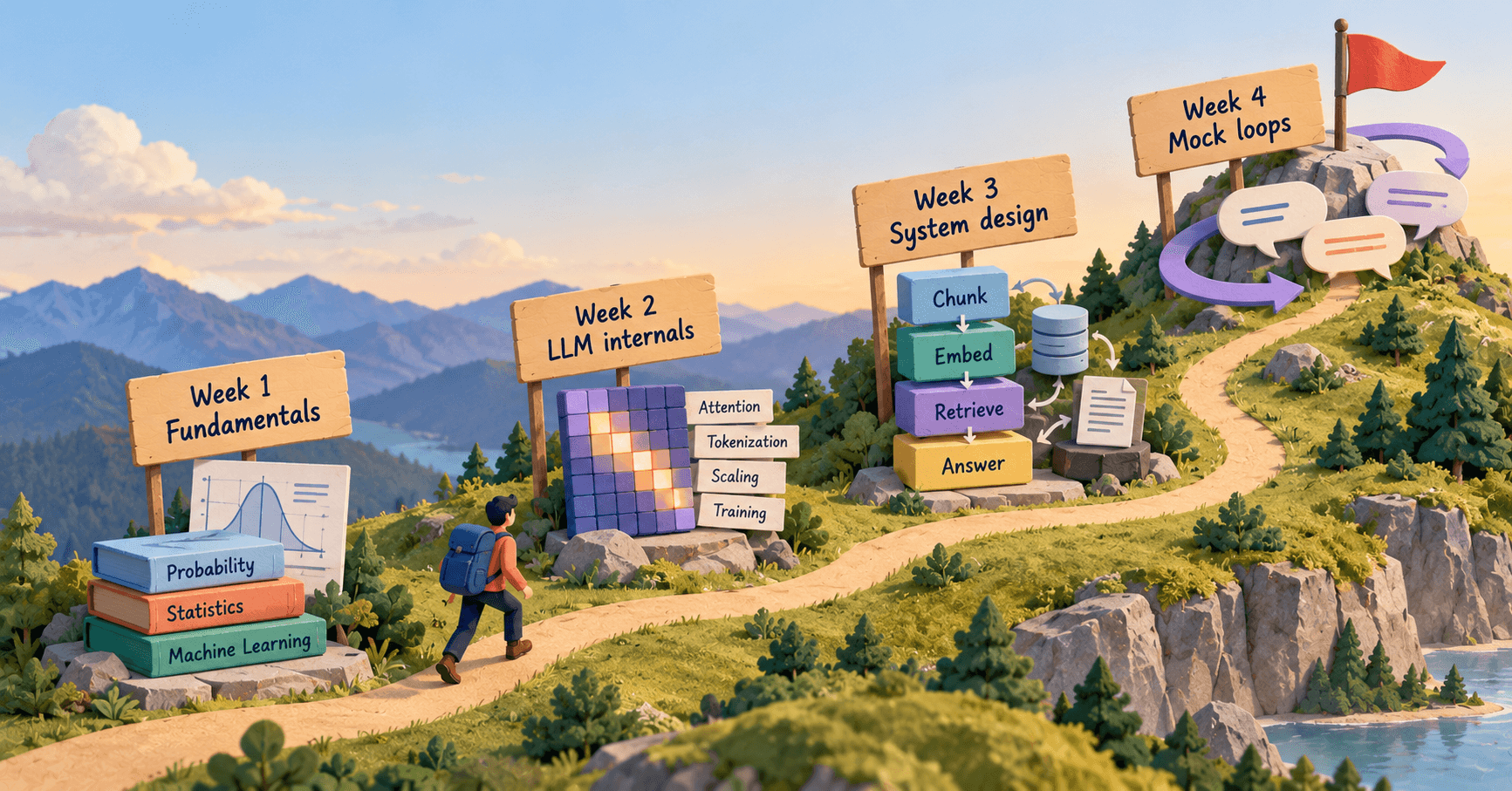
Last updated: October 2026.
Quick answer: Give each of four weeks one job. Week 1: ML fundamentals, spoken out loud. Week 2: LLM internals, including attention from scratch and the KV cache. Week 3: two system designs, one classic ranking system and one LLM application. Week 4: full timed mock loops and fixing whatever they expose. Read early in each week and spend the rest of it answering out loud.
The plan below assumes you already build or study ML and have about an hour or two a day. If you're starting from scratch, keep the order and stretch each week. Don't shuffle it. Each week leans on the one before, and a system design answer with shaky fundamentals underneath falls apart on the second follow-up question.
What Does an AI/ML Interview Loop Actually Test?
Loops differ by company and level, so read the job description first. The rounds that keep appearing for ML and AI engineer roles look like this:
- ML fundamentals. Rapid scenario questions: your model scores 99% on train and 65% on test, what do you check first?
- LLM internals. How attention and the KV cache work, plus the RAG versus fine-tuning call.
- ML coding. Implement a piece of a model or a training loop in Python, with NumPy or PyTorch.
- ML system design. Design a ranking system, an LLM-backed assistant, or both.
- Project deep-dive. One project of yours, questioned until you hit the edge of what you know.
The design round needs the most spoken practice. Drawing boxes is the easy part. The hard part is explaining how you'd know the system works and what it costs per request.
Why Four Weeks, and Why in This Order?
Four weeks is long enough to cover each layer once and short enough that week one is still fresh in week four. The order follows dependency. You can't defend a retrieval design if you can't explain what an embedding captures. You can't explain the KV cache if attention is fuzzy.
The trap is spending all four weeks on the comfortable part. People who like theory reread papers. People who like building skip to system design and hand-wave the math. Pick the week that scares you and protect its hours.
What Does the Week-by-Week Plan Look Like?
| Week | Focus | Daily drill (60 to 90 min) | End-of-week check |
|---|---|---|---|
| 1 | ML fundamentals | Two scenario questions answered out loud, plus one from-scratch implementation | Diagnose an overfitting case in the right order without notes |
| 2 | LLM internals | Implement or explain one component, then defend one design decision | Write attention from memory and explain the scaling step |
| 3 | System design | One full design per day, alternating classic and LLM | Talk through a RAG design in 30 minutes with half the time on evals |
| 4 | Mock loops | One timed mock round, then a fix session on its weakest answer | Two full mock loops back to back with no topic you'd dodge |
Week 1: How Do You Rebuild ML Fundamentals Fast?
Skip the textbook reread. Work from scenario questions, because that's the shape the round takes.
- Overfitting diagnosis. For the 99% train, 65% test case, start with the data. Check the split for leakage and duplicates, then check whether test comes from a different distribution than train. Only then reach for regularization. The order is the answer.
- Metrics. Know when accuracy misleads (imbalanced classes), when to prefer precision or recall, and what a calibrated probability buys you downstream.
- Bias and variance. Explain them through a learning curve you could sketch, without a formula.
- One implementation a day. Logistic regression with gradient descent on day one, k-means on day two, and so on. Keep each one small enough to finish.
Say every answer out loud, even alone. Written answers hide gaps that speaking exposes in the first ten seconds.
Week 2: Which LLM Internals Do You Need to Know Cold?
This is the week that separates current prep from prep built on older question lists.
- Attention from scratch. Project the input into queries and keys, score them against each other, then use the softmax weights to mix the values. Be ready for the follow-up on why the scores get divided by the square root of the key dimension: without it, the dot products grow with dimension and push the softmax toward a near one-hot output, where gradients get very small.
- The KV cache. Explain what it stores and why it exists: during generation, each new token reuses the keys and values already computed for earlier tokens. Then explain why memory grows with context length, and with the number of sequences in the batch. Expect to estimate the memory for a given setup in plain arithmetic.
- Decoding. What temperature changes, and what top-p sampling cuts off.
- RAG, fine-tuning, or prompting. Practice the decision with a concrete case, such as an assistant over internal docs that change weekly. Freshness of knowledge pushes toward retrieval. A fixed output format or tone pushes toward fine-tuning. Cost and latency matter too, but in this case freshness settles it.
Week 3: How Do You Practice Two Kinds of System Design?
Alternate days. The shared skeleton makes both easier.
Classic ranking or recommendation system:
- Pin down the objective and the business metric it serves.
- Describe the data and the labels, including where the labels are noisy.
- Split the system into candidate generation (fast, broad) and ranking (slower, precise).
- Pick offline metrics such as precision@k or NDCG, and say how an online A/B test confirms them.
- Cover serving latency, then monitoring and drift after launch.
LLM application, usually a retrieval-augmented assistant:
- Chunking: what size, what overlap, and what breaks when chunks are too big or too small.
- Embedding and indexing: which content gets embedded, and how the index is refreshed when documents change.
- Retrieval and reranking: how many candidates come back and what reorders them.
- Prompt assembly: how the retrieved text and your instructions share the context window with the user's question.
- Evaluation: a labeled question set, a model-graded rubric where labels run out, and the regressions you'd track release to release.
- Cost per request and latency, plus access control so one user can't retrieve another team's documents.
Spend half your answer on steps 5 and 6. That's where the follow-ups go, and it's where a memorized diagram stops helping.
Week 4: What Should the Final Week of Mock Interviews Look Like?
Stop learning new material by about day two. The job now is retrieval under pressure.
- Run one timed mock round a day, rotating through the round types listed at the top of this post.
- After each one, pick the single weakest answer and redo it the same day. Don't re-run the answers you already nailed.
- Prepare your project story with numbers you can defend, such as the baseline you beat and by how much.
- Rehearse the behavioral side with the STAR method, which keeps project stories from wandering.
Two days before the interview, do a full loop back to back. Then rest.
What Can You Safely Skip?
Some prep feels productive and moves the needle very little.
- Reading papers end to end. Read the method section and the figures. The related-work section won't come up.
- Memorizing parameter counts and benchmark scores. They change constantly. Explaining why a design choice matters is the durable skill.
- Grinding hard algorithm puzzles for an ML role. If the loop has a general coding round, medium-level practice covers it. The ML coding round wants a clean, correct implementation of a model component.
- Building a giant flashcard deck. A card you recognize won't help when you have to explain the idea from a blank start.
If the loop also includes an AI-allowed coding round, the skills shift again. How to Prep for an AI-Allowed Coding Interview covers that format.
How Do You Know You're Ready?
Run this self-test at the end of week four. If you can do every item out loud, without notes, you're ready to interview.
- Diagnose a train/test accuracy gap and name what you check first, and why.
- Write scaled dot-product attention from memory and explain the scaling.
- Estimate KV cache memory for a model configuration someone gives you.
- Argue RAG versus fine-tuning for a specific case and name what would flip your answer.
- Design a ranking system from objective to monitoring in 30 minutes.
- Design a retrieval-augmented assistant and spend half the time on evaluation and cost.
- Tell your project story in two minutes, then survive five follow-up questions on it.
Any box you can't tick is next week's first drill. If the role leans toward data science rather than engineering, compare this list with what data science interviews test in 2026, which weights statistics and experiment design more heavily.
How Does PokeBot Fit Into This Plan?
The plan needs two things: good questions to work from, and a way to practice answering them out loud with feedback.
- The reading half. The AI/ML Engineer Interview Workbook has 21 questions restated from 2024 to 2026 publicly shared interview experiences, each with an original worked solution and the interviewer follow-ups to expect. Its three chapters line up with weeks one to three of this plan:
- ML Fundamentals
- LLMs & Generative AI
- ML System Design & Applied Cases
- The speaking half. In the app, pick your target role (the AI/ML interview prep page shows how), then run Technical sessions in Interview Practice out loud and get scored feedback after every session. That's your week four.
- Keeping score. The Progress Tracker shows your mock interview score trends over time, and its Skill Matrix turns a Skill Gap Analysis for your target role into actions you check off. Use it to see whether week four is moving your weakest area.
Frequently Asked Questions
How long does it take to prepare for an AI/ML engineer interview?
Four focused weeks is a realistic window if you already work with ML and need to sharpen it for interviews. Spend week one on ML fundamentals, week two on LLM internals, week three on system design, and week four on full mock loops. Starting from little ML background, expect the fundamentals alone to take longer, and stretch the plan rather than skipping weeks.
What topics should I study for an AI/ML interview?
Four areas cover the technical rounds. ML fundamentals: diagnosing overfitting, choosing metrics, and explaining trade-offs. LLM internals: attention, the KV cache, decoding, and when to use RAG, fine-tuning, or prompting. ML system design: both a classic ranking or recommendation system and an LLM application. Coding: implementing core pieces like attention or a training loop in Python. Add a project deep-dive story for the behavioral side.
Do I need to implement attention from scratch for an ML interview?
You should be able to. Writing scaled dot-product attention in a few lines of Python, and explaining why the scores are divided by the square root of the key dimension, is a reasonable bar for LLM-focused roles. It shows you understand the mechanism well enough to debug it, which is what the question is testing.
How do I prepare for an LLM system design interview?
Practice one end-to-end design until you can draw it from memory: a retrieval-augmented assistant over a document set. Walk through chunking, embedding, retrieval, reranking, and prompt assembly, then spend at least half your answer on evaluation, latency, cost, and failure modes. Rehearse it out loud, because the follow-up questions decide the round.
Is classic ML system design still asked if the role is LLM-focused?
It can be, so prepare one classic design too. A ranking or recommendation system, built as candidate generation followed by a ranking model, with offline metrics like NDCG and an online A/B test, covers the pattern. The two designs share the same evaluation and monitoring questions, so the practice transfers.
What is the most overlooked part of AI/ML interview prep?
Saying answers out loud. Reading a solution until you recognize it feels like progress, and it doesn't prepare you to explain a trade-off in real time with someone pushing back. Timed, spoken mock sessions in the last two weeks close that gap faster than more reading.
How can PokeBot help with AI/ML interview prep?
PokeBot's AI/ML Engineer Interview Workbook has 21 questions with original worked solutions, across ML fundamentals, LLMs and generative AI, and ML system design. In the app, Interview Practice lets you run technical mock sessions out loud with scored feedback, and the Progress Tracker shows your score trends and a Skill Matrix built from your skill-gap analysis.