
Should You Skip the ATS and Email the Hiring Manager Directly?
Direct outreach to hiring managers works in specific situations. An honest case for when to try it, when to skip it, and a word-for-word cold email template.
Last updated: August 2026.
Quick answer: Yes, email the hiring manager directly, but apply through the portal as well. The email gives you a second way in, and your application still needs to be in the system. It works when you have something specific to say and a named person to say it to. It fails when your message is generic, or when it lands in a central recruiting inbox at a company where recruiters handle the first screen. Below is when to do it, how to find the right contact, and a template that doesn't read like a mass email.
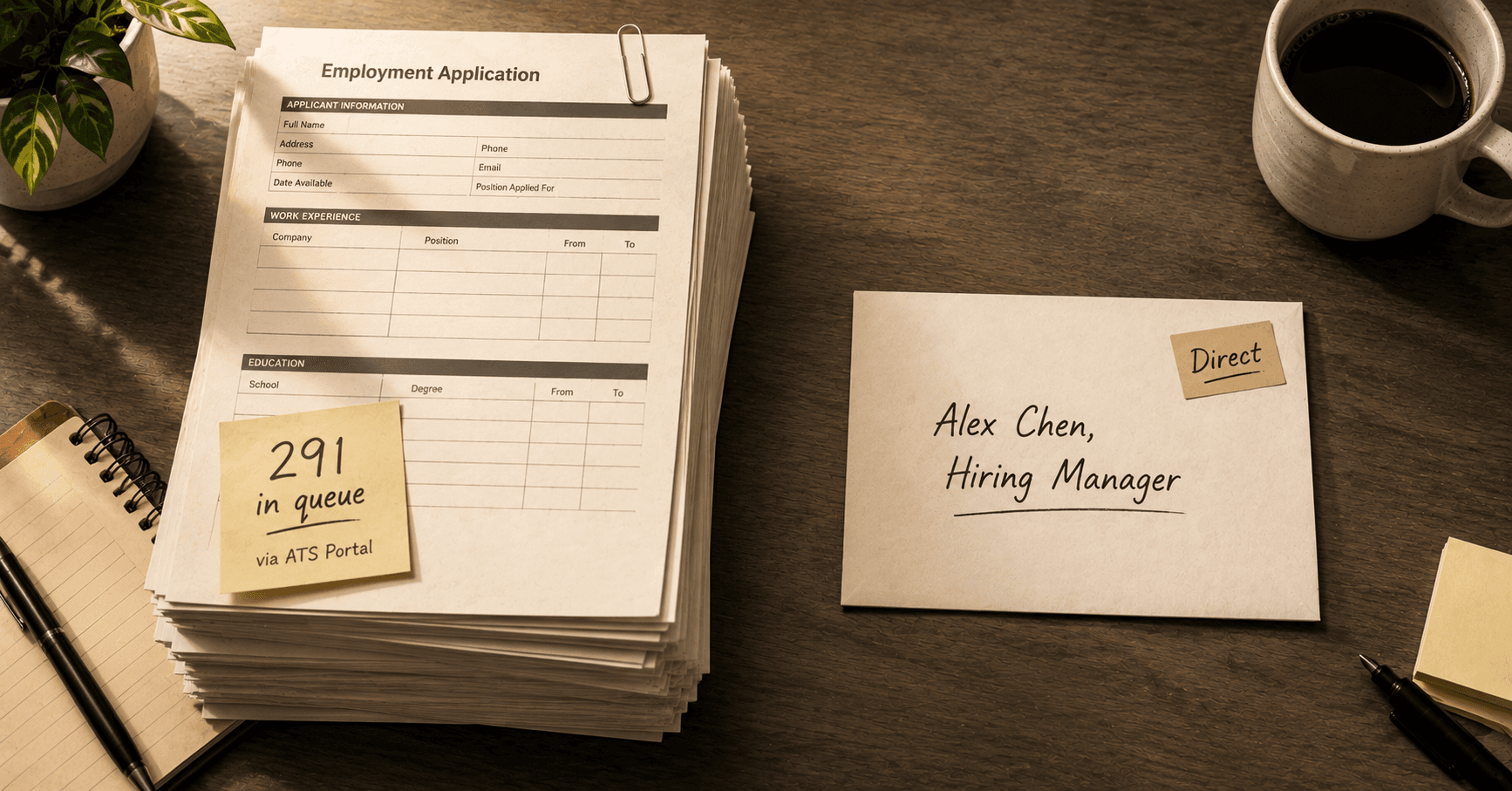
For many openings, one-click apply buttons and mass-application bots have pushed up the number of applications, while the number of hires stays the same. The people reviewing those applications have less time for each resume. The application funnel math has shifted, and the front door is more crowded than it used to be.
Emailing the hiring manager is a side door. Fewer candidates use it, which is why a good email can stand out.
When Does Cold Outreach to a Hiring Manager Work?
Plenty of hiring managers are fine with being emailed directly. What matters is whether you have something useful to say.
Direct email tends to work in these situations:
- The company is small or mid-size. At many companies under a few hundred employees, hiring isn't routed through a central HR queue. The hiring manager probably reads their own email and owns the early decisions.
- You have a specific reason to reach out. For example, a project that maps directly to what they're building, or a result they won't see from your resume header alone.
- The role has been posted for two or three weeks. This is when a well-timed email is less likely to land in a pile that's already been worked through, and when it's worth confirming the role is still moving.
When Should You Skip the Direct Email?
Some postings say no direct outreach. Take that seriously, because emailing anyway suggests you didn't read the posting.
At large companies where applications feed into a centralized ATS and recruiters own the early screening, the hiring manager typically isn't involved until candidates have already been filtered. Your email may arrive after the first cut is done. At those companies, your time is better spent getting a warm intro from someone inside, which can move you up the stack.
The other situation to skip: you have nothing specific to say. An email that amounts to "I'm passionate about this opportunity and would love to connect" gives the hiring manager nothing to act on. It goes in the same mental pile as every other application.
Should You Send the Email or Skip It?
| Situation | Send the email? |
|---|---|
| Small or mid-size company, identifiable hiring manager | Yes |
| Large company with centralized HR or recruiting team | No |
| You have a specific proof point or result to mention | Yes |
| Your message would be "I'm excited about this role" | No |
| Posting explicitly says no direct outreach | No |
| Role has been posted for 2+ weeks | Yes |
| You'd be emailing a shared recruiting inbox | No |
How Do You Find the Right Person?
Start on LinkedIn. Search the company name combined with the team or function mentioned in the posting. The hiring manager is typically one or two levels above the role. For a product analyst opening, look for the head of analytics or the director of product. For a junior engineer, look for the engineering manager or team lead on the relevant team.
Once you have a name, try these formats in order:
firstname.lastname@company.comfirstnamelastname@company.comf.lastname@company.com
You can often figure out the correct format by checking a known contact at the same company, or by running the address through an email-verification tool to confirm it exists before you send. If you find the name but can't confirm the email, a LinkedIn direct message works just as well for first contact.
Don't send the same email to several people at the company. Write to one person, and if they're the wrong contact, they'll often tell you who to reach.
What Does a Good Cold Email Template Look Like?
Keep it short: under 150 words, with no attachments in the first email. All it needs to do is get the hiring manager to pull up your application and read it.
Subject: [Role title] application ([Your name])
Hi [Name],
I applied for the [role title] opening through [company's portal] and wanted to reach out directly.
I've spent the past [X] years [one-line description: what you do and in what context, e.g., "building data pipelines at fintech startups"]. I came across [company name]'s work on [something specific you actually know: a product, a team, a recent announcement], and that's what made this role stand out.
The one thing I'd flag from my background: [single most relevant proof point, e.g., "I built a similar ingestion system that cut data latency from six hours to 40 minutes"].
Happy to answer any questions. Thanks for the time.
[Your name] [LinkedIn URL]
A few things that make this work:
- The subject line is plain. "Excited to connect!" and "Quick question" tend to get ignored. Your name and the role title are enough.
- The hook is specific. You named something specific about the company, which shows you want this job in particular, beyond a general interest in the industry.
- The proof point is one thing. One result or one skill that maps directly to what they're hiring for, in a single sentence.
- The ask is small. You're flagging your application and making it easy for them to pull it up, without asking for a call.
If a week passes with no response, one follow-up is fine. Keep it to one sentence: "Wanted to follow up on my note from last week. Still very interested in the [role]." Send two follow-ups at most, then move on.
Should You Still Apply Through the Portal?
Yes. The email works alongside your application, so apply first and then send it. That way your application is in the system when the hiring manager looks it up.
The same logic applies to what you're sending them to look at. A direct email that creates curiosity, followed by a generic resume, wastes the opening you just made. Your resume still needs to be specific to the role.
Resume Studio in the Resume Builder room can generate both a role-tailored resume and a cold email in the same session, so both documents point to the same relevant experience. The cold email draft it produces is built from your resume and the job description.
The strategic job search case for doing fewer applications with more care points in the same direction. When you've done the research to write a specific email, you've already done the research to write a strong application.
Score your resume free, create your PokeBot account
So, Should You Email the Hiring Manager?
Cold email works best at a small or mid-size company, for a role that's been posted for two or three weeks, when you have a specific result or project to point to. You send a 120-word email to the person one level above the role and follow up once. That can be enough to get you on a call.
What makes it work is the part most applicants skip: finding out who reads the applications for the role, and writing something only someone who did that research could write. The hiring manager can see that effort before opening your resume.
Frequently Asked Questions
Should I email the hiring manager directly instead of applying online?
Do both. Submit the application through the portal and send a short direct email. The email is a second path in when the portal queue is slow, and it works best when your application is already in the system. Skip the direct email at large companies where hiring is fully centralized in HR, or when you have nothing concrete to add beyond 'I applied.'
How do I find the hiring manager's email address?
Start on LinkedIn. Search the company name plus the team or function in the posting, and look for people one or two levels above the role. Then try the most common formats: firstname.lastname@company.com, firstnamelastname@company.com, or f.lastname@company.com. An email-verification tool can confirm whether an address exists without you having to guess. If you find the name but can't confirm the email, a LinkedIn direct message works just as well.
What should a cold email to a hiring manager say?
Four things: why you're writing (the specific role), one concrete reason you're relevant, a direct ask, and your application reference. Keep it under 150 words. No attachments in the first email.
Is emailing a hiring manager annoying or inappropriate?
Usually not, as long as the posting doesn't say otherwise. What annoys people is a long email with no specific reason to respond, follow-ups every two days, or messaging multiple people at the company simultaneously. One well-targeted email followed by one follow-up after a week is entirely reasonable.
What's the difference between a cold email to a hiring manager and a warm intro?
A warm intro comes through a mutual connection who vouches for you. A cold email is direct outreach with no prior relationship. Cold emails tend to have lower response rates, so the email itself has to do more work: you need a stronger hook and a cleaner ask. If you have a path to a warm intro, take it first.
When should I skip emailing the hiring manager directly?
Skip it if the posting says no direct outreach. Skip it at companies where applications feed into a centralized recruiter queue. And skip it if you have nothing specific to say beyond 'I applied and I'm excited.' That message gives the hiring manager nothing to act on.
Can PokeBot help me write a cold email to a hiring manager?
Yes. Resume Studio in the Resume Builder room generates a role-targeted cold email alongside your resume and cover letter. It pulls from your uploaded resume and the job description, so the email refers to your own relevant experience.