
The Onsite Is Back: Prepping for In-Person, No-AI Interview Rounds
Google and McKinsey reinstated in-person interview rounds in 2025 to counter AI-assisted cheating. Here is how to prep for an onsite with no AI to lean on.
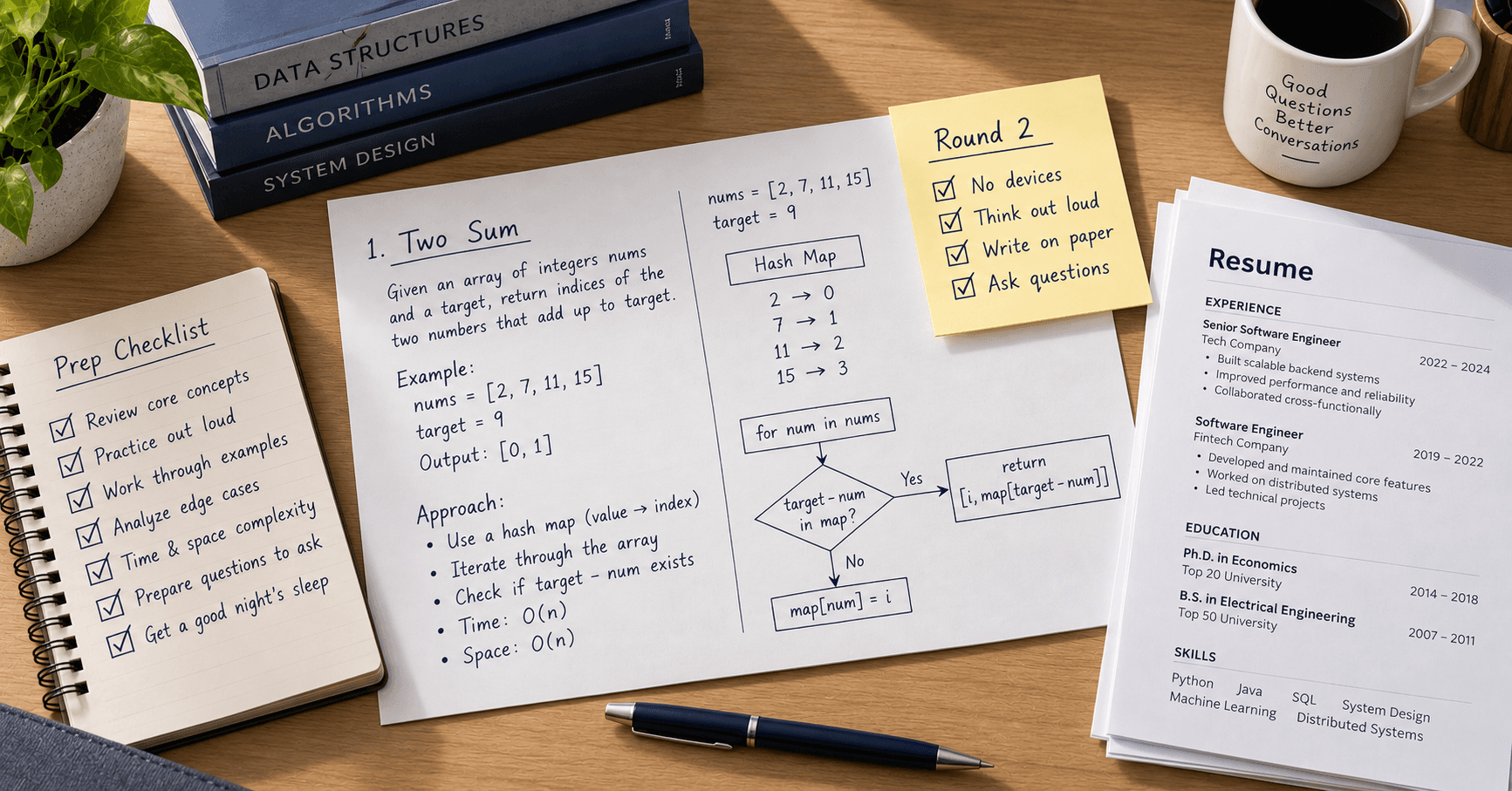
Last updated: September 2026.
Quick answer: Several major employers, Google and McKinsey among them, reinstated in-person interview rounds in 2025 to counter AI-assisted cheating in remote loops, and more employers have added them since. If your upcoming interview includes an onsite, the most important preparation is practicing out loud, from memory, with no AI assist. The rest is logistics and stamina. This guide covers both.
The shift is already affecting candidates in tech and consulting. Google's CEO confirmed the move publicly, and McKinsey followed. Both companies gave the same reason, and other employers that made the change followed the same logic: remote interviews became hard to trust as AI-assisted cheating in video-based assessments rose through 2025.
For candidates who have grown used to a second screen, or whose prep has been mostly reading rather than speaking, this changes what it means to be prepared.
Why Did In-Person Rounds Come Back?
A candidate on a video call can run a model on a second screen or use whisper-mode tools to receive prompted answers during the call. Both became common enough that some employers stopped trusting remote results to show what a candidate can do.
The logic behind the shift is simple: a candidate at a whiteboard in the same room has none of those options. Being in the room solves the cheating problem without any need for sophisticated detection. That is what drove the move at Google and McKinsey, and the trend spread from there.
What Does an Onsite Look Like?
An onsite is a full sequence, usually three to six sessions back-to-back, each with a different interviewer. Here is a representative structure for a software engineering role:
| Session | Format | What it assesses |
|---|---|---|
| Coding round 1 | Whiteboard or paper, no AI | Algorithm thinking, ability to work out loud |
| Coding round 2 | Same format, different problem | Consistency and recovery when stuck |
| System design | Diagram and discussion | Architecture reasoning, communication clarity |
| Behavioral | Structured story-based questions | Judgment, ownership, and past decision-making |
| Hiring manager | Open conversation | Motivation and team fit |
Consulting onsites replace the coding rounds with cases, sometimes presented as written packets rather than verbal prompts. Product management onsites often include a product critique or a short presentation. The format changes by field, but in each case several people assess you over several hours, with nothing to fall back on and no easy way to buy time.
For most candidates, the hardest part is staying sharp and consistent from the second session to the fifth.
What Do Onsite Interviewers Watch For?
The rubric covers the obvious: did you solve the problem, did you answer the behavioral question fully. But there is a second layer that only shows up in person.
Interviewers watch how you handle getting stuck. If you hit a wall in a coding round, freeze, and are still frozen thirty seconds later, you come across differently from someone who says "I'm not sure this is the most efficient approach, but here's where I'd start" and keeps working. The second candidate is showing how they work when things get hard.
They also notice transitions. If you get stuck in a coding round and then walk into a behavioral interview two minutes later, can you reset? Interviewers can see when a candidate carries stress from one session into the next, and candidates who can set it aside stand out.
And they notice engagement. An interviewer asking "what's your reasoning there?" wants to see whether you can explain your thinking and adapt when pushed. That exchange often tells them more than your final answer does.
What Should You Drill Without AI?
You build these skills by practicing them the hard way: out loud, with a timer, with no notes and no model.
Behavioral preparation
- Write down ten experiences that each show one of: judgment under pressure, taking ownership of a failure, a conflict you navigated, or something you taught yourself from scratch
- Practice each one out loud targeting two minutes per answer, and time yourself, because many candidates run either 45 seconds (too thin) or five minutes (too long)
- After each answer, immediately ask yourself "why did you make that call?" and answer that out loud for another 60 seconds
- Run at least three full behavioral sessions with no notes and no pausing
Technical preparation (SWE and quant roles)
- Work problems on paper rather than a keyboard, since writing by hand slows you down and makes you think each step through
- Talk out loud the whole time, especially when you are unsure
- Practice "working through failure" explicitly: at the 20-minute mark on any problem you have not solved, say out loud what you would try next and why
- Time every problem; 35 minutes is a common onsite budget per round, so stop and review at the cutoff whether or not you finished
Day-of preparation
- Confirm the full address, floor, and the name of your contact at the front desk
- Map your backup transit option in case your primary route fails
- Eat before you arrive: you will talk for hours, and hunger wears down your thinking before you notice it
- Silence your phone completely and leave it in your bag during each session
The reset drill (usually skipped)
- Deliberately practice an emotional reset under time pressure: work a hard problem until you get stuck, then immediately pivot to a behavioral question and answer it in full. The point is building the habit of switching gears when you are frustrated and mid-task.
What Is the Biggest Preparation Mistake?
It is preparing heavily for content and too little for delivery.
Knowing 150 LeetCode problems does not help much if you freeze when asked to work one out loud with someone watching. Knowing every STAR story you have does not help if you cannot feel when two minutes is up and it is time to stop. Strong content gets you to the onsite, and once you are in the room, delivery is what separates candidates who know the same material.
Delivery is a physical skill, so you build it by speaking your answers out loud. Doing that to an empty room feels uncomfortable and slightly absurd, but do it anyway, and do it often.
How Does Out-Loud Practice Carry Over to the Real Interview?
Speaking practice works because it trains what you will do in the interview itself. Saying an answer is harder than writing one, and thinking out loud under a time limit is harder than thinking quietly with no clock. Reading a guide can make you feel prepared, but that feeling does not reliably predict how you will perform in the room.
PokeBot's Interview Practice runs structured, timed sessions across behavioral and technical formats, with scored feedback on what you said and, in Audio Mode, your speaking pace. The reps are close enough to the real thing to make the interview itself feel familiar.
For behavioral questions, the STAR format gives you the right structure. The mistake is memorizing scripted answers, which sound rehearsed and collapse under follow-up questions. Instead, know your stories well enough to tell them from memory and cut them short when the interviewer signals they have what they need.
If you want to work on your closing, the list of questions to ask at the end of an interview gives you a solid bank to practice with. Onsites typically end with the hiring manager session, and how you close that conversation stays with the interviewer.
What Should You Focus On One Week Out?
With one week before an onsite, content review is mostly done, so skip new material and practice performing what you already know under pressure. Spend the week like this:
- Two full mock behavioral sessions, timed, no notes, no AI
- Three to five coding problems on paper, worked out loud start to finish
- One clean pass through your strongest stories for this specific role, checking that each one is tight and concrete
- Logistics confirmed: address, backup transit, outfit decided
Frequently Asked Questions
Are companies really bringing back in-person interviews in 2026?
Yes. Google and McKinsey reinstated in-person rounds in 2025 to address AI-assisted cheating in remote loops, and some other employers now require at least one onsite session before extending an offer. If your loop suddenly includes an in-person visit, this is likely why.
What happens at an onsite interview?
An onsite is a series of back-to-back sessions, typically three to six, each with a different interviewer. A tech onsite usually includes one or two coding rounds, a system design discussion, and a behavioral interview. Consulting onsites swap coding for cases. You complete all rounds in one day, often at the company's office.
How is an onsite different from a video or phone interview?
Presence is the obvious difference: interviewers read your body language, watch how you handle pressure across a full day, and see how you engage in real time. There is no second screen and no AI to prompt you. You also meet more people in sequence, so consistency across sessions matters as much as any single answer.
How do I prepare for an onsite when I cannot use AI assistance?
Practice out loud, alone, without notes or AI. Pick ten behavioral questions, set a timer, and answer each one out loud from memory, targeting two minutes per answer. For technical rounds, work problems on paper rather than a keyboard, talking through your reasoning as you go. Do this daily in the two weeks before the interview.
What should I bring to an onsite interview?
Copies of your resume and a pen and notebook. Silence your phone and leave it in your bag during each session. Arrive ten minutes early, know the address and the name of your contact at the front desk, and have a backup transit plan in case your first route fails.
What do onsite interviewers actually score against?
Interviewers running structured interviews usually score against a rubric covering problem-solving approach, clarity of communication, how you engage with the question beyond just the answer, and whether you recover well when you get stuck. Body language and how you handle transitions between sessions also factor in, and a remote loop does not show either of those.
How does PokeBot help me prep for an onsite interview?
PokeBot's Interview Practice lets you run timed, structured sessions across behavioral and technical formats, the same session types you will face in a real onsite loop. You answer out loud in Audio Mode and get scored feedback on what you said, plus your speaking pace, without needing a practice partner to schedule around.