
How to Prepare for Your Performance Review: Scripts, Templates, and a Practice Loop
A self-review template, scripts for the raise and growth conversation, and a rehearsal loop for your performance review, so you walk in with data instead of hoping for the best.
Last updated: October 2026.
Quick answer: A performance review shifts in your favor when you arrive with evidence instead of impressions. The preparation that matters is a self-review written in outcome language and at least one practice run before the real thing. The scripts and templates below build both.
The default posture in a performance review is to let the conversation happen to you. You recap the year from memory, then respond to whatever feedback your manager raises. The employees who leave with raises and clear paths forward prepare for it the same way they'd prepare for any high-stakes conversation.
Skip that preparation and you rely on your manager's memory of your year, which is shorter than yours and subject to recency bias. The review that should document your best work turns into a summary of what your manager happened to notice.
Why Does Outcome Language Make a Self-Review Work?
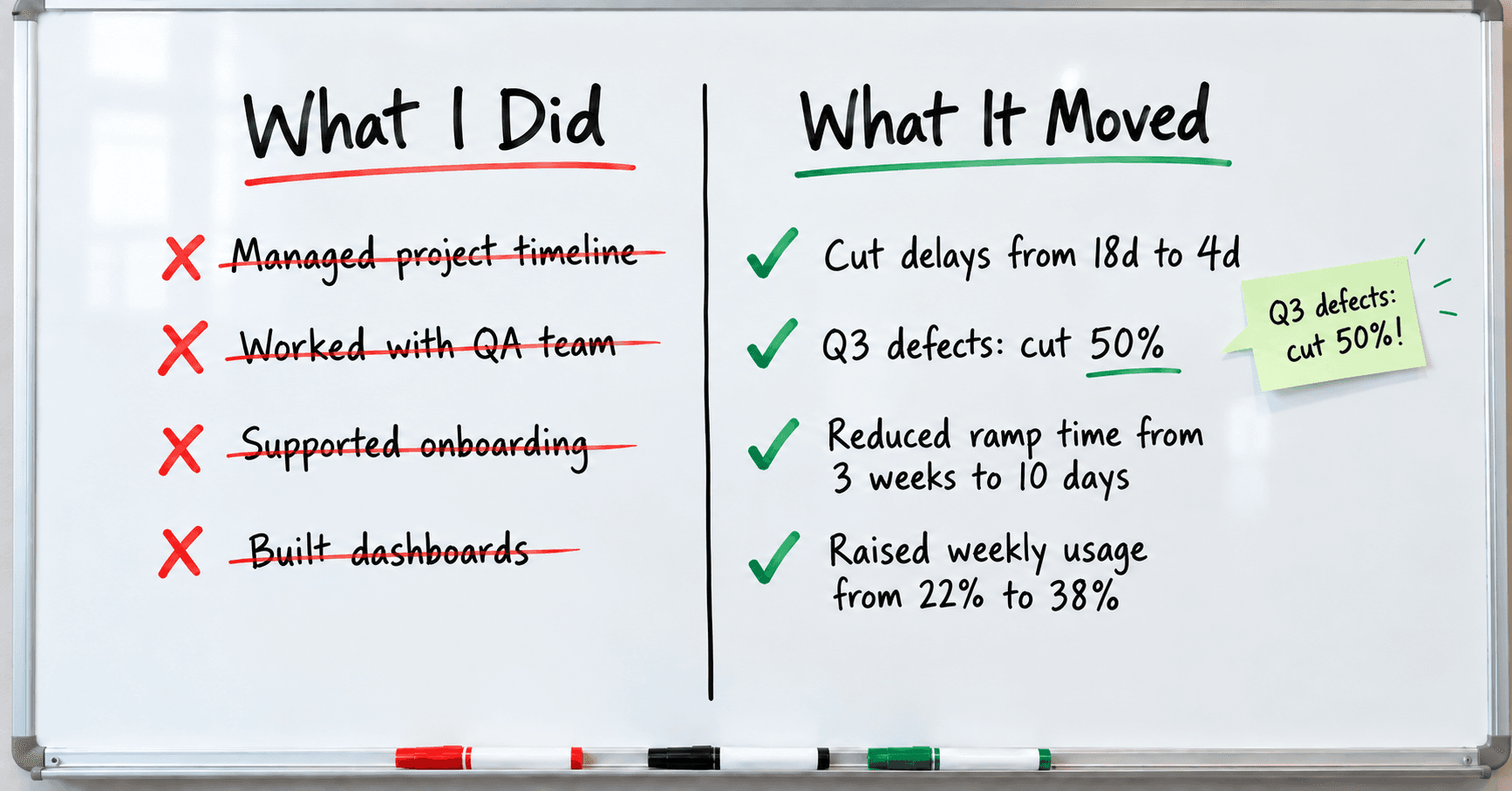
The gap between a strong self-review and a weak one is almost entirely about outcome language versus activity language.
"Contributed to the Q3 launch" is activity language. "Owned QA for the Q3 launch and caught 14 regressions before release, cutting post-launch defects by more than half versus Q2" is outcome language. One describes what you were present for; the other describes what moved because of you.
What to include per major contribution:
- What you owned (project, initiative, or standing responsibility)
- What you shipped or measurably improved
- The business impact: time saved, metric moved, or problem solved
Start with your strongest contribution, not your most recent one. Managers read the top and skim the rest.
What to skip:
- Activities without outcomes ("participated in the leadership program")
- Team wins you cannot claim individually
- Complaints about the year's challenges, unless you have a specific ask about resourcing attached
This table helps organize before you write:
| Contribution | Outcome | Evidence you can name |
|---|---|---|
| Project or initiative | Metric moved, feature shipped, or problem solved | Date, number, or named person who saw it |
| Standing responsibility | How you raised the standard or scale | Comparison to baseline or prior cycle |
| Skill built or stretched | Where you applied it and what changed | A moment you handled something new |
Fill in the table first, then write the self-review from it.
What Scripts Do You Need for a Performance Review?
Three conversations happen in almost every review. Prepare a script for each one.
The raise ask
Frame it as a business case, not a request. The difference matters because a request leaves the decision entirely with your manager; a business case requires them to respond to your argument.
Script: "I'd like to discuss compensation. This year I [specific outcome at a specific scale]. I've also taken on [expanded scope or responsibility]. I'd like to move my base to [number or range]."
Then stop talking and let your manager respond. A long justification after the number weakens it.
The growth conversation
Every review should end with clarity on two things: what is expected in the next cycle, and what it would take to reach the next level. If your manager doesn't raise both, you should.
Script: "I want to make sure I'm clear on what a strong next year looks like. What outcomes would be most important to you? And what's the gap between where I am now and [title or level above yours]?"
Writing the answer in real time signals that you're taking it seriously. It also creates a record you can reference when the next review comes around.
Handling critical feedback
When feedback stings, the instinct is to explain or push back immediately. A clarifying question works better.
Script: "Can you give me a specific example of where you saw that?" or "Is there a particular project that comes to mind?"
Specific feedback is actionable. Ask for an example and vague feedback either becomes specific enough to act on or turns out to be a general impression rather than a documented concern. Both outcomes help you. The same reflex, staying curious instead of defensive, applies in job interviews too. If you've practiced it while preparing to answer "what's your greatest weakness?", you already have the instinct.
How Does a Practice Run Change the Outcome?
Reading the scripts helps, but saying them out loud under a little pressure is what makes them stick. One 20-minute practice session, where you state your self-review and field follow-up questions, makes the real conversation easier, because you have already heard yourself say the hard parts once.
In PokeBot's Mock Interview, the Performance Review practice (choose "Review with Boss") plays your manager and asks follow-up questions. Pick Hard for a tougher conversation. At the end you get a score, your strengths, areas to improve, and a flag if you came across as defensive. Run it two or three days before the real review, so you still have time to fix what it finds.
Practice your performance review free in PokeBot
What Does a Two-Week Prep Checklist Look Like?
| Task | When | Notes |
|---|---|---|
| Pull notes and project records from the full year | 2 weeks out | Don't rely on memory |
| Draft the self-review in outcome language | 1-2 weeks out | First draft, then cut to essentials |
| Identify the conversations you'll need scripts for | 1 week out | Raise? Growth path? Critical feedback? |
| Run one practice session | 2-3 days before | PokeBot's Performance Review practice or a trusted colleague |
| Read your self-review one more time | Night before | Know your three strongest contributions cold |
How Does This Connect to the Rest of Your Career Tracking?
If you've been tracking your career progress throughout the year, logging wins and outcomes as they happen, the review preparation is mostly done before you start. The data is organized rather than scattered across months of memory.
The STAR framework that works in job interviews applies directly here. Situation and task give context. Action is what you owned. Result is what moved. Most self-reviews are weak on action and result. That's the part to strengthen.
The review is also a legitimate venue for asks that don't have a natural home in normal workflow: a scope change, a support request, a promotion case. You have your manager's full attention and a format designed for honest conversation. Use the prep above to make those asks.
Frequently Asked Questions
How do I prepare for a performance review?
Three moves matter: write a self-review that leads with specific outcomes from the past year, prepare scripts for the conversations you expect (raise ask, growth goals, critical feedback), and run at least one practice session before you walk in. Showing up with data and prepared answers changes how the whole meeting goes.
What should I say in a performance review?
Lead with your strongest outcomes first. Name the project and the impact on the team or business. Then raise your goals for the next cycle so the review ends on a forward-looking note. If you want a raise or promotion, say so directly and anchor the ask to the work, not to tenure or cost of living.
How do I ask for a raise in a performance review?
Connect the ask to specific outcomes: 'I led the account onboarding redesign that cut time-to-first-value from six weeks to two. Based on that and the broader responsibilities I've taken on, I'd like to discuss moving my compensation to [range].' State the number and stop talking. Let them respond. A long justification after the ask weakens it.
How do I handle critical feedback in a performance review?
Ask for a specific example before responding: 'Can you give me a specific example of where you saw that?' That buys time, signals that you take it seriously, and reveals whether the feedback is precise or vague. Precise feedback you can act on. Once you ask for an example, vague feedback usually either becomes precise or turns out to be a general impression.
How long before a performance review should I start preparing?
Two weeks is enough if you have notes and project records from the year available. The night before is not enough time to do the self-review well. A 15-minute monthly log of wins and outcomes throughout the year makes review-time preparation almost trivial, because the data is already organized rather than buried in memory.
Should I mention a competing offer in a performance review?
Only if you have one and are prepared to act on it. Mentioning an offer and then staying after a no signals that you won't use leverage, which makes it harder to use next time. If you raise it, be ready for the answer to be no and have your next step clear before you say it.
What is a self-review and how do I write one?
A self-review is a written summary of your performance in the past cycle, submitted before the review or used as your opening in the meeting. Write in outcome language: name what you owned and what moved as a result. Start with your strongest contribution. List results, not activities.