
Quant Trader vs Quant Researcher: What the Interviews Actually Test
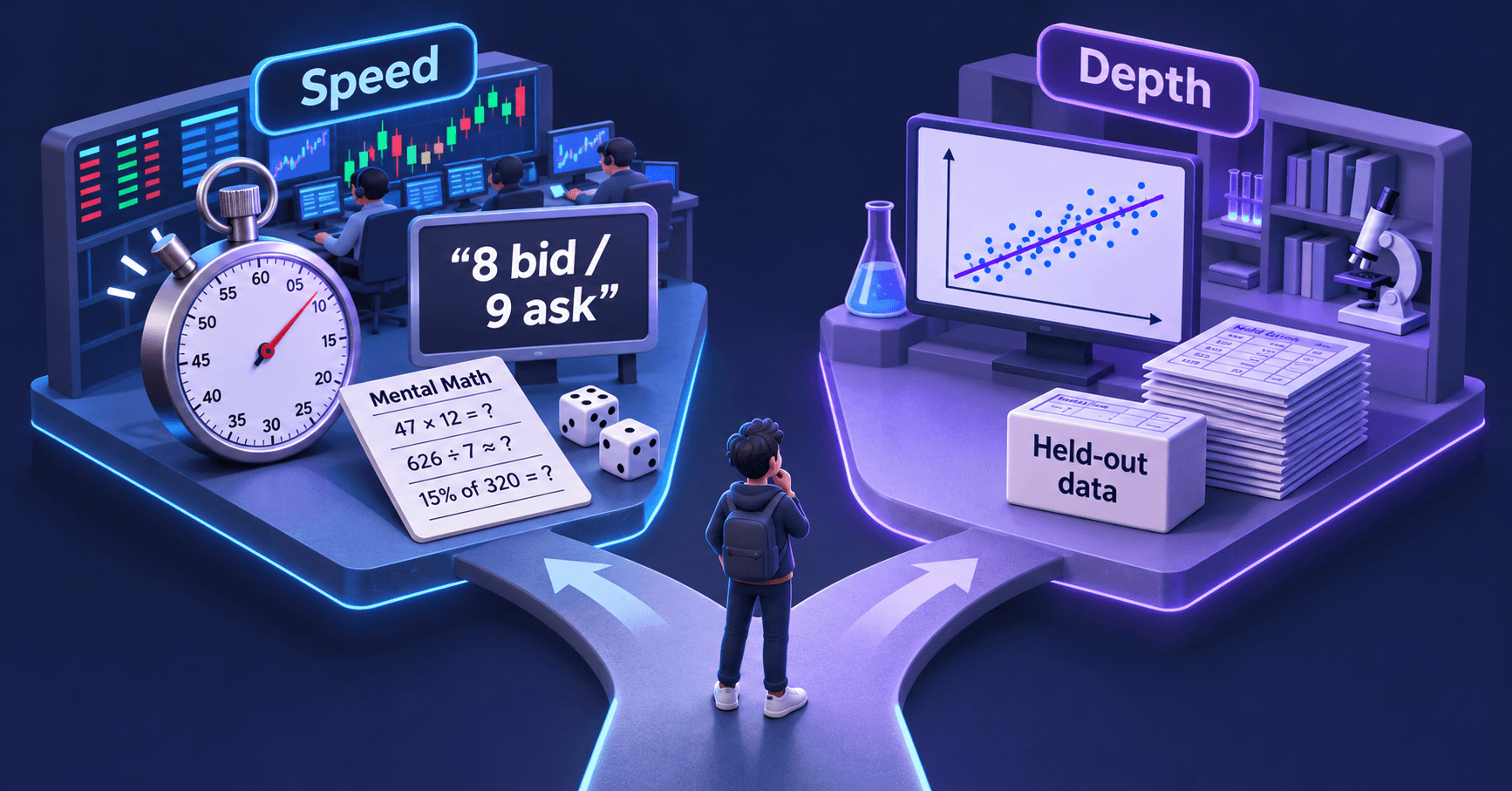
Trader interviews select on speed and composure in live games. Researcher interviews select on statistical depth. Here is what each loop tests and how to prep.
Last updated: November 2026.
Quick answer: Quant trader interviews test speed and composure: timed mental math, fast probability, live market-making games and bet sizing. Quant researcher interviews test depth: statistics, regression pitfalls, a grilling on past research and moderate coding. Both share a probability core. Past that, prep for the loop your target firms actually run.
A lot of quant prep material puts both roles under one heading, "quant interviews," and hands you the same list of brainteasers. That costs you time. The two loops are filtering for different people, and a strong trader candidate and a strong researcher candidate can each fail the other's interview.
If you want the day-to-day view of the researcher seat first, read what quant researchers actually do all day. This post is about the interviews themselves: what each round measures, and where your prep hours should go.
How Is the Quant Trader Interview Different From the Quant Researcher Interview?
The cleanest public summary of the split is QuantVault's comparison of the two roles (updated July 2, 2026). In their words:
- Trader loops: "mental math screens, fast probability, market-making games, sizing questions"
- Researcher loops: "statistics/ML depth, regression pathologies, research discussions, moderate coding"
The same page sums up the selection logic in one line: "QT selects hard on speed (mental math, live games, composure), QR on depth."
Here is that split laid out round by round:
| Quant trader loop | Quant researcher loop | |
|---|---|---|
| Early screen | Timed mental arithmetic, often with wrong answers penalized | Statistics and probability questions, sometimes an online test |
| What gets rewarded | A good answer fast, and staying calm when traded against | A correct answer with every assumption stated |
| Signature round | Market-making game: quote, get traded against, update | Research discussion: defend a past project under pushback |
| Probability style | Quick expected value and odds, often tied to a bet | Conditional reasoning that changes after your first answer |
| Statistics depth | Enough to price a bet sensibly | Regression pitfalls, inference, overfitting |
| Coding | Not on QuantVault's trader list; check the posting | Moderate: data handling and a simple analysis |
| A typical miss | Freezing, or never moving your quote after a trade | Trusting a result that looks too good |
The last row is the one to remember. Trader interviewers are watching for someone who stalls under pressure. Researcher interviewers are watching for someone who gets fooled by their own data.
What Does a Quant Trader Interview Actually Test?
Every round puts a clock on you, and most of them make you commit to a number while someone pushes back. Expect these rounds:
- A timed arithmetic screen. TraderMath's practice page (checked November 2026) describes one widely discussed format as "80 mental-arithmetic questions in 8 minutes, with negative marking." Six seconds a question with a penalty for misses means guessing is a bad strategy. A steady pace with near-perfect accuracy beats a fast pace with errors.
- Fast probability and expected value. Short questions where the answer feeds a decision: would you take this bet, and at what price?
- Market-making games. You quote a two-sided price on something uncertain. The interviewer buys or sells against you, then adds information.
- Sizing questions. You know your edge on a bet. How much do you put on?
Sizing is where candidates who studied only puzzles get caught. Take a made-up example: a bet pays even money and you win 60% of the time. The textbook answer from the Kelly rule is to stake 20% of your bankroll, because at even money the fraction is your win probability minus your loss probability. A strong candidate gives that number and then says why they would bet less in practice: their 60% is an estimate, and overbetting an edge you have misjudged does far more damage than underbetting it.
How do you play the market-making game well?
Here is an original walkthrough on a clearly hypothetical quantity, the sum of two fair dice.
The fair value is 7, so you open with a market around it, say 6.5 bid and 7.5 ask. The interviewer buys at your ask. Now you ask yourself why they bought. Maybe they know something. You move your quote up a little, perhaps 7 bid, 8 ask. Then the interviewer tells you one die shows a 5. The fair value becomes 5 plus 3.5, which is 8.5, so your new market goes around 8.5, and the spread can tighten because half the variance is gone.
Compare two ways of handling that information step:
Weak:
"Okay, one die is a 5... I'll stay at 7 bid, 8 ask, since I already moved once."
Strong:
"With one die known at 5, fair value is 8.5. I'll go 8 bid, 9 ask. The remaining die still has spread, but half the variance is gone, so I can quote tighter than I did at the start."
The weak answer protects the last quote. The strong one throws it away the moment the facts change, which is exactly the habit the game is built to test.
What Does a Quant Researcher Interview Actually Test?
These rounds give you more time per question and then spend it probing whether you would catch your own mistake. Expect these rounds:
- Statistics and machine learning questions. Inference, regression, model validation, and what to do when you have run many tests at once.
- Regression pathologies. A question that looks routine until you notice the trap.
- Probability with a twist. The interviewer changes one condition after your first answer to see whether you understood it or memorized it.
- A research discussion. You walk through a past project and the interviewer pushes on everything that could have fooled you.
- Moderate coding. Load messy data, compute something, and explain what could make it misleading.
A typical regression pathology: you add a second predictor that is highly correlated with the first. Predictions might barely change. The two coefficients, though, can swing wildly and their standard errors balloon, because the model cannot tell which of the two variables deserves the credit. A candidate who stops at "R² went up a bit" misses what the question was for.
The research discussion is where researcher loops are won or lost, and you cannot cram for it. You need one project you know cold. Be ready to say what you hypothesized before looking at any results. Above all, know how many variants you tried before the one you are showing, because that is the question the interviewer is circling. The Sharpe-of-3 question in our researcher guide shows the kind of skepticism interviewers want to hear.
What Does the Same Setup Look Like in Each Loop?
Both loops can start from identical props. Here is one hypothetical setup, a single six-sided die, asked two ways.
Trader version: "Make me a market on how many sixes come up in 60 rolls." Fair value is 10. You quote around it, get traded against, and update. The interviewer cares about whether your first price came out in a few seconds and whether you moved when you should have.
Researcher version: "You roll a die 600 times and see 120 sixes. Is it loaded?" You expect 100. The standard deviation of the count is the square root of 600 × 1/6 × 5/6, which is about 9.1, so 120 sits roughly 2.2 standard deviations above expectation. That is suspicious but short of proof, and a strong candidate says so, then asks how many dice were checked before this one was flagged. If this die was the worst of twenty fair ones, chance alone would produce a result that extreme roughly one time in four.
The trader is graded on a fast, sensible price. The researcher is graded on whether they question where the number came from.
Which Track Should You Prep For?
Prep for the seat your applications point at. Splitting your time evenly between both "to be safe" is how candidates end up mediocre at both. Spend a base layer on shared probability, using the 20 quant interview questions that keep appearing as your core set, then commit.
If you are aiming for trader roles:
- Drill timed arithmetic daily, scoring accuracy as hard as speed.
- Practice market-making out loud with a friend or a mock tool, including being traded against.
- Learn the Kelly rule and why practitioners bet a fraction of it.
- Rehearse thinking aloud, since a silent correct answer often earns less credit than a narrated one.
If you are aiming for researcher roles:
- Work through regression and inference until you can explain each common pitfall in one sentence.
- Build one research project on a public dataset, with held-back data and a count of every variant tried.
- Practice a short coding exercise on messy data each week.
- Rehearse a two-minute project walkthrough that ends with what would have proved you wrong.
Both loops also include behavioral rounds that candidates underrate. The STAR method guide covers how to structure those answers.
How Can You Practice Each Path With PokeBot?
Start on the quant prep page and pick quant trader or quant researcher as your target role. Your resume is scored 0 to 100 against that role's hiring bar, and the skill-gap diagnosis measures readiness for that specific seat, so your prep targets one seat.
The Quant Interview Workbook has 56 questions with original step-by-step solutions. Trader candidates should go to the Brainteasers & Market-Making Games chapter. Researcher candidates have three chapters aimed at them: statistical inference and time series, financial machine learning, and portfolio and risk.
Then practice the spoken rounds in Interview Practice. Both signature rounds happen out loud, so reading solutions only gets you part of the way. Add your own prompts, such as a market-making setup or your research walkthrough, under "I have my own interview questions," and you get scored feedback on how specific and structured your answer is.
Your resume still decides whether you get the interview at all, so make sure it reads like the seat you want.
Frequently Asked Questions
How is the quant trader interview different from the quant researcher interview?
Trader loops select on speed: timed mental-math screens, fast probability, market-making games and bet-sizing questions. Researcher loops select on depth: statistics and machine learning, regression pathologies, a discussion of past research and moderate coding. That split comes from QuantVault's comparison of the two roles, updated July 2026. Both loops share a probability core, so the overlap is real but smaller than most prep material implies.
Do quant traders need to know statistics and machine learning?
They need solid probability and expected value, and they need to reason about bets quickly. Deep statistics and machine learning are what researcher loops lean on. If your target firm hires traders, put the hours into mental math, market-making games and sizing first, then add statistics if the posting asks for it.
What is a market-making game in a trading interview?
The interviewer asks you to quote a bid and an ask on an uncertain quantity, such as the sum of two dice, then trades against your quote and feeds you new information. You are scored on whether your price is sensible, whether you adjust after being traded against, and whether you update correctly when information arrives. It is spoken and live, so out-loud practice matters more than reading.
Is the 80 questions in 8 minutes mental math test real?
A timed arithmetic screen in that shape is publicly described on practice sites. TraderMath's practice page describes an 80-question, 8-minute mental-arithmetic test with negative marking, so wrong answers cost you points. Formats change, so confirm what your firm uses with the recruiter. Because of the penalty, accuracy at a steady pace beats rushing through every question.
Do quant researcher interviews include coding?
Usually yes, at a moderate level. QuantVault lists moderate coding as part of the researcher loop, alongside statistics depth and research discussions. Expect to load and clean a dataset, compute a statistic or simple signal, and explain what could make your result misleading. Speed matters less than correctness and clear reasoning.
Can I prepare for both quant trader and quant researcher interviews at once?
You can share a base layer: probability, expected value and conditional reasoning appear in both loops. Past that, the tracks diverge, so split the rest of your time by where you are actually applying. Spending weeks on timed arithmetic for a researcher loop, or on regression theory for a trader loop, is the most common misallocation.
How can I practice quant trader or researcher interviews with PokeBot?
Pick quant trader or quant researcher as your target role on PokeBot's quant prep page and your resume is scored against that role's hiring bar. The Quant Interview Workbook has 56 questions with original worked solutions, including a market-making chapter for traders and three chapters aimed at researcher interviews. Mock interviews let you rehearse market-making or a research walkthrough out loud with scored feedback.