
What Does a Quant Researcher Actually Do? Day Job vs Interview
A quant researcher spends the day testing ideas against data and trying to break the best results. Here's that loop, and how interviews test it.
Last updated: October 2026.
Quick answer: A quant researcher turns an idea about why prices move into a trading signal that still works on data it has never seen. The day job is data work and backtesting, including deliberate attempts to break your own best result. Interviews test the same habits in miniature: statistical depth, plus the skepticism to distrust a backtest that looks too good.
Job postings for this role are accurate but abstract. Two Sigma's 2027 summer intern posting asks quant researchers to "Use the scientific method to develop sophisticated investment models and shape our insights into how the markets will behave." That sentence is true, and it still leaves you guessing what you would be doing at 2 p.m. on a Tuesday.
Below is the actual loop, then a map from each part of it to the interview round that checks it. Once you see what the job rewards, the interview questions stop looking random, and you can stop over-preparing the parts that carry little weight.
What Does a Quant Researcher Actually Do All Day?
The job is one loop, run over and over. QuantVault's 2026 comparison of quant roles compresses a researcher's day into four words: "Hypotheses, data work, backtests, papers-to-production." Each of those words hides a lot of work:
- A hypothesis. A reason some price should move, written down before you look at any results. A made-up example: "stocks that lag their sector after an earnings beat drift back toward it over the following weeks." Writing it first is what separates research from fishing through the data for anything that correlates with returns.
- Data work. Getting the data into a state where a test means something. Two traps catch people here. One is using a number on a date before it was actually published. The other is quietly dropping companies that later went bankrupt, which can make a backtest look far better than reality.
- A signal. The idea turned into a score you can compute for every asset on every day, using only information that existed that day.
- A backtest. The signal run through history with realistic trading costs, to see what it would have earned.
- An attempt to break it. Testing on data you held back from the start, and counting how many variants you tried before this one looked good.
- Production. Handing what survives to engineers and portfolio managers, then checking whether live results match the backtest. Two Sigma's posting folds testing and hand-off into one line: "Create and test complex investment ideas and partner with our engineers to test your theories."
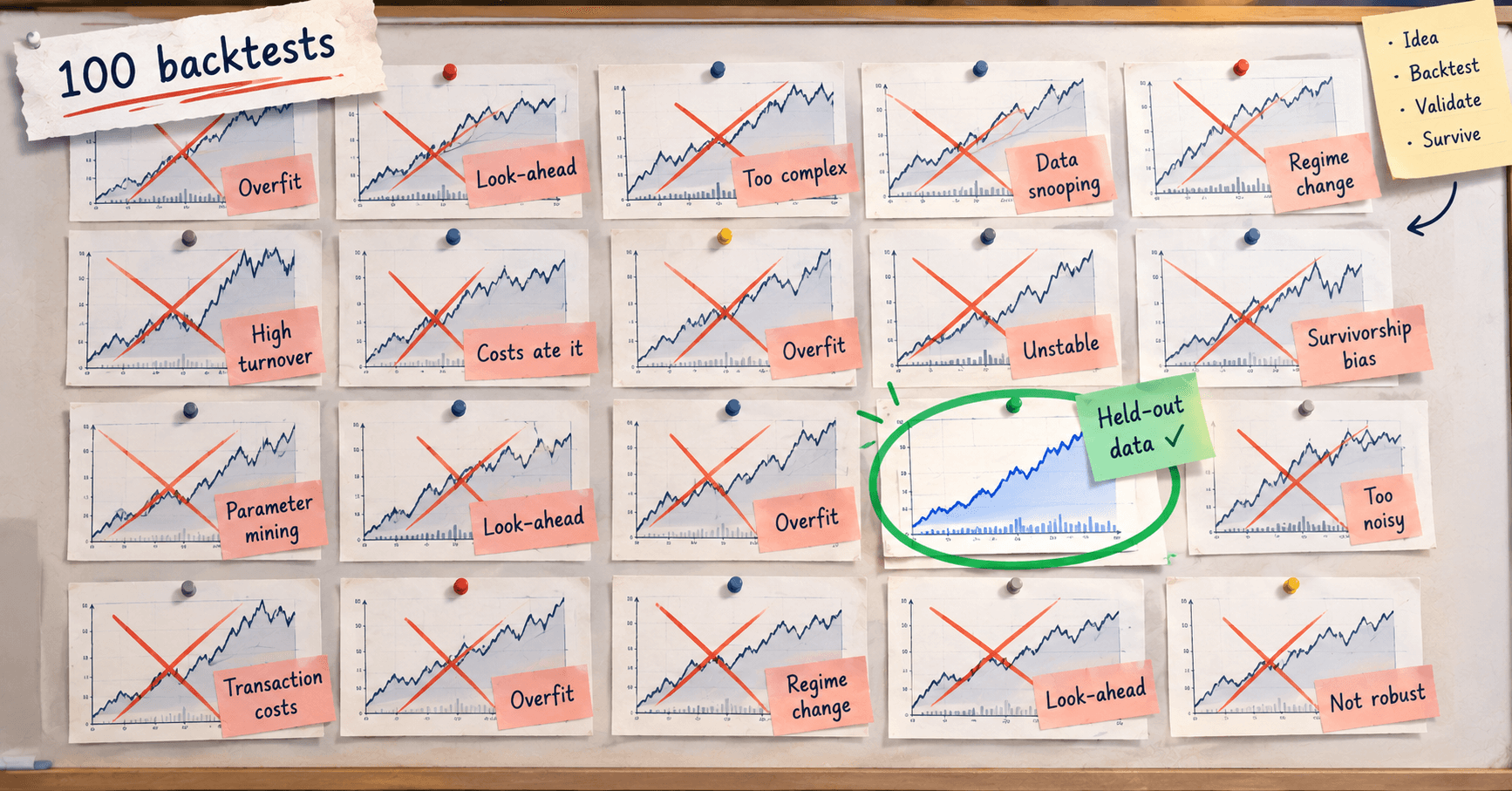
The fifth bullet is the one outsiders underrate. Producing a great-looking backtest takes no special talent: try enough variations and one of them will look great by luck. The skill a firm pays for is distrusting your own best result, and the interviews are built to find out whether you have it.
What Does Each Stage of the Research Loop Look Like?
Here is the loop as a reference, with the specific way each stage tends to fool people:
| Stage | What you're doing | How it goes wrong |
|---|---|---|
| Hypothesis | Writing down why a price should move before testing it | Mining the data for any pattern, then inventing a story to fit |
| Data | Lining up every number with the date it became public | Using a figure before it was published, which leaks the future into the test |
| Signal | Computing a score per asset per day from past data only | A feature that peeks ahead, such as scaling by an average taken over the whole sample |
| Backtest | Simulating trades with realistic costs | Ignoring costs, so a strategy that trades constantly looks rich |
| Validation | Testing on held-back data and counting the variants tried | Reporting only the winner out of dozens of tries |
| Production | Handing off to engineers and comparing live results to the backtest | Live results drift and nobody asks why |
Read the right-hand column again. Every failure in it produces a backtest that looks better than the strategy really is. That is why a good researcher's first reaction to a great result is suspicion.
How Is a Quant Researcher Different From a Quant Trader?
Titles vary by firm, so read the job description before you trust the job title. QuantVault's comparison draws the line between the two seats like this (wording from their guide):
| What differs | Quant researcher | Quant trader |
|---|---|---|
| What the day is made of | Hypotheses, data work, backtests, papers-to-production | Monitoring, adjusting, sizing; intense during market hours |
| Time horizon of decisions | Weeks to months (research cycles) | Seconds to days (live risk) |
| What the interview loop leans on | Statistics/ML depth, regression pathologies, research discussions, moderate coding | Mental math screens, fast probability, market-making games, sizing questions |
The horizon row is the one to sit with. If you want a scoreboard that updates every second, the trader seat will suit you better. If you would rather spend a month trying to prove an idea wrong before it costs anyone money, keep reading.
What Do Quant Researcher Interviews Actually Test?
Each round checks one part of the loop above. Here is the mapping:
| What you do on the job | How the interview checks it |
|---|---|
| Reason about noisy, uncertain data | Probability and statistics questions, often with a twist added after your first answer |
| Notice when a regression is misleading you | Regression questions, such as what happens to your results if you duplicate every row of the data |
| Distrust a great backtest | A judgment question like "your best of 100 backtests has a Sharpe ratio of 3; do you trade it?" |
| Turn an idea into a test | A coding round on a messy dataset |
| Defend research to skeptical colleagues | A walkthrough of a past project, with pushback on what could have fooled you |
Take the duplicated-data question. The coefficients don't move, and R² doesn't either. The standard errors fall to about 70% of their old size, so every t-stat rises by about 40%, even though you added zero information. A candidate who says that and then adds "so I check for repeated or overlapping observations before I trust a t-stat" has just described a real part of the job. Overlapping return windows create the same problem in real data, without anyone copying a row.
Look at what every row has in common. The interviewer wants to know whether you would catch your own mistake before it reached a trading book.
How Would You Answer "Your Best Backtest Has a Sharpe of 3"?
This question is worth rehearsing because it compresses the whole job into one line. The Sharpe ratio measures return per unit of risk, and higher is better. Here are two answers side by side:
Weak answer:
"Three is a great Sharpe, so yes. I'd start with a small position and scale up if it keeps working."
Strong answer:
"Not yet. It's the best of 100 tries, so part of that number comes from picking the winner. First I'd ask how the 100 were generated and how different they really were, because that tells me how many independent bets I actually made and how much of the 3 the selection explains. Then I'd test the winner on data none of the 100 runs touched, and check how much of the return survives realistic trading costs. I'd also want an economic reason it should keep working. If it passes all of that, I'd trade it small and compare live results with the backtest before sizing up."
The weak answer reads the 3 as a fact about the strategy. The strong answer reads it as a fact about the search that found it.
That instinct has a formal basis. In a 2014 paper in the Notices of the American Mathematical Society, David Bailey and three co-authors wrote: "We prove that high simulated performance is easily achievable after backtesting a relatively small number of alternative strategy configurations." The next line of their abstract is the one to remember in the interview room: "The higher the number of configurations tried, the greater is the probability that the backtest is overfit."
An interviewer asking this wants to hear you count the tries before you celebrate the result.
How Should You Prepare If This Is the Job You Want?
Prepare in the order the job weights things:
- Statistics before puzzles. Regression and what breaks it come first, plus hypothesis testing when you have run many tests at once. If you are also applying to data science roles at finance firms, that prep carries over; the data science interview topics guide covers the classic stats track.
- Probability reps, as a supporting act. The 20 quant interview questions that keep appearing cover the probability core. Learn the techniques behind them, because a memorized answer falls apart the moment the interviewer changes one number.
- One research project you can defend. Pick a public dataset and write your hypothesis down first. Build a simple signal, and hold back a slice of data you never touch until the end. Keep a count of every variant you try, since that count is your best material for the research discussion. Two Sigma's intern posting lists "Performed an in-depth research project, examining real-world data" among its qualifications, which tells you it counts.
- Practice saying it out loud. The research discussion is spoken. Rehearse a two-minute walkthrough of your project that ends with what would have proved you wrong.
If you are still deciding whether this is your job, Career Planning in PokeBot has Simulate a Day in the Role, which walks you through a typical day in your target role hour by hour, and Skill Gap Analysis, which compares your current skills with what the role needs and ranks the gaps by priority. The Career Planning guide shows how both work.
For the interview itself, the quant prep page lets you pick quant researcher as your target role and score your resume against that role's hiring bar. The Quant Interview Workbook has 56 questions with original step-by-step solutions, including three chapters aimed at quant researcher interviews. Then rehearse the research discussion in Interview Practice: add your own prompts, like the Sharpe-of-3 question, under "I have my own interview questions," and you get scored feedback on how specific and structured your answer is.
Is Quant Research the Right Job for You?
It suits people who enjoy finding the flaw in their own work. Every idea has to clear every stage of the loop before it trades, and each stage is one more chance for it to fail, so a normal week includes throwing away ideas you liked. If a dead backtest ruins your afternoon, this job will wear you down. If it makes you curious about why it died, you are the person these interviews are trying to find.
Whichever seat you aim for, your resume is the first screen, so put that research project where a reader sees it in the first few seconds.
Frequently Asked Questions
What does a quant researcher actually do?
A quant researcher turns ideas about why prices move into trading signals, then tests whether those signals hold up on data they were never tuned on. The day job is data work and backtesting, including deliberate attempts to break a promising result. Signals that survive are handed to engineers and portfolio managers for live trading, and the researcher checks whether live results match the backtest.
What is the difference between a quant researcher and a quant trader?
A quant researcher builds and tests signals over research cycles of weeks to months. A quant trader manages live positions, with decisions that play out over seconds to days, according to QuantVault's 2026 comparison of the two roles. The interviews follow the same split: trader loops lean on mental math and market-making games, while researcher loops lean on statistics and research discussion.
What do quant researcher interviews test?
They test the habits the job needs. Expect statistics and machine learning questions with regression problems, plus probability questions that change after your first answer. QuantVault's 2026 guide also lists research discussions and moderate coding as part of the researcher loop. In the research discussion, the interviewer pushes on what could have fooled you in a past project.
Do you need a PhD to become a quant researcher?
Not always. Requirements vary by firm and by level, so read each posting. Two Sigma's 2027 summer quant researcher intern posting, for example, says "all levels welcome, from bachelor's to doctorate" and lists an in-depth research project on real-world data among its qualifications. Whatever your degree, have one research project you can defend in detail.
Why do quant interviews ask about a backtest with a Sharpe ratio of 3?
Because the best result out of many tries looks better than it really is. A 2014 paper in the Notices of the American Mathematical Society showed that high simulated performance is easy to reach after testing a relatively small number of strategy variants, and that the more variants are tried, the more likely the backtest is overfit. A strong answer asks how many variants were tried and tests the winner on untouched data before trading it small.
What happens to a regression if you duplicate every row of the data?
The coefficients and R² stay exactly the same. The standard errors fall to about 70% of their old size, so every t-stat rises by about 40%, even though no new information was added. Interviewers use the question to check whether you know that a t-stat assumes independent observations, which matters in real data with overlapping return windows.
How should I prepare for a quant researcher interview?
Start with statistics and regression, then add probability practice built on techniques instead of memorized answers. Build one research project on a public dataset with held-back data, and keep count of every variant you try. PokeBot's Quant Interview Workbook has 56 questions with original worked solutions, and Interview Practice lets you rehearse your project walkthrough out loud with scored feedback.
How can I tell if quant research is the right career for me?
Ask whether you enjoy finding the flaw in your own work, since every idea has to survive every test before it trades. PokeBot's Career Planning can help you check: Simulate a Day in the Role walks you through a typical day in your target role hour by hour, and Skill Gap Analysis compares your skills with what the role needs and ranks the gaps by priority.