
Salary Negotiation Scripts for a 2026 Market: Offer and Raise Versions
Word-for-word salary negotiation scripts for a new offer and for a raise, what to say when they push back, and a rehearsal loop so you don't cave.
Last updated: October 2026.
Quick answer: Negotiate almost every offer and every raise with one specific number. Say it once, then stop talking. For an offer, name your base and say you're ready to sign if they can get there. For a raise, tie the number to outcomes. Then rehearse out loud against pushback until the number comes out steady.
When hiring feels slow, the instinct is to sign fast and feel grateful. Your starting base sets the floor for every raise that follows, so a few awkward minutes now compound for years.
The scripts below are written to be said out loud. Swap in your own numbers, then practice them until they sound like you.
Should You Negotiate an Offer When the Market Feels Tight?
Yes. A tight market means fewer offers, so the one in your hand feels fragile. The worst realistic result of a polite counter on it is still a no.
You can still accept the original offer after a no. And if a company pulls an offer because you asked one clear question in a friendly tone, you just learned how it treats people who ask for things, before your first day instead of after.
What actually costs people money:
- Accepting on the call because silence felt rude
- Giving a range, so the employer picks the bottom of it
- Apologizing for the number before they have even reacted
- Treating base salary as the only thing on the table
How Do You Pick the Number to Ask For?
Start with the posting. If it lists a pay range, that range is the clearest signal you'll get of what they budgeted, so read it as their starting position. Then check a crowdsourced compensation site for the same title and level in your city, and ask one or two people in similar roles what they would expect.
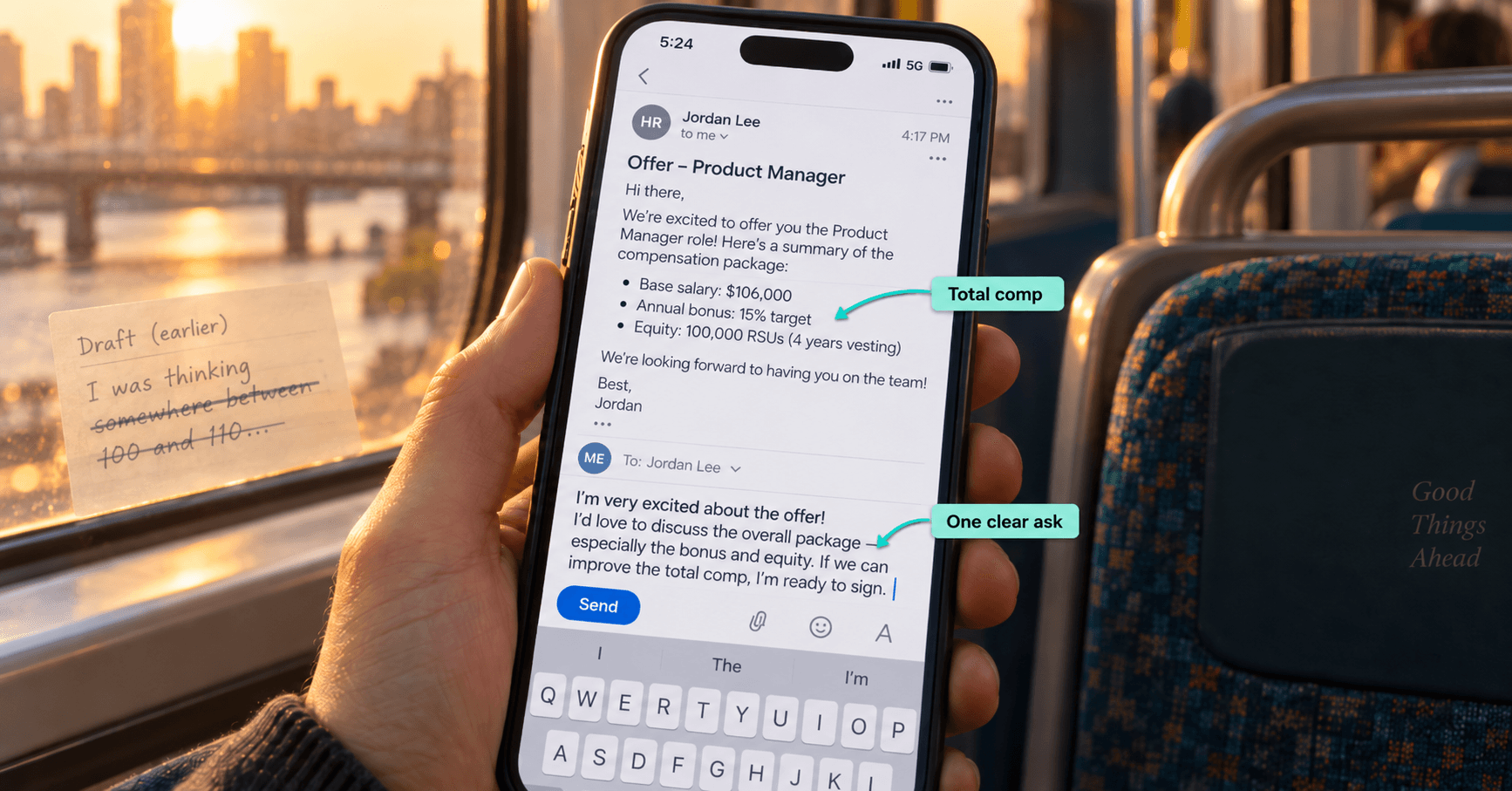
You want one number at the top of a range you can defend out loud. Say the offer comes in at $95,000 and everything you found supports roles like this up to about $108,000. Ask for $106,000 or $108,000. Do not say "somewhere between 100 and 110." The other side hears 100.
Pick the number before the call and write it down. Decide your walk-away number privately. You will not say the walk-away number to anyone. It exists so you know when a no is a real no for you.
What Do You Say When They Ask for Your Salary Expectations?
It can come up as early as the first recruiter screen, before you know enough about the job. Push it back politely.
Script (early, deflect): "I'd like to learn more about the scope first so I can give you a useful answer. What range has the team budgeted for this role?"
If they insist, give your researched number. Anchoring low to seem easy to hire caps every number that comes after it, before the interviews even start.
Script (pressed): "Based on what I've seen for similar roles, I'm targeting a base around [your number]. I'm flexible depending on the full package, including equity and bonus."
What Is the Word-for-Word Script for Negotiating an Offer?
Negotiate after you have the written offer and before you sign. Phone or video is better for the counter itself, because tone carries. Email is fine for the follow-up that puts it in writing.
Step 1, buy time: "Thank you, I'm really excited about this. Could I have until [day] to look over the full offer?"
Step 2, the counter: "I've looked at everything and I'm excited about the role and the team. Based on the scope we discussed and what I'm seeing for similar roles, I'd like to ask for a base of [number]. If we can get there, I'm ready to sign."
Then stop. The silence after a number feels long. Let it be long. The next person to speak should be them.
Step 3, if base is fixed: "I understand base is set for this level. Is there flexibility on a sign-on bonus, or on a written compensation review at six months?"
Step 4, if you have a real competing offer: "I have another offer at [number], and I'd honestly rather join your team. Is there any way to close the gap?" Use this only if the offer exists and you would take it. A bluff that gets called leaves you with less room than you started with.
Step 5, the close: "Thank you for working on this. Could you send the updated offer in writing? I'll sign as soon as I have it."
Here is what common pushback usually signals and a line that keeps the conversation moving:
| What they say | What it usually signals | What to say back |
|---|---|---|
| "This is our standard offer for the level." | Base may be capped by a band | "Understood. Is there room on sign-on or equity?" |
| "We don't have budget for that." | The number needs approval above them | "Could you check what's possible? I'm ready to sign if we get closer." |
| "We need an answer by tomorrow." | Pressure, sometimes a real deadline | "I can give you an answer by [day]. Could we talk numbers before then?" |
| "What would it take for you to sign today?" | They want to close and have some room | Repeat your number. Do not lower it to be agreeable. |
| "That's above the range for this role." | You may be at the band's ceiling | "Would a higher level or a review at six months be possible?" |
What Is the Script for Asking for a Raise?
A raise conversation runs on different mechanics. Your manager often has to take your case to someone above them, so hand them an argument they can repeat without you in the room.
Timing matters more than wording. Ask before the next cycle's budgets are set, and ask in a meeting about compensation rather than at the end of a status update. If your company runs formal reviews, the performance review is the natural venue.
Script (the ask): "I'd like to talk about my compensation. This year I [specific outcome, with a number if you have one]. I've also taken on [expanded scope or responsibility]. Based on that, I'd like to move my base to [number]."
Script (if they say not now): "I understand. What would need to be true for this to happen, and when can we revisit it?" Then send a short email the same day that restates what they said, so the commitment exists in writing.
Script (if they say you are at the top of the band): "Then I'd like to understand the path to the next level. What's the gap between my work now and what that level expects?"
The case is much easier to make if you logged wins all year. If you have not, start a running list now, one line per outcome with its number, so next cycle's ask has evidence behind it.
How the two conversations differ:
| New job offer | Raise at your current job | |
|---|---|---|
| Who decides | Recruiter and hiring manager, often with a band | Your manager, plus someone above them |
| Your strongest evidence | Market data and other offers | Outcomes you delivered this cycle |
| Best timing | After the written offer, before signing | Before budgets are set for the next cycle |
| Common fallback | Sign-on bonus, equity, start date | Written review date, title change, scope |
| Biggest risk | Accepting on the spot | Asking vaguely, with no number |
How Do You Rehearse a Negotiation So You Don't Cave?
Reading a script and saying it to someone who pushes back are two different skills. The first time you say a salary number to a person, there's a strong pull to let your voice rise at the end and start explaining. Practice the out-loud version before the real call so that pull is already spent.
A rehearsal loop that works:
- Write your number and your two strongest reasons on one card.
- Say the counter script out loud three times, alone, until the number comes out flat.
- Run it against an opponent who says no. Practice the line you'll use after "we don't have budget."
- Read the feedback, cut any sentence that apologizes or over-explains, then run it again with tougher pushback.
In PokeBot's Mock Interview room, Mock Everything has a Salary Negotiation template. By default the AI plays your manager, who is empathetic but constrained by budget and asks you to justify the number. To rehearse an offer, rewrite "Describe the Conversation" as an offer call and set "Other Party's Role" to Recruiter. Switch the response mode to Audio so you say the number out loud, and set the tone to Heated if you want a harder conversation. You get a score at the end, and you can retry with the same setup to see if your next run improves.
For a raise, the Performance Review format (choose "Review with Boss") plays your manager in a review conversation. Pick Hard if your real manager tends to push back. Run either practice two or three days before the real conversation, so you still have time to fix what the feedback finds.
Score your resume free, create your PokeBot account
What Should You Do After They Say Yes?
Get the new number in writing before you celebrate. For an offer, wait for the updated offer letter and check it says what you agreed to. For a raise, ask when it takes effect and whether it shows up in the next paycheck or the next cycle.
Then thank the person who went to bat for you. A recruiter or manager who pushed your number through spent effort on your behalf, and you want them willing to do it again the next time you ask.
Frequently Asked Questions
Should I negotiate a job offer if I really need the job?
Yes, as long as the ask is polite and specific. If they say no, you can still accept the original offer. Thank them and say you are excited about the role. Then name one number and give them room to answer.
What do I say when a recruiter asks for my salary expectations?
Early in the process, turn it around: 'I'd like to learn more about the role first. What range has the team budgeted for it?' If they press, give a number from your research at the top of a defensible range, and say it is flexible depending on the full package.
Should I give a range or a single number when I counter?
Give a single number. A range invites the employer to pick the bottom of it, so the bottom becomes your real ask. Pick the number from your research and state it plainly, without apologizing for it.
What is a good script for countering a job offer?
'Thank you, I'm excited about this role and the team. Based on the scope we discussed and what I'm seeing for similar roles, I'd like to ask for a base of [number]. If we can get there, I'm ready to sign.' Then stop talking and let them respond.
What if they say the salary is fixed?
Ask about the parts of the package that may have more room, such as a sign-on bonus or a written compensation review after six months. One line works: 'I understand base is set. Is there flexibility on a sign-on bonus or an early review?'
How do I ask for a raise without a competing offer?
Build the case on outcomes from the past cycle and your current scope, then name a number. A script: 'This year I [specific outcome]. I've also taken on [expanded scope]. I'd like to move my base to [number].' Ask before budgets are set, and if the answer is not now, ask what would need to be true and when you can revisit it.
How can I practice a salary negotiation?
Say the scripts out loud against someone who pushes back. In PokeBot's Mock Interview room, Mock Everything has a Salary Negotiation template where the AI plays a manager who is constrained by budget, and you can answer by voice in Audio mode. To rehearse an offer, change the other party's role to Recruiter. For a raise, the Performance Review format lets you rehearse the conversation with your boss and get a score.