
AI Product Manager Interview Questions: Cost, Latency, and Evals
AI PM interviews now add follow-ups on token cost and evals to product sense. Here are 10 AI product manager interview questions and one worked answer.
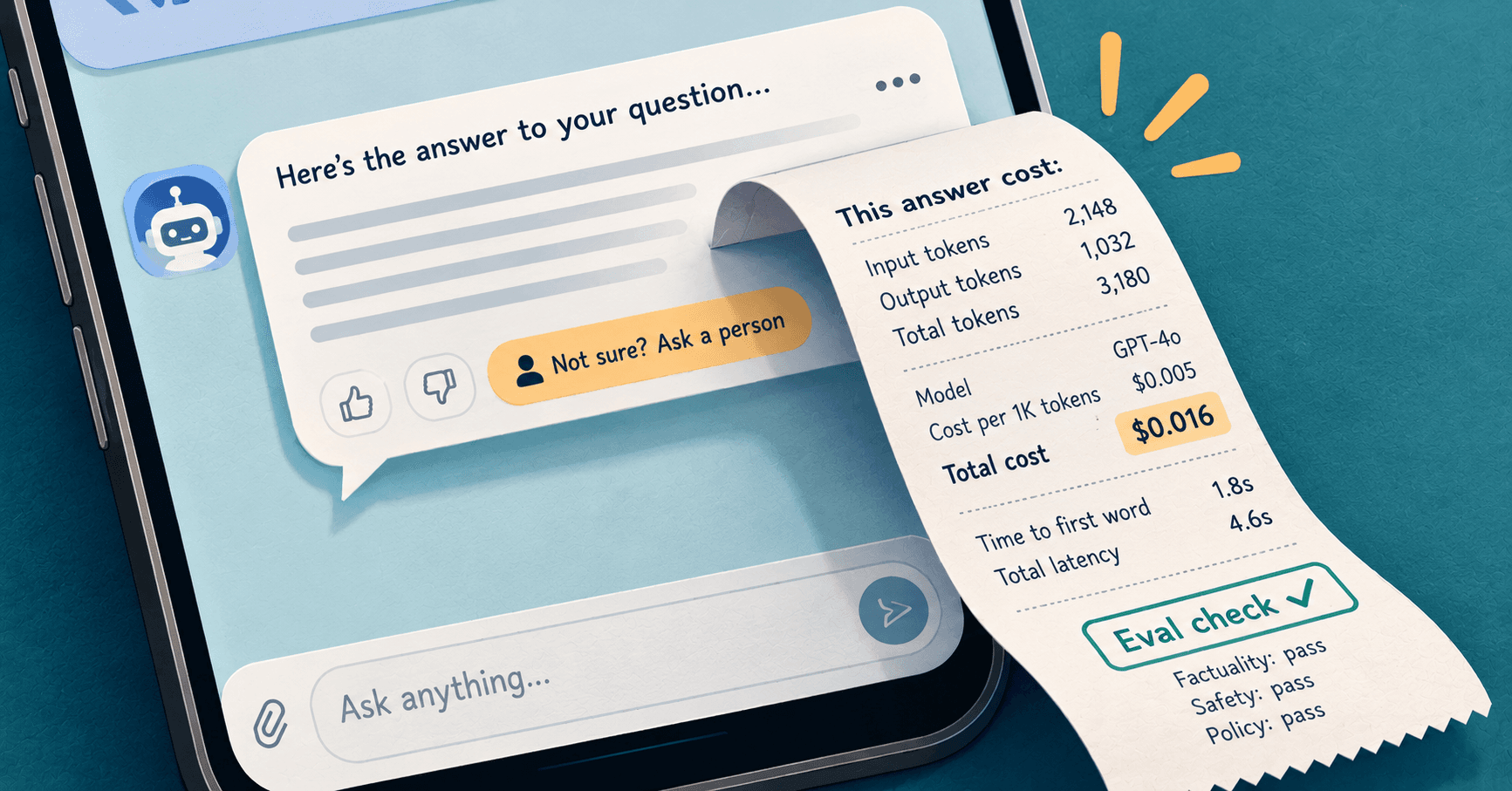
Last updated: October 2026.
Quick answer: AI product manager interview questions start as ordinary product sense or metrics prompts, then push into what makes AI products different. Expect follow-ups on what each request costs in tokens and how long users wait. Expect questions on measuring answer quality with evals, and on what the product does when the model is wrong.
The AI round is still a product round. You still pick a user and argue for one solution to their problem. What changes is the material. The thing you're building has a running cost on every request and an error rate you can't engineer down to zero, and the interviewer wants to hear you price both before they ask.
This guide is for PMs heading into a loop with AI in it, whether that's a dedicated round or AI follow-ups inside a regular product sense interview.
What Do AI Product Manager Interviews Test That a Regular PM Loop Doesn't?
Some companies now give AI a round of its own. Prepfully's guide to the new Meta PM round, updated November 2025, says "Meta recently added a fourth interview to its final PM loop." Prepfully says the new round, Product Sense with AI, seems to be showing up mainly for senior IC and people-manager PM roles. A candidate account of a Meta AI PM interview, posted on an interview-prep site, describes a 60-minute round: about 30 minutes of product sense, then prototyping in Meta's Llama-based vibe-coding tool. One of the interviewer's follow-ups: "Is this the most efficient way to prompt it, or are you using more tokens than you need?"
You don't need a dedicated round to get questions like that. Any company shipping an AI feature has reasons to ask them, so prepare for four kinds of follow-up:
- Cost. How many tokens a request uses, and what that adds up to per user each month.
- Speed. How long the user waits, and whether the job can tolerate the wait.
- Quality. How you'd know the answers are good, before launch and after it.
- Failure. What the product does when the model is wrong or unsure.
Model architecture is the part you can mostly leave to the engineers in the room. The PM version of every technical question is what the choice does to the user and to the bill.
Which AI Terms Should You Be Able to Explain?
You don't need to build a model. You do need to use these words correctly under a follow-up, because a fuzzy definition shows the moment someone asks "and what does that cost?"
| Term | What to be able to say about it |
|---|---|
| Token | A piece of text, often part of a word. Prices and context limits are counted in tokens. |
| Context window | The most text the model can consider in one request. Long documents and long chats run into it. |
| Latency | How long the user waits. Split it into time to the first words and time to the finished answer. |
| Eval | A repeatable test of output quality, usually real inputs paired with checked answers. |
| Hallucination | A confident answer the facts don't support. Product design reduces it; it rarely disappears. |
| Retrieval (RAG) | Fetching relevant documents into the prompt so answers rest on your data. Suits facts that change often. |
| Fine-tuning | Further training on your own examples. Suits a fixed format or tone, and is slower to update. |
| Guardrail | A limit on what the AI may say or do, such as needing a person to approve a refund. |
If one of these makes you hesitate, practice explaining it in two sentences to someone outside tech. That's roughly the depth a PM interviewer wants.
What AI Product Manager Interview Questions Should You Practice?
These ten are practice prompts written in the style of current AI product rounds, and none is taken from a specific company's loop. For the behavioral version ("tell me about an AI feature you shipped"), see How to Show AI Fluency in an Interview.
Product sense with AI built in
- Design an AI feature that summarizes a user's unread messages every morning. The interviewer is listening for who it's for, and for what happens when the summary leaves out the one message that mattered.
- Improve an AI chat assistant for enterprise customers. Strong answers get specific about admins and data access, then about what trust means to a buyer who answers to a security team.
- Design an AI agent that handles refund requests for an online store. The real question is where the agent stops and a person takes over.
Execution and metrics
- Your AI assistant sounds confident but is wrong a lot, and users are complaining. How do you fix it? Worked through in the next section.
- Thumbs-up rate on AI answers rose after a model change, and weekly retention fell. What happened? Start with what a thumbs-up measures and who bothers to click it.
- How would you know a new model version is better before you ship it? The answer is an eval set you already trust, plus a rule for what counts as a regression.
- You're launching an AI feature in beta. What metrics and guardrails do you commit to for the first quarter? Name one success metric, then the cost and quality lines you won't cross to hit it.
Cost and strategy
- Heavy users of your AI feature cost more to serve than their plan earns. What do you change? Do the math out loud before proposing anything.
- When would you ship a smaller, cheaper model instead of the best one available? When the eval set shows the small model is good enough for the job, and speed or cost matters more than the last bit of quality.
- Would you fine-tune a model for this use case, or use retrieval? Pick one and say what would change your mind, including whether a better prompt alone would do.
What Does a Weak vs Strong Answer Look Like?
Take question 4, the confidently wrong assistant.
Weak answer: "I'd retrain the model with more data so it's more accurate, and add a disclaimer telling users AI can make mistakes. Then I'd track user satisfaction to make sure it improves."
"Retrain the model" hands the problem to another team and is the slowest fix available. The disclaimer shifts the blame onto the user. "User satisfaction" with no definition can't tell you whether the fix worked.
Strong answer: "First I'd find out what 'wrong a lot' means. I'd pull a sample of the complaints and sort them into wrong facts and questions it should never have tried to answer. Say most turn out to be wrong facts about our own product. Those complaints become my eval set: a few hundred real questions with answers someone has checked. Every fix gets scored against it.
Then I'd fix the product before touching the model. The assistant should answer from our help docs and show the source it used, so users can check it. When nothing relevant comes back, it says it doesn't know and offers a person. For refunds and account changes, it drafts and a human approves.
Success is accuracy on the eval set going up while the decline rate stays reasonable. After launch I'd watch how often users correct it or ask the same thing again. Cost per answer and response time are guardrails, because retrieval adds to both. If accuracy is still short after all that, then we talk about fine-tuning or a stronger model, and the eval set tells us which."
| Weak answer | Strong answer |
|---|---|
| Fixes the model first | Fixes the product first, the model last |
| Treats every error the same | Sorts complaints by type before choosing a fix |
| Adds a disclaimer | Shows sources and lets the assistant decline |
| Measures "user satisfaction" | Measures accuracy on a named eval set, plus decline and correction rates |
| Never mentions cost | Names cost and response time as guardrails |
How Do You Do the Cost Math Out Loud?
The arithmetic is easy, and doing it before you're asked tells the interviewer you've thought about running the thing, past the launch demo.
Model APIs bill by the token. As of October 2026, Anthropic's published API price list charges input and output tokens separately. Output tokens cost five times as much as input on every model it lists, and cached input costs far less than fresh input. So the length of the answer matters as much as the length of the prompt.
Here's the math with made-up round prices, so you can see the shape of it:
- One request sends 3,000 tokens in, mostly instructions and retrieved documents, and gets 500 tokens back.
- Say input costs $1 per million tokens and output costs $5 per million.
- Input: 3,000 × $1 ÷ 1,000,000 = $0.003. Output: 500 × $5 ÷ 1,000,000 = $0.0025. Together that's about half a cent per request.
- A heavy user sends 10 requests a day, about 300 a month. That's about $1.65 per user per month.
Half a cent sounds like nothing. Against an $8 monthly plan, $1.65 is about a fifth of what that user pays, spent on one feature. That's the moment to name your levers:
- Cache the part of the prompt that repeats on every request, such as fixed instructions.
- Send easy requests to a smaller model and keep the large one for hard cases.
- Cap answer length when a short answer does the job.
- Retrieve fewer, better documents instead of filling the context window.
Each lever trades something, so say what. A smaller model will get some hard cases wrong if your routing misjudges them.
One more detail worth knowing: token counts differ between models. Anthropic's pricing page notes that its newer models use a tokenizer that "produces approximately 30% more tokens for the same text" than the previous one. Comparing two models on price per token alone can mislead you. For a longer argument about judging models on quality per dollar, see Why AI Leaderboards Need Efficiency-Adjusted Rankings.
How Should You Talk About Latency?
Start from the job, then pick the number. Autocomplete that shows up after you've finished typing the word is useless. A weekly account summary can take a minute to generate and arrive by email, and nobody will mind.
Then split the wait in two: the time until the first words appear, and the time until the answer is done. Streaming text as it's generated shortens the first wait without changing the second, and in a chat window the first wait is the one users feel. Longer answers take longer to finish, so a tight cap on answer length helps your speed and your cost at once.
A strong latency answer names a budget and a fallback. For example: "If the answer isn't ready in two seconds, show the top help article and keep generating in the background."
How Do You Answer Questions About Evals?
If your prep time is short, spend it here. "We'll A/B test it" is an incomplete answer when the output is text, because first you need a way to say whether a given answer is any good.
A credible eval plan has four parts:
- A labeled test set from real cases. Real user inputs, including the ones that went wrong, with answers someone checked. Every prompt change and model upgrade runs against it before it ships.
- A model-graded rubric where labels run out. A second model scores answers against written criteria, and people spot-check its grades, because the grader can be wrong too.
- Live signals after launch. How often users correct an answer or ask the same question again. A request for a person counts too.
- A regression rule. Decide in advance how big a drop on the test set blocks a release.
Be ready to say why thumbs-up rate alone is weak. It only hears from people who bother to click, and a confident wrong answer can earn a thumbs-up from someone who never checked it. That's also your opening for question 5 above.
What If the Round Asks You to Build a Prototype?
If your loop includes live prototyping with an AI tool, the product sense half still carries most of the weight. Some practical rules:
- Get a rough version running early, so most of your time goes to trade-offs instead of polish.
- Say the cost and speed trade-offs out loud before you're asked. In the candidate account above, the interviewer pushed on token use and latency.
- Point at one place the output could go wrong, and say what the product would do about it.
What Can You Skip When Preparing?
- Model internals. Deriving attention belongs to the ML engineer's loop. If you want that depth anyway, the 4-week AI/ML interview plan covers it.
- Leaderboard trivia. Benchmark scores and model rankings change constantly. "Which model would you use?" is asking how you'd decide, so answer with your eval set and your cost per request.
- Recited frameworks. A memorized acronym gets you through the first five minutes. The second follow-up is where it runs out.
How Should You Practice for an AI PM Interview?
Reading strong answers feels like progress, but the follow-up is where AI rounds are decided, so you need reps saying answers out loud with someone pushing back.
- Work through real questions. The Product Manager Interview Workbook has 21 questions restated from 2024 to 2026 publicly shared interview experiences, each with an original worked solution. It includes AI product questions like the confidently wrong assistant above. Its three chapters:
- Product Sense & Design
- Execution & Metrics
- Strategy & Estimation
- Say the answers out loud. In the PokeBot app's Mock Interview room, Interview Practice has a Product Sense interview type. Run it in Audio Mode with follow-up questions turned on. Pick the Challenger interviewer style, who pushes back on almost every answer. You get scored feedback when the session ends.
- Do the strategy reps. Case Interview runs a full consulting-style case with exhibits. Its Pricing and Market Sizing case types are good practice for the strategy and estimation half of a PM loop.
- Rehearse the prototype walk-through. The Product Demo type in Pitch & Demo has you walk through a product and answer follow-up questions. The feedback covers how clear your walk-through was and how well you tied features to user problems.
The PM interview prep page shows how these steps fit together. The interview only happens if your resume gets you in the door, so start with a score against the PM roles you're targeting.
Frequently Asked Questions
What questions are asked in an AI product manager interview?
Expect a regular product sense or metrics prompt with AI built into it, followed by technical follow-ups. The cost and speed follow-ups ask how many tokens a request uses and how long the user waits. The quality follow-ups ask how you would measure answer quality with evals and what the product does when the model is wrong. Strategy questions can come up too, such as when you would ship a smaller, cheaper model.
Do AI product manager interviews include live prototyping?
Some do. Prepfully's Meta guide, updated November 2025, says Meta added a fourth interview called Product Sense with AI to its final PM loop, and that it seems to show up mainly for senior IC and people-manager roles. One candidate account of a Meta AI PM interview describes about 30 minutes of product sense followed by prototyping with an AI tool. If your loop includes a round like this, get a rough version working early and spend the rest of the time on its cost and on what happens when the output is wrong.
What technical concepts does an AI product manager need to know for interviews?
Know tokens and context windows, since pricing and limits are counted in tokens. Know the two parts of latency: the time until the first words appear and the time until the answer is finished. Know what an eval is, a repeatable test of output quality, and what a hallucination is, a confident answer the facts don't support. Finally, know when retrieval beats fine-tuning: retrieval suits facts that change often, and fine-tuning suits a fixed format or tone.
How do you answer 'your AI assistant is confidently wrong, how would you fix it?'
Start by sorting the complaints to learn which errors matter, then turn real failing questions into an eval set with checked answers. Fix the product before the model: answer from your own documents with the sources shown, and let the assistant decline and offer a person when nothing relevant comes back. Measure accuracy on the eval set and the decline rate, with cost and response time as guardrails. Reach for fine-tuning or a stronger model only if the eval set says you still need it.
How do you estimate the cost of an AI feature in a PM interview?
Multiply the tokens per request by the price per token, then by the requests per user each month. With made-up prices of $1 per million input tokens and $5 per million output tokens, a request with 3,000 tokens in and 500 tokens out costs about half a cent. At 300 requests a month, that is about $1.65 per user. Compare that with what the user pays, then name a lever or two, such as caching repeated instructions or sending easy requests to a smaller model.
How should a product manager measure the quality of an AI feature?
Use evals: a labeled set of real inputs with checked answers that every prompt change or model upgrade must pass before release. Where labels run out, a second model can grade answers against a written rubric, with people spot-checking the grader. After launch, watch how often users correct an answer or ask the same question again. Thumbs-up rate on its own is a weak signal, because it only hears from people who click and it can reward a confident wrong answer.
How can I practice for an AI product manager interview?
Work through realistic questions first, then answer them out loud with someone pushing back. PokeBot's Product Manager Interview Workbook has 21 questions with original worked solutions, including AI product questions. In the PokeBot app, Interview Practice has a Product Sense interview type you can run in Audio Mode with follow-up questions turned on. Case Interview has Pricing and Market Sizing cases for the strategy half of a PM loop, and the Product Demo type in Pitch & Demo lets you rehearse walking someone through a prototype.