
How to Train for a Timed Mental-Math Screen: The 80-Questions-in-8-Minutes Format
How the 80-questions-in-8-minutes mental math screen is scored, why net score beats raw attempts, and a 4-week daily drill plan to get faster without errors.
Last updated: November 2026.
Quick answer: The 80-questions-in-8-minutes screen gives you about six seconds per question and takes a point off for every wrong answer, so your net score matters more than how many you attempt. Train accuracy first and speed second, with short daily drills aimed at the error types you log, and score every practice run the way the real test does.
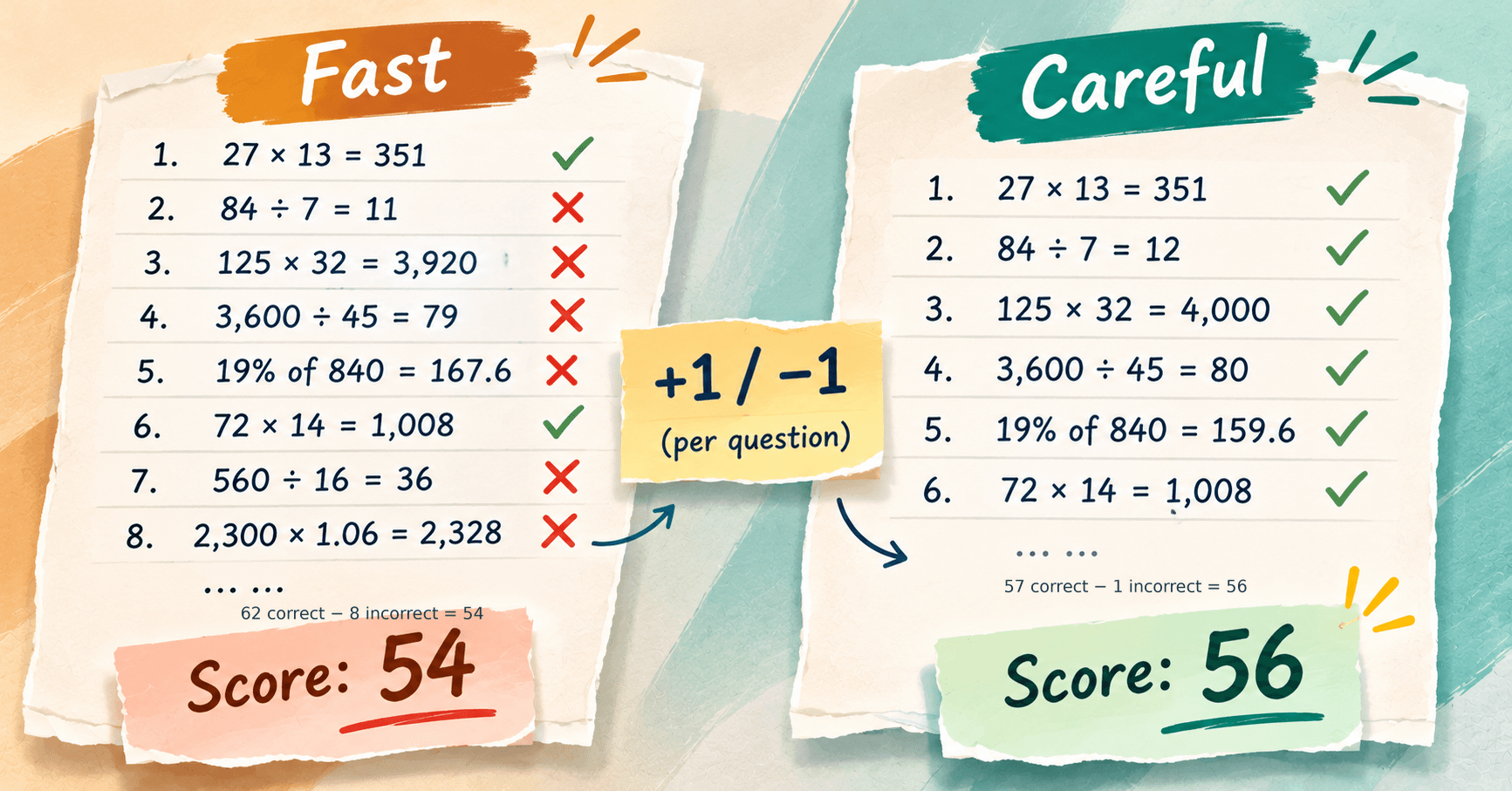
Most people prepare for this test by trying to go faster. That is the wrong first move. With negative marking, a fast candidate who makes eight mistakes can lose to a slower one who makes one.
This post is about speed training for the arithmetic screen only. If you want the probability puzzles and brainteasers that come after it, those are in the 20 quant interview questions that keep appearing.
What Is the 80-in-8 Format, Exactly?
The most detailed public description is QuantVault's page on Optiver's 80-in-8 mental arithmetic screen, which we checked in November 2026. It describes the test this way:
- 80 multiple-choice questions in 8 minutes, no calculator, four answer options each.
- Scoring: +1 for a correct answer, −1 for a wrong one. Questions you never reach cost nothing.
- No skipping and no going back. Once you pick an option, the next question appears.
- Question types: the four basic operations on whole numbers, decimals and fractions, written both directly (373 + 57 = ?) and with a missing operand (66 × ? = 138.6).
That description comes from a prep site, and firms adjust their assessments without notice. Read your invite email carefully, and if anything about the format is unclear, ask the recruiter. A format question is a normal thing to ask.
Why Does Net Score Beat Raw Attempts?
Because the penalty makes careless speed expensive. Here are two hypothetical runs:
| Run | Answered | Wrong | Net score |
|---|---|---|---|
| Fast and sloppy | 70 | 8 | 62 − 8 = 54 |
| Steady and careful | 58 | 1 | 57 − 1 = 56 |
The careful run answered 12 fewer questions and still won. Every wrong answer costs you two points relative to getting it right: the point you missed and the point you lost.
Guessing works the same way. With four options, a blind guess wins a point one time in four and loses a point three times in four. That averages out to minus half a point per guess. If you can rule out two options, a guess between the last two breaks even. Since you cannot skip, a question you are stuck on leaves you two moves: spend a few more seconds to get it right, or eliminate down to two and commit.
QuantVault reports that candidates put the pass line around 55 net, and it says plainly that the number is candidate-reported, not official. Use it as a rough target. Then aim to clear it on an average day, because test day is rarely your best day.
Which Mistakes Cost the Most Points?
Log every error you make in practice by type. After a week the pattern is usually obvious, and it is almost never "I need to be faster at everything." These are the error types worth tracking:
| Error type | Hypothetical example | What usually goes wrong | Fix |
|---|---|---|---|
| Decimal placement | 0.6 × 0.07 = ? | Answering 0.42 instead of 0.042 | Multiply as whole numbers (6 × 7 = 42), then count decimal places in the question: three, so 0.042 |
| Fractions | 3/8 + 1/6 = ? | Adding tops and bottoms, or a slow common denominator | Know the common denominator on sight (24), so 9/24 + 4/24 = 13/24 |
| Fraction to decimal | 5/8 = ? | Long division under time pressure | Memorize eighths, sixths, sevenths, ninths and twelfths as decimals |
| Missing operand | 48 × ? = 132 | Freezing because the format feels unfamiliar | Turn it into a division: 132 ÷ 48 = 2.75, then check 48 × 2.75 = 132 |
| Division by a decimal | ? ÷ 0.25 = 36 | Getting the direction wrong (answering 144) | Dividing by 0.25 is the same as multiplying by 4, so ? = 36 ÷ 4 = 9 |
| Subtraction borrowing | 1,003 − 478 = ? | Dropping a borrow across zeros | Count up instead: 478 to 500 is 22, then 503 more, so 525 |
| Misclick | Right answer, wrong option | Rushing the click after solving | Glance at the option you picked before moving on |
The misclick row looks trivial and costs real points. In a format where you cannot go back, a click on the wrong option is a two-point swing, the same as a wrong calculation.
How Do You Use the Answer Options to Go Faster?
Four options turn many questions from "calculate" into "eliminate." Two checks do most of the work:
- Magnitude. Estimate roughly first. For 37 × 43, both numbers are near 40, so the answer is near 1,600. Any option near 1,200 or 2,000 is out.
- Last digit. 7 × 3 ends in 1, so the answer ends in 1. If only one option near 1,600 ends in 1 (1,591), you are done before you finish multiplying.
When both checks leave two candidates, then do the full calculation. For 37 × 43, the shortcut is (40 − 3) × (40 + 3) = 1,600 − 9 = 1,591. The same pattern gives 97 × 103 = 10,000 − 9 = 9,991.
Typed-answer tools like Zetamac are good for raw integer speed, and they are free. They do not train elimination, decimals or missing operands, so use them as a warm-up rather than your whole plan.
What Does a 4-Week Daily Drill Plan Look Like?
Twenty to thirty minutes a day, every day, beats two long sessions a week. Arithmetic speed is mostly recall, and recall needs frequent short reps.
| Week | Daily focus | Session shape | Goal by end of week |
|---|---|---|---|
| 1 | Accuracy on integers, plus the fraction-to-decimal table | 10 min untimed drills, 10 min flashcards for eighths, sixths, sevenths, ninths and twelfths | Near-zero errors at a pace that feels slow |
| 2 | Decimals and fractions | 15 min mixed decimal and fraction sets, 5 min reviewing the error log | Decimal placement errors gone |
| 3 | Missing operands and elimination | 10 min missing-operand sets, 10 min multiple-choice sets using magnitude and last-digit checks | You eliminate before you calculate |
| 4 | Full simulations | One 8-minute, 80-question run with net scoring, then 15 min drilling the error types it exposed | A net score you can hit on an average day |
Three rules make the plan work:
- Score every timed run as net. If you track attempts, you train yourself to rush.
- Keep an error log by type, using the rows in the table above. Your drills next session target the top row of that log.
- Do a full simulation at least every other day in week 4. Eight minutes of sustained focus is a skill of its own. Note when in the run each error happens: only full runs show whether your mistakes bunch up late.
The case interview world has the same lesson for a different kind of arithmetic: short daily sets on the exact calculation types you will face. The drills in case interview practice without a partner follow that pattern if you want a second example.
What Should You Do on Test Day?
- Set your pace from your practice data. If your simulations show you are accurate at eight seconds a question, go at eight seconds. Six is the pace to finish, and finishing is optional.
- Never blind-guess. Eliminate to two first, or spend the extra seconds.
- Do not chase lost time. One slow question does not mean the next ten need to be rushed. Rushing after a slow question is how a 56 turns into a 48.
- Check the option before you click. One glance saves two points.
What Comes After the Mental-Math Screen?
Passing the screen gets you to the rounds that test probability and live trading games. If you are on the trader track, quant trader vs quant researcher interviews lays out what those later rounds test and why the arithmetic screen sits at the front of trader loops. Researcher candidates should spend far less time on this post's drills.
PokeBot does not have a mental-math drill mode, so do the arithmetic reps with the plan above. Where PokeBot helps is the rest of the loop. The Quant Interview Workbook has 56 questions with original step-by-step solutions, including a Brainteasers & Market-Making Games chapter for the rounds that follow the screen. In Interview Practice you can run timed, structured technical sessions out loud and get scored feedback on how clearly you reasoned. And on the quant prep page, your resume is scored against a quant trader or researcher hiring bar, since that decides whether you get the test invite at all.
See free sample questions from PokeBot's 56-question Quant Interview Workbook ($29) →
Frequently Asked Questions
What is the 80 in 8 mental math test?
It is a timed arithmetic screen used early in some trading hiring processes. As publicly described by QuantVault (checked November 2026), it has 80 multiple-choice questions in 8 minutes with four options each. Scoring uses negative marking: +1 for a correct answer and −1 for a wrong one. Formats change, so confirm the details in your own invite.
How much time do you get per question in the 80 in 8?
Eight minutes is 480 seconds, so finishing all 80 means averaging six seconds a question. You do not need to finish: questions you never reach are not penalized in the publicly described format, while wrong answers are.
Should you guess on the 80 in 8 if you are unsure?
Only if you have narrowed it to two options or better. A blind guess among four options gains 1 point a quarter of the time and loses 1 point three quarters of the time, so it costs half a point on average. A coin flip between two remaining options breaks even. Since the publicly described format does not let you skip, the real choice is between spending a few more seconds and committing.
What is a good score on the 80 in 8?
There is no published pass mark. QuantVault reports that candidates place the pass line around 55 net and flags that figure as candidate-reported, not official. Treat it as a rough target and aim for a net score you can hit on an average day, not your best run.
Is Zetamac good practice for the 80 in 8?
It is good for raw arithmetic speed and it is free. It uses typed answers rather than multiple choice and mostly integers, so it will not train decimals or missing operands, and it will not teach you to eliminate options. Use it as a warm-up and add multiple-choice drills that match the real format.
How long does it take to get faster at mental math?
There is no fixed timeline, and it depends on where you start. Short daily sessions over several weeks work better than cramming, because arithmetic speed is mostly recall. A 4-week plan of 20 to 30 minutes a day, with every error logged by type, gives you enough full simulations to see whether your net score is moving.
Does the mental math screen matter for quant researcher roles?
Less. Timed arithmetic screens are mainly a trader-track filter. Researcher loops lean on statistics and research discussion, so researcher candidates should not spend weeks on arithmetic drills at the expense of those.